
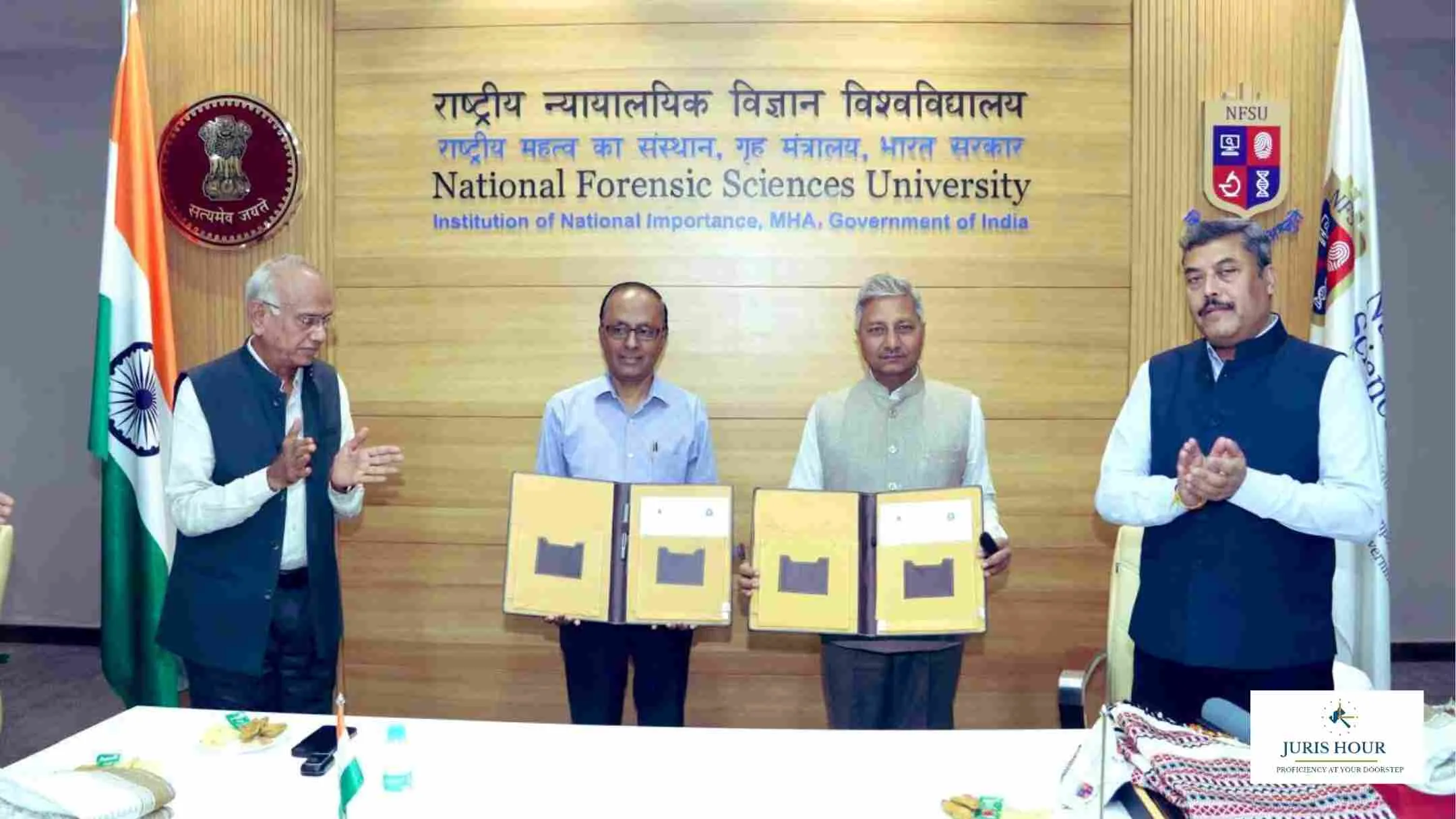
The Central Revenues Control Laboratory (CRCL), under the Central Board of Indirect Taxes and Customs (CBIC), has signed a Memorandum of Understanding (MoU) with the National Forensic Sciences University (NFSU), Gandhinagar to boost NDPS enforcement.
The collaboration aims to enhance the scientific and investigative capabilities of enforcement agencies in tackling drug-related offences.
The MoU was signed in the presence of Shri Surjit Bhujabal, Special Secretary & Member (Customs), CBIC, and Dr. J.M. Vyas, Vice Chancellor, NFSU. The agreement was formally inked by Dr. S.O. Junare, Director, NFSU, and Shri V. Suresh, Director, CRCL.

Key Objectives of the MoU
The partnership is expected to significantly enhance operational effectiveness in NDPS enforcement through the following strategic initiatives:
Advanced Trace Detection: Leveraging NFSU’s cutting-edge forensic expertise and CRCL’s analytical capabilities to detect minute traces of narcotics in complex matrices such as courier parcels, chemical consignments, or intercepted cargo.
Court-Admissible Evidence: Developing robust protocols and standards to ensure that forensic reports generated by CRCL and its regional labs meet stringent legal admissibility standards for court proceedings.
Faster Turnaround: Optimizing laboratory workflows and forensic analysis procedures to deliver time-bound results that can expedite investigation and prosecution timelines.
R&D on Emerging Drug Trends: Conducting joint research to identify and characterize new and emerging psychoactive substances (NPS), designer drugs, and synthetic opioids that are increasingly being trafficked across international borders.
Empowering Enforcement Through Technology
Speaking at the event, Shri Surjit Bhujabal emphasized that the partnership between CRCL and NFSU marks a watershed moment for customs enforcement in India. “We are entering a new era where science and enforcement will work hand-in-hand to protect society from the threats posed by narcotics smuggling. This MoU will equip our labs and officers with the tools and technologies needed to stay ahead of drug traffickers,” he said.
Dr. J.M. Vyas added that NFSU, as a premier institution in forensic science education and research, is well-positioned to support national anti-narcotics efforts. “Through this collaboration, we aim to not only deliver quick and reliable forensic results but also develop the next generation of tools and techniques to address emerging threats,” he noted.
A Holistic Approach to Narcotics Control
With increasing complexity in drug trafficking operations—often involving designer substances and concealment in industrial chemicals—the collaboration is a timely intervention to future-proof India’s enforcement systems.
By combining CRCL’s nationwide lab infrastructure with NFSU’s academic and technological expertise, the MoU is expected to usher in smarter lab operations, safer borders, and stronger, science-backed enforcement action.
About the Organizations:
CRCL is the apex laboratory under CBIC, with a network of regional labs tasked with chemical analysis of seized goods, verification of imported/exported substances, and forensic testing under NDPS and Customs Acts.
NFSU, established under the Ministry of Home Affairs, is a globally recognized institution specializing in forensic science, cyber security, homeland security, and related domains.
This collaboration is seen as a model for future partnerships between enforcement bodies and academic institutions to strengthen India’s internal security and legal infrastructure.

