
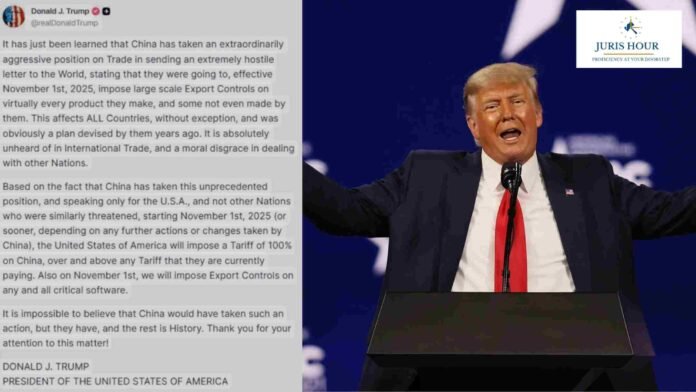
In a forceful escalation of trade tensions, President Donald Trump announced that beginning November 1, 2025, the United States will impose an additional 100% tariff on Chinese imports—on top of existing duties—and will enact sweeping export controls on all “critical software.” The move comes in response to what the White House describes as an unprecedented and hostile Chinese threat to impose export controls on virtually all products, including those not even manufactured in China.
“It is absolutely unheard of in international trade, and a moral disgrace in dealing with other Nations,” Trump said in a public statement, characterizing China’s actions as the culmination of a long-planned strategy.
What China Claimed and Why the U.S. Consider it an Escalation?
According to U.S. officials, China’s purported letter to the world signals that, effective November 1, Beijing will implement sweeping export controls across its entire industrial base. The letter reportedly states that China may restrict not just goods it manufactures but also products from other nations—if they embed Chinese technology or components.
U.S. officials argue that this is a departure from conventional export control regimes, which typically target strategic or dual-use goods under narrow rules. Imposing blanket restrictions on nearly every product—especially those not made in China—is seen in Washington as an extreme, coercive strategy.
In response, the U.S. frames its new measures as defensive and retaliatory: doubling down on tariffs and leveraging America’s own technological strengths in software.
Immediate Impacts and Market Reactions
The announcement sent shockwaves through financial markets. Earlier in the day, the Dow Jones Industrial Average plunged around 900 points, and the S&P 500 fell 2.7 percent as investors absorbed the blow of renewed trade war escalation.
Analysts warn that the combination of 100 percent tariffs and export controls on software could ripple across U.S. industry, particularly high-tech firms reliant on Chinese components or with China-based operations.
China’s earlier move to intensify export controls on rare-earth minerals and magnets—citing “national security” concerns—provided a pretext for Washington’s reaction.
Still, U.S. officials argue China’s announced plan is much broader and more aggressive than prior export control measures.
Legal, Diplomatic, and Strategic Issues Ahead
Legal and WTO Risks
Critics argue that unilateral U.S. retaliation at this level may violate World Trade Organization (WTO) rules, particularly concerning most-favored-nation treatment and proportionality. China, in turn, is likely to file complaints and launch countermeasures.
Export Control Complexity
Enforcing export controls on “any and all critical software” poses serious challenges. Deciding what counts as “critical,” licensing, oversight, and enforcement will demand new regulatory infrastructure. There is also the risk of overreach, divergence among allies, and loopholes.
Alliances and Global Response
Some U.S. allies may balk at joining such broad export control efforts. They may find themselves squeezed between Washington and Beijing, especially if side effects harm their industries.
Long-term Escalation
In historic precedent (e.g. CoCom during the Cold War), export control regimes tend to balloon over time, making discipline harder to maintain.
China may also respond with retaliatory tariffs, further export restrictions, or even delisting U.S. firms from Chinese supply chains.
Reactions
- China’s likely response: Beijing is expected to counterattack with tariffs, further export controls, corporate blacklists, and diplomatic pressure.
- U.S. business concerns: Companies that depend on cross-border supply chains or sell into China may face severe disruptions.
- Allied governments: European, East Asian, and other governments will watch closely to see whether to support the U.S. stance or distance themselves to preserve trade relations with China.
- Public and political debate: This move will provoke fierce debate in Congress, among trade groups, and within the tech community over costs, risks, and strategic necessity.
Whether the U.S. escalation delivers leverage or catalyzes a deep global trade fragmentation remains to be seen. Much will depend on China’s response, allied participation, and whether any diplomatic back channels remain viable.
But one thing is clear: the global trade architecture—with assumptions of openness, gradualism, and rules-based order—faces a new stress test.

