
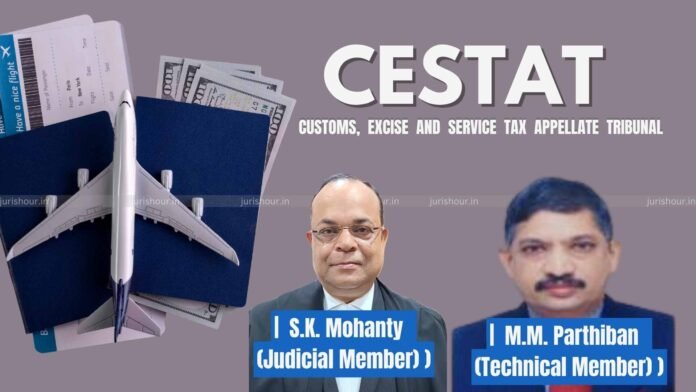
The Mumbai Bench of the Customs, Excise and Service Tax Appellate Tribunal (CESTAT) has held that service tax was not leviable on tour operator services wholly conducted in the erstwhile State of Jammu & Kashmir during the pre-GST period, as the provisions of Chapter V of the Finance Act, 1994 did not extend to the State.
The bench of S.K. Mohanty (Judicial Member) and M.M. Parthiban (Technical Member) has observed that mere non-payment of tax, in the absence of deliberate concealment or fraudulent intent, was insufficient to invoke the extended period prescribed under the Finance Act, 1994.
The dispute arose after the Service Tax Department conducted an audit of the records of Heena Tours & Travels, a Mumbai-based tour operator engaged in organizing package tours. During the audit, the Department noticed that the company had not discharged service tax on receipts generated from tours conducted in Jammu & Kashmir.
According to the Department, the assessee had received approximately ₹11.61 crore from tours conducted in Jammu & Kashmir during the period from October 2005 to September 2010 and had allegedly failed to pay service tax amounting to ₹1.28 crore. A show cause notice was therefore issued seeking recovery of tax, interest and penalties.
The adjudicating authority subsequently confirmed a reduced demand of about ₹22.98 lakh for the normal period while dropping the larger portion of the demand raised for the extended period and refraining from imposing penalties. Both the assessee and the Revenue challenged the order before the Tribunal.
The tour operator argued that its Jammu & Kashmir packages commenced, operated and concluded entirely within Jammu & Kashmir. Since Section 64 of the Finance Act, 1994 specifically excluded the State of Jammu & Kashmir from the operation of Chapter V relating to service tax, the services were outside the territorial scope of the levy.
The assessee further contended that service tax was a destination-based consumption tax and that the actual performance and consumption of the service took place in Jammu & Kashmir. Therefore, no service tax liability could arise merely because the tour operator or customer was located elsewhere in India.
The Department maintained that the activity fell squarely within the definition of “tour operator service” and that service tax was payable on the consideration received for arranging and conducting tours.
The department argued that the adjudicating authority had wrongly restricted the demand to the normal limitation period and should have invoked the extended period under Section 73 of the Finance Act, 1994. It further sought imposition of penalties under Sections 76, 77 and 78.
The Tribunal undertook an extensive examination of the historical evolution of service tax provisions applicable to tour operators and the territorial extent clause contained in Section 64 of the Finance Act, 1994.
It noted that the service tax chapter expressly extended to the whole of India except the State of Jammu & Kashmir. The Bench also referred to departmental circulars issued when service tax was introduced on tour operators, which clarified that service tax was leviable only on services rendered within Indian territory covered by the statute and that services rendered outside such territory were not taxable.
The Tribunal observed that because the Finance Act, 1994 did not apply to Jammu & Kashmir during the relevant period, activities undertaken and services rendered in that State could not automatically be brought within the service tax net.
The Bench also analysed the Larger Bench decision in Cox & Kings Ltd., which examined the nature and scope of tour operator services and the territorial nexus required for levy of service tax.
After considering the statutory framework and judicial precedents, the Tribunal concluded that the issue was no longer res integra and that the taxability of such services had to be assessed with reference to the place where the relevant service activities were performed and consumed.
The Tribunal agreed with the adjudicating authority’s finding that the Department had failed to establish suppression of facts, wilful misstatement or intent to evade tax.
It observed that the assessee had entertained a bona fide belief regarding non-taxability of Jammu & Kashmir tours and that the Department had produced no convincing evidence to justify invocation of the extended limitation period. Consequently, the extended period demand could not be sustained.
The Tribunal found no material to demonstrate fraud, collusion, suppression or wilful misstatement by the assessee.
The Bench observed that the assessee had acted under a reasonable interpretation of the law and therefore penalties under Sections 76, 77 and 78 were not justified. It also noted that the circumstances disclosed a bona fide dispute concerning the applicability of service tax to services connected with Jammu & Kashmir.
Allowing the assessee’s challenge and rejecting the Revenue’s appeal, the Tribunal held that tours conducted in Jammu & Kashmir during the relevant period could not be subjected to service tax merely because the tour operator and customer were situated outside the State.
Membership Required to Access Case Details & Order Copy
To view the complete Case Details and Download Order Copy, you must have an active membership. Please subscribe to continue.

