
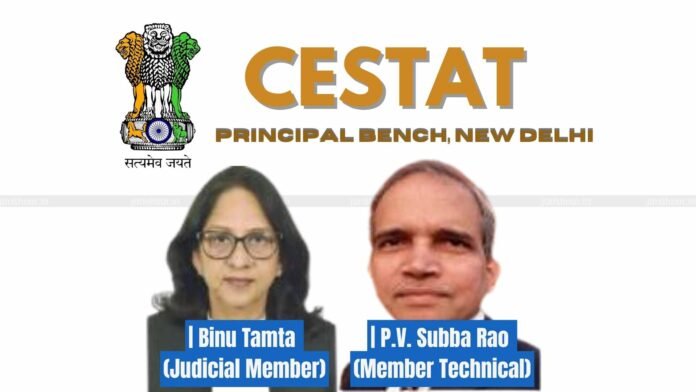
The Customs, Excise & Service Tax Appellate Tribunal (CESTAT), New Delhi, has set aside a service tax demand of ₹35.14 lakh against a contractor after holding that road construction work executed as a sub-contractor for Public Works Department (PWD) projects was exempt from service tax.
The bench of Justice Binu Tamta (Member Judicial) and P. V. Subba Rao (Member Technical) ruled that construction of individual residential houses, bank interest, and receipts qualifying under the small service provider exemption could not be subjected to service tax.
Buy Now: Service Tax Judgement E-Compilation : June 2026
The dispute arose after the Service Tax Department initiated an investigation against the appellant based on third-party information. The Department alleged that the contractor had provided taxable services under the categories of commercial and industrial construction, residential complex construction, and maintenance and repair services without paying service tax.
A show cause notice dated 23 April 2019 demanded ₹35,14,080, along with interest under Section 75 of the Finance Act, 1994, penalties under Sections 77 and 78, and late fees for failure to file service tax returns. The adjudicating authority confirmed the demand, and the Commissioner (Appeals) upheld the order, leading to the appeal before CESTAT.
The principal issue before the Tribunal concerned receipts earned from three entities for construction of roads.
The appellant argued that it had acted only as a sub-contractor executing road construction work awarded by principal contractors engaged by the Public Works Department. Since construction of roads for public use was exempt under Serial No. 13(a) of Notification No. 25/2012-ST, and services provided by a sub-contractor in respect of exempt works contracts were separately exempt under Serial No. 29(h), no service tax was payable.
The Commissioner (Appeals) had denied the exemption, pointing to inconsistencies in the agreements, including reconstructed agreements containing GSTIN details that were introduced only after the GST regime.
The Tribunal, however, accepted the appellant’s explanation that the original agreements were unavailable and had subsequently been reconstructed. After examining the documents placed on record, the Bench concluded that the contracts unmistakably related to road construction undertaken as a sub-contractor for PWD projects.
Accordingly, the Tribunal held that the services were squarely covered by the exemption available under Notification No. 25/2012-ST and deleted the service tax demand of ₹16.93 lakh raised on this count.
The Department had also demanded service tax on amounts received for constructing individual houses for five different persons.
Revenue authorities had denied the exemption because the agreements allegedly lacked complete property addresses, ownership documents, and approved building plans.
Rejecting this reasoning, the Tribunal observed that production of ownership records, blueprints or complete addresses was not a mandatory condition for claiming exemption available for construction of individual residential houses under the notification.
Holding that the Department had imposed unnecessary documentary requirements, the Bench set aside this portion of the demand as well.
Another component of the demand related to bank interest received by the appellant.
The Tribunal categorically ruled that interest earned from banks cannot be regarded as consideration received for rendering any taxable service. Consequently, this portion of the service tax demand was also quashed.
The appellant had also received limited income from vehicle and machinery hiring and HR PWD receipts, for which it claimed the benefit of Notification No. 33/2012-ST, granting exemption to small service providers where taxable turnover remained within the prescribed threshold.
The Department had rejected the exemption by including receipts from activities that it considered taxable, resulting in turnover exceeding the threshold.
The Tribunal noted that since it had already held the other receipts to be exempt from service tax, the appellant’s taxable receipts in each financial year remained below ₹10 lakh, thereby qualifying for the small service provider exemption.
Accordingly, the Tribunal extended the benefit of Notification No. 33/2012-ST and set aside the remaining demand.
Allowing the appeal in its entirety, the CESTAT held that the impugned order of the Commissioner (Appeals) could not be sustained.
The Bench therefore quashed the entire ₹35.14 lakh service tax demand; set aside the corresponding interest, penalties and late fees; and allowed the appeal with consequential relief to the appellant.
Membership Required to Access Case Details & Order Copy
To view the complete Case Details and Download Order Copy, you must have an active membership. Please subscribe to continue.
Read More: Job Work Can’t Be Treated as ‘Exempted Service’; No 7% CENVAT Reversal on Job Charges: CESTAT

