
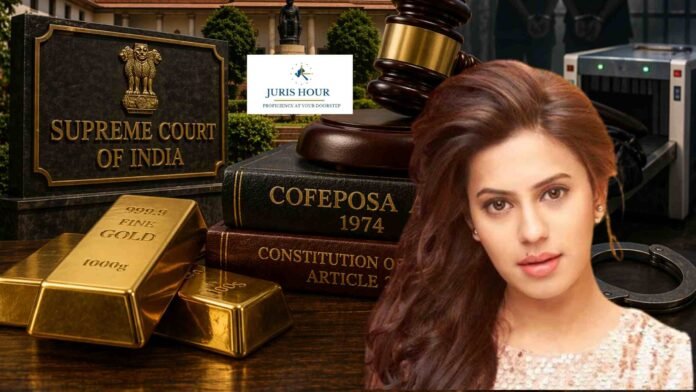
The Supreme Court has held that under Article 22(3)(b) of the Constitution read with Section 8(e) of COFEPOSA, a detenu does not have a right to be represented by a lawyer before the Advisory Board as a matter of course.
The bench of Justice M. M. Sundresh and Justice Nongmeikapam Kotiswar Singh upheld detention orders issued against two individuals allegedly involved in a large-scale gold smuggling syndicate. The Court dismissed the Special Leave Petitions challenging the detention, affirming that procedural safeguards under the Constitution were adequately followed.
The case arose from detention orders dated April 22, 2025, passed under Section 3(1) of COFEPOSA against two detenus accused of facilitating the disposal of foreign-marked gold smuggled into India. The matter reached the Supreme Court after the Karnataka High Court upheld the detention orders in December 2025.
The case traces back to an operation by the Directorate of Revenue Intelligence (DRI), which intercepted a passenger at Bengaluru airport on March 3, 2025. Authorities recovered 17 foreign-marked gold bars weighing approximately 14.2 kg. Subsequent investigations linked the accused to multiple prior transactions involving smuggled gold and alleged hawala dealings running into crores.
Based on statements recorded under Section 108 of the Customs Act and digital evidence, the second detenu was arrested and accused of acting as an intermediary in the smuggling network. The authorities relied on these materials to justify preventive detention, citing the likelihood of continued illegal activity.
The petitioners challenged the detention on multiple grounds, including non-supply of relied-upon documents, improper service of electronic evidence, lack of “subjective satisfaction” by the detaining authority, and denial of legal representation before the Advisory Board.
A major contention was that the detenus were not provided full access to electronic evidence, including CCTV footage stored in a pen drive, thereby affecting their ability to make an effective representation under Article 22(5) of the Constitution.
Another critical issue was whether the detenus had a right to legal representation before the Advisory Board constituted under COFEPOSA.
Relying on its Constitution Bench judgment in A.K. Roy v. Union of India, the Court reiterated that such a right arises only if the detaining authority itself engages a legal practitioner. In the present case, officials merely assisted the Board by producing records and did not act as legal representatives, thus not triggering any right for the detenus to seek legal assistance.
On the issue of non-supply of the pen drive, the Court held that there was “substantial compliance” by the authorities. The contents of the pen drive, including CCTV footage, were shown to the detenus in prison using a laptop, and attempts were made to provide copies to their representatives.
The Court noted that prison rules restrict access to electronic devices, and in the absence of renewed requests from the detenus for further access, the claim of non-supply was an afterthought.
Rejecting the argument that the detention lacked a “live and proximate link” to the alleged offence, the Court held that the detaining authority had recorded sufficient reasons. The materials indicated prior involvement in smuggling activities and established a nexus with the current incident.
The Court emphasized that subjective satisfaction in preventive detention cases must be based on relevant material, and in this case, the threshold was met.
Addressing procedural objections, the Court clarified that although rejection of representations was communicated by a single officer, the decisions were actually taken by competent authorities. The communication was merely a ministerial act and did not invalidate the process.
The Court also found that representations were considered within permissible timelines and that there was no violation of constitutional safeguards.
Concluding that there was no violation of Article 22 or statutory provisions, the Supreme Court dismissed both petitions and upheld the preventive detention orders. It held that adequate procedural compliance had been ensured and that the challenge lacked merit.
Case Details
Case Title: Priyanka Sarkariya Versus The Union Of India & Anr.
Citation: JURISHOUR-815-SC-2026
Case No.: Special Leave Petition (Criminal) No. 24/2026
Date: 16/04/2026

