
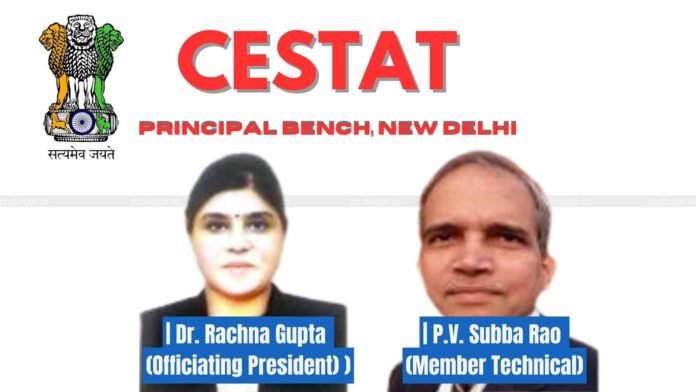
The Customs, Excise and Service Tax Appellate Tribunal (CESTAT), New Delhi, has held that the tax department cannot compel an assessee to adopt a particular option under Rule 6(3) for reversal of CENVAT credit. Setting aside a demand exceeding ₹12.36 crore, the Tribunal ruled that the choice of compliance under Rule 6 rests exclusively with the assessee and not with the department.
The Bench of Dr. Rachna Gupta (Officiating President) and P.V. Subba Rao (Technical Member) has observed that where an assessee has already restricted its CENVAT credit to the proportion attributable to taxable services, the question of reversing credit under Rule 6(3) does not arise at all.
BUY NOW: Service Tax E-Compilation : March 2026
The dispute arose from an Order-in-Original dated December 28, 2018, covering the period from 2011-12 to 2014-15. The Commissioner had confirmed: Recovery of ₹12.36 crore under Rule 14 of the CENVAT Credit Rules read with Rule 6(3); Service tax demand of ₹51.65 lakh; Interest; Equivalent penalties under Rule 15 of the CENVAT Credit Rules and Section 78 of the Finance Act, 1994, besides other statutory penalties.
The department alleged that Vertiv had availed CENVAT credit on common input services used for both taxable and exempted services without maintaining separate records and was therefore liable to pay an amount under Rule 6(3).
Vertiv argued that it had not taken full CENVAT credit on common input services. Instead, it had availed only proportionate credit attributable to taxable output services, supported by detailed voucher-wise calculations and documentary evidence submitted during adjudication.
According to the company, since no excess or ineligible CENVAT credit had been availed, there was no requirement to reverse credit or pay any amount under Rule 6(3).
The Tribunal accepted the appellant’s contention and observed that Rule 6 provides multiple methods for complying with CENVAT credit obligations.
An assessee may refrain from taking credit attributable to exempted services; maintain separate accounts for taxable and exempted services; or opt for payment under Rule 6(3).
The Bench categorically held that these are statutory choices available to the assessee and that tax authorities cannot impose one option upon the taxpayer merely because they believe another method should have been adopted.
Relying upon the judgment of the Telangana High Court in Tiara Advertising v. Union of India, the Tribunal held that recovery of an amount under Rule 6(3) cannot be made by the department simply by selecting that option on behalf of the assessee.
The Tribunal also examined the allegation that Vertiv had short-paid service tax under the category of “Erection, Commissioning and Installation Service.”
After examining the Chartered Accountant’s certificate and invoice-wise records, the Bench found that the appellant had correctly classified its activities under various taxable categories including: Works Contract Service; Erection, Commissioning and Installation Service; and Annual Maintenance Contract Service.
Since appropriate service tax had already been discharged under the relevant taxable heads, the Tribunal held that no additional demand could survive merely because the department sought to classify the services differently.
The third dispute related to the increase in the service tax rate from 10% to 12% with effect from April 1, 2012.
The department alleged that invoices raised before April 1, 2012 but paid thereafter should attract service tax at the enhanced rate.
The Tribunal analysed the Point of Taxation Rules and accepted the appellant’s explanation that where both services and invoices were completed before April 1, 2012, the old rate applied; where payment had been received in advance before April 1, 2012, the old rate remained applicable; and wherever payments were actually received after April 1, 2012, the appellant had already paid the differential service tax of ₹4.15 lakh, along with interest, during the departmental audit.
Accordingly, the Tribunal concluded that no further liability survived.
Having rejected all three components of the department’s case, the Tribunal held that none of the demands could be sustained on merits.
Consequently, it also set aside the demands for interest and all penalties.
Allowing the appeal, the Bench quashed the impugned order and granted consequential relief to the appellant.
Membership Required to Access Case Details & Order Copy
To view the complete Case Details and Download Order Copy, you must have an active membership. Please subscribe to continue.
Read More: CESTAT Quashes ₹2.31 Crore Service Tax Demand on Legal Services

