
Mumbai, India’s financial capital and one of the country’s busiest international gateways, has emerged as a major frontline in the fight against transnational drug trafficking. At the heart of this battle is Mumbai Customs Zone-III, whose Airport Commissionerate at Chhatrapati Shivaji Maharaj International Airport (CSMIA) has reported an unprecedented rise in narcotics seizures and cases during the current financial year.
Sharp Rise in NDPS Cases
According to official data, the Airport Commissionerate has registered 207 cases under the Narcotic Drugs and Psychotropic Substances (NDPS) Act up to January 2026 in FY 2025–26, marking a steep jump from 57 cases in FY 2024–25. The surge reflects both intensified enforcement and evolving smuggling patterns.
Cocaine seizures illustrate the trend. While FY 2024–25 saw five cases involving 5.09 kg of cocaine valued at around ₹50.9 crore, the current financial year has already recorded five cases with a much larger seizure of 11.626 kg, estimated to be worth ₹116.26 crore. Arrests in these cases remain consistent at five individuals.
Hydroponic Weed: The Fastest-Growing Threat
One of the most alarming developments has been the rapid rise in smuggling of Hydroponic Weed, a high-potency form of cannabis. Thailand has emerged as a key source country. Between April 2025 and January 2026, the Air Intelligence Unit (AIU) at CSMIA alone booked 200 cases, seizing more than 1,101 kg of cannabis.
Customs officials note that traffickers typically exploit vulnerable individuals as couriers, luring them with free air tickets, accommodation in Bangkok, and small cash payments in exchange for carrying drug consignments back to India.
Sophisticated and Deceptive Modus Operandi
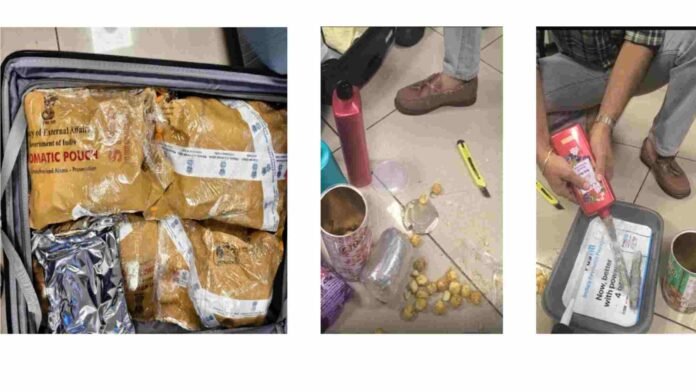
Investigations have revealed increasingly innovative concealment techniques. In one startling case, smugglers attempted to pass off narcotics using a fake “Diplomatic Pouch of the Ministry of External Affairs”, exploiting the perceived immunity associated with diplomatic consignments.
Other methods include:
- Attaching baggage tags from unrelated flights to mislead profiling teams.
- Concealing drugs inside chips packets, shampoo bottles, vegetables, and food items.
- Swallowing drug-filled capsules to evade scanners and manual checks.
Shift Toward “Low-Risk” Carriers
To counter Mumbai Customs’ high interception rate, syndicates have changed recruitment strategies. More than 50% of recent seizures were made without prior intelligence, indicating that traffickers are increasingly relying on passengers who appear less suspicious.
This new pool includes:
- Carriers aged 21 to 61 years.
- Families travelling with children.
- Women, who now account for about 25% of booked cases.
Officials say this deliberate diversification is designed to defeat conventional profiling techniques.
Cocaine Trafficking by Transnational Syndicates
Organised international crime networks continue to dominate cocaine smuggling into India. Foreign nationals, particularly from African and South American countries, are frequently used as couriers.
In one case, a 61-year-old Ugandan national was found to have swallowed 80 capsules containing 866 grams of cocaine. In another operation, an airline crew member was intercepted while attempting to smuggle 5.194 kg of white powdered cocaine, acting on a tip-off.
Strict Legal Consequences
Under the NDPS Act, 1985, penalties vary according to the quantity involved:
- Small quantity: up to one year imprisonment or fine of ₹10,000.
- Commercial quantity: minimum 10 years’ rigorous imprisonment, extendable to 20 years, along with heavy fines.
- For repeat or large-scale offenders, punishment may extend up to 30 years or, in extreme cases, the death penalty.
Large-Scale Destruction of Seized Narcotics
In line with the national vision of a drug-free India, the Airport Commissionerate has carried out the destruction of over 415 kg of seized narcotics during the current financial year, with an estimated illicit market value of ₹486 crore. The disposal was conducted under stringent legal and environmental safeguards to ensure that the contraband is permanently removed from circulation.
Frontline Role in “Nasha Mukt Bharat Abhiyan”
Through sustained vigilance, intelligence-led operations, and rapid adaptation to changing smuggling tactics, the Mumbai Airport Commissionerate continues to play a pivotal role in dismantling international drug networks and safeguarding Indian society.
Officials reiterate that the intensified crackdown is part of the broader national mission for a “Nasha Mukt Bharat Abhiyan”, underscoring Mumbai Airport’s position as a crucial bulwark against the global narcotics trade.

