
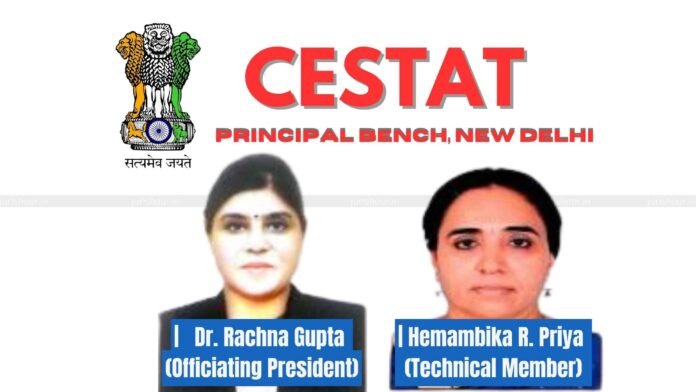
The Principal Bench of the Customs, Excise and Service Tax Appellate Tribunal (CESTAT), New Delhi, has upheld a customs duty demand of over ₹1.54 crore against an automobile components importer, ruling that several imported products were wrongly classified under incorrect Customs Tariff Headings (CTHs) to avail lower duty benefits.
The bench of Dr. Rachna Gupta (Officiating President) and Hemambika R. Priya (Technical Member) classification disputes must be resolved with reference to the Harmonised System of Nomenclature (HSN) and the General Rules for Interpretation. Referring to Supreme Court precedents, the Bench reiterated that HSN Explanatory Notes provide authoritative guidance in determining the appropriate tariff classification of imported goods.
Buy Now: 100+ Judgements On Customs Classification
The appeal arose from an Order-in-Original passed by the Commissioner of Customs, ICD Patparganj, Delhi, concerning imports made by a company engaged in the import and domestic trading of brake hoses and other automobile brake components. During an audit conducted by the Customs Department, multiple instances of non-compliance were detected, leading to a detailed examination of the classification adopted for various imported products.
The Customs Department’s audit identified nine major discrepancies, including alleged misclassification of gauges, protector tubes, adapter joints, brackets, crimping dies, jig tools, connectors and issues relating to freight valuation. According to the Department, the importer had earlier classified certain goods under tariff headings that were subsequently changed in later Bills of Entry, enabling the company to claim customs duty benefits that would otherwise not have been available.
Based on these findings, a show cause notice was issued proposing recovery of differential customs duty amounting to ₹1.54 crore along with interest, confiscation of the imported goods under Section 111(m) of the Customs Act, 1962, and penalties under Sections 114A and 117 of the Act.
The importer accepted liability regarding several audit observations, including classification issues relating to gauges, crimping dies, jig tools and freight-related discrepancies. The principal dispute eventually remained confined to three products—Protector Tubes, Brackets and Connectors.
The importer argued that there was no suppression of facts because all documents had been submitted before Customs authorities and the imported goods had been physically examined at the time of clearance. It also contended that classification disputes stemmed from interpretational differences rather than deliberate misdeclaration.
One of the central issues concerned the classification of “Protector Tubes.” The importer had classified the product under CTH 40091100, applicable to certain rubber products, whereas the Department classified it under CTH 39172310 applicable to PVC tubes.
The Tribunal noted that catalogues and manufacturer literature relied upon by the Department clearly established that the Protector Tube was made of 100% PVC. Since the importer failed to produce evidence contradicting those documents, the Tribunal concluded that the product could not be classified as a rubber tube. Consequently, it upheld classification under CTH 39172310 and confirmed the resulting differential duty demand.
The Bench further held that the importer was not entitled to claim benefits under Customs Notification No. 46/2011-Cus issued pursuant to the ASEAN Trade Agreement because the benefit had been claimed on the basis of an incorrect tariff classification.
The second dispute related to the classification of brackets used in brake hose assemblies. The importer had classified the goods under tariff entries relating to metal fixtures and other iron and steel articles, whereas the Department classified them under CTH 87089900 as parts and accessories of motor vehicles.
Examining the relevant section notes and HSN provisions, the Tribunal observed that the brackets were specifically designed for use in brake hose assemblies forming part of motor vehicles. Since the goods were not of general-purpose use and were principally intended for automobiles, the Bench held that they were correctly classifiable as motor vehicle parts under Chapter 87.
Accordingly, the differential duty demand relating to the brackets was upheld.
The Tribunal similarly rejected the importer’s classification of connectors under Chapter 39 relating to plastic fittings. It observed that Chapter Note 2(t) expressly excludes vehicle parts falling under Section XVII from Chapter 39.
The Bench found that the connectors were specifically designed for use in automobile brake systems to regulate brake fluid flow and were not generic plastic fittings. Therefore, they were held to be correctly classifiable as parts and accessories of motor vehicles rather than as plastic tube fittings.
Extended Limitation and Penalties Upheld
On the question of limitation, the Tribunal rejected the importer’s argument that Customs authorities were already aware of the facts due to document verification and physical examination.
The Bench emphasized that under the self-assessment regime, importers are obligated to declare the correct classification of goods. It noted that the importer had previously classified the products under the tariff headings now claimed by the Department and later changed the classifications, resulting in reduced customs duty liability. This, according to the Tribunal, indicated intentional misclassification leading to evasion of duty.
Holding that the conditions for invoking Section 28(4) of the Customs Act were satisfied, the Tribunal upheld the extended period of limitation and affirmed the penalties imposed by the adjudicating authority.
Concluding that the Department had correctly reclassified the disputed products and validly invoked the extended period for recovery of duties, the CESTAT affirmed the Commissioner’s order and dismissed the appeal filed by the importer.
Membership Required to Access Case Details & Order Copy
To view the complete Case Details and Download Order Copy, you must have an active membership. Please subscribe to continue.
Read More: Bombay High Court Quashes Rs. 100 Crore PMLA Freezing Action Against Coda Payments

