
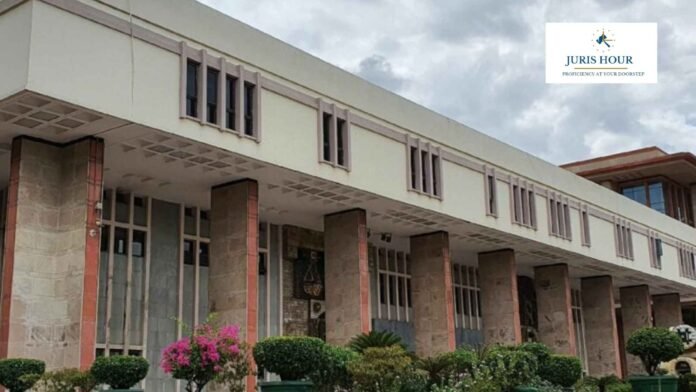
The Delhi High Court has ruled that a person who fails to comply with the mandatory pre-deposit requirement for filing a customs appeal cannot ordinarily bypass the statutory appellate mechanism by directly invoking the High Court’s writ jurisdiction on the ground of financial hardship.
The Bench of Justice Anil Kshetarpal and Justice Shail Jain has observed that the issues raised by the petitioner—including denial of cross-examination, admissibility of statements recorded during investigation, retraction of his own statement and legality of the confiscation—were matters connected with the merits of the adjudication and should be examined by the competent statutory appellate forum.
Buy Now: 100+ Judgements On Customs Classification
The dispute arose from an investigation conducted by the Directorate of Revenue Intelligence into an alleged attempt to illegally export red sanders wood.
On November 14, 2014, the DRI intercepted a container loaded on a truck at the Inland Container Depot, Tughlakabad, New Delhi. Carpets had been declared for export under the relevant shipping bill.
Upon examining the container, the authorities allegedly recovered 142 logs of red sanders wood weighing approximately 4.43 metric tonnes. The red sanders were allegedly concealed beneath the carpets and had not been declared in the shipping bill. The goods were consequently seized under the Customs Act.
The DRI also searched premises situated at Gannaur in Haryana, which were allegedly being used in connection with the export operation. Red sanders wood, carpets and a truck were reportedly seized during the search.
Statements of several persons were recorded under Section 108 of the Customs Act. The petitioner’s statement was also recorded on March 14, 2015.
A show-cause notice dated May 11, 2015, was subsequently issued proposing, among other actions, the imposition of a penalty upon the petitioner under Section 114 of the Customs Act.
The petitioner denied having any connection with the exporter or the disputed export transaction. He also challenged the reliance placed on the statements of three persons and sought permission to cross-examine them.
The adjudicating authority, however, passed an Order-in-Original on March 26, 2018. It relied upon the statements recorded during the investigation, including the petitioner’s statement under Section 108 of the Act.
The authority concluded that the petitioner’s acts and omissions attracted Section 114 and imposed a penalty of ₹3 crore upon him.
The petitioner challenged the adjudication order before the Commissioner (Appeals) under Section 128 of the Customs Act. He also sought a waiver of the statutory pre-deposit.
During the appellate proceedings, it was admitted that the petitioner had not deposited 7.5% of the disputed penalty as required under Section 129E of the Act.
The Commissioner (Appeals) held that the prescribed deposit was a mandatory statutory condition and could not be waived. The appeal was accordingly rejected on December 10, 2020, without examining the dispute on merits.
The petitioner thereafter approached the Delhi High Court under Articles 226 and 227 of the Constitution.
Before the High Court, the petitioner argued that the adjudication order was vitiated by a fundamental breach of the principles of natural justice because he was not allowed to cross-examine the persons whose statements were relied upon against him.
He contended that Section 138B of the Customs Act governs the circumstances in which statements recorded during an inquiry or investigation may be admitted as evidence. According to him, the statements could not be treated as substantive evidence without examining their makers and making them available for cross-examination.
The petitioner further claimed that his own statement was recorded while he was in custody and was subsequently retracted before the competent court.
It was also argued that there was no independent evidence establishing that the petitioner was the real owner or mastermind behind the exporter or that he was connected with the export transaction.
The petitioner additionally questioned the confiscation of the red sanders allegedly recovered from the Gannaur premises, arguing that the goods were found outside the customs area and could not be confiscated under Section 113 of the Act.
His counsel submitted that the requirement to deposit 7.5% of the ₹3 crore penalty caused grave financial hardship and that the petitioner did not possess the means to make the deposit.
The Customs Department opposed the petition on the ground that an efficacious statutory remedy was available under the Customs Act.
It argued that the pre-deposit prescribed under Section 129E was mandatory and that the Commissioner (Appeals) had no jurisdiction to waive it.
The department further submitted that the petitioner could challenge the Commissioner (Appeals)’ order before the Customs, Excise and Service Tax Appellate Tribunal. Therefore, he could not invoke the High Court’s extraordinary jurisdiction to bypass the statutory appellate framework.
On the merits, the department maintained that the investigation and mutually corroborative statements established the petitioner’s involvement in the attempted export of red sanders.
The High Court observed that the Customs Act provides a complete mechanism for adjudicating disputes and challenging orders passed by statutory authorities.
An adjudication order can be challenged before the Commissioner (Appeals) under Section 128, while a further remedy is available before the Appellate Tribunal against specified orders.
The Court acknowledged that the existence of an alternative remedy does not constitute an absolute bar against exercising jurisdiction under Article 226. However, where legislation provides an efficacious mechanism, writ jurisdiction is ordinarily not exercised to bypass that framework, particularly when the dispute requires examination of facts and merits falling within the jurisdiction of appellate authorities.
The Bench noted that the petitioner wanted the Court to examine the alleged denial of cross-examination, the evidentiary value of statements recorded under Section 108, the effect of the retraction, the absence of independent evidence and the legality of the confiscation.
According to the Court, these questions directly concerned the correctness of the findings recorded by the adjudicating authority and required consideration of the underlying evidence, statements and allegations.
“These are precisely matters which fall for examination before the statutory appellate forum,” the Court observed.
The Bench noted that the petitioner had availed himself of the first appellate remedy, but his appeal was not examined on merits because he failed to comply with Section 129E.
The Court held that Section 129E makes the deposit of the prescribed percentage of the disputed duty or penalty a condition for entertaining an appeal. Consequently, the Commissioner (Appeals) could not examine the appeal’s merits in the absence of the mandatory deposit.
Addressing the plea of financial hardship, the Court observed that once the legislature prescribes a statutory condition for entertaining an appeal, that condition cannot ordinarily be bypassed merely by invoking writ jurisdiction.
The petitioner had not been denied access to the statutory remedy for reasons beyond his control, the Court noted. His appeal was rejected because he admittedly failed to fulfil the statutory precondition.
Permitting him to challenge the adjudication order directly before the High Court would effectively allow him to circumvent the conditions attached to the appellate remedy under the Customs Act.
The High Court also rejected the argument that the allegation of denial of cross-examination was sufficient, by itself, to justify entertaining the writ petition.
The Court said that a mere assertion regarding violation of natural justice does not automatically require a High Court to exercise writ jurisdiction despite the availability of an efficacious alternative remedy.
Whether the petitioner was entitled to cross-examine the persons whose statements were relied upon, and the legal consequences of refusing such cross-examination, were issues intrinsically connected with the merits of the adjudication.
The Bench declined to express any opinion on the petitioner’s contentions relating to cross-examination, admissibility of statements, retraction or the legality of the adjudication findings, noting that such observations could prejudice consideration by the competent appellate forum.
Finding no exceptional circumstances warranting the exercise of extraordinary writ jurisdiction, the High Court dismissed the petition on the ground of availability of an efficacious alternative statutory remedy.
The petitioner was granted liberty to pursue the remedy available before the competent appellate forum under the Customs Act.
The Court clarified that all questions raised by the petitioner—including cross-examination, reliance on statements recorded under Section 108, applicability of Section 138B, alleged retraction, confiscability of the goods and the legality and quantum of penalty—would remain open.
It directed that the competent appellate forum should consider those issues independently and in accordance with law, without being influenced by any observations contained in the High Court’s order.
Membership Required to Access Case Details & Order Copy
To view the complete Case Details and Download Order Copy, you must have an active membership. Please subscribe to continue.

