
The Central Board of Indirect Taxes and Customs (CBIC) has reviewed the preparedness of Jawaharlal Nehru Customs House (JNCH), Nhava Sheva, for the proposed rollout of 100% Non-Intrusive Inspection (NII) of import containers.
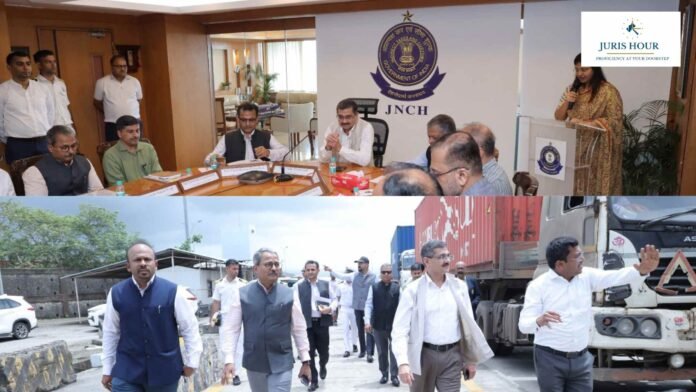
CBIC Chairman Shri Vivek Chaturvedi, accompanied by Member (Customs) Shri Yogendra Garg and other senior officials, visited JNCH on September 2, 2026, to assess the operational arrangements being made for implementing the major Customs reform announced in the Union Budget 2026.
Non-Intrusive Inspection enables Customs authorities to examine containerised cargo through scanning and other technology-based systems without physically opening every container. The proposed expansion of NII coverage is expected to strengthen border enforcement while facilitating faster cargo clearance and reducing the need for physical examination.
Buy Now: E-Handbook: Draft Replies to GST Notices On 40+ Issues
During the visit, the CBIC delegation examined the infrastructure and operational preparedness at JNCH for handling the large-scale scanning of imported containers. The review covered the systems and processes necessary to ensure that comprehensive inspection does not create avoidable congestion or disrupt the movement of cargo at one of the country’s busiest container ports.
The officials also reviewed the movement of containers within the port and assessed the logistical arrangements governing the transportation, examination and clearance of cargo. Efficient coordination among Customs, port authorities, terminal operators, scanning facilities and other stakeholders will be crucial to the successful implementation of 100% NII.
The delegation further inspected export container logistics at the Centralized Parking Plaza. Such facilities are intended to streamline the handling of export-bound containers, reduce congestion around port terminals and improve coordination between exporters, transporters and Customs authorities.
Following the operational review, Shri Chaturvedi interacted with representatives of trade and industry. The meeting focused on obtaining feedback regarding the Customs-related reforms announced in the Union Budget 2026 and understanding the practical concerns of businesses involved in international trade.
Trade representatives were provided an opportunity to share their views on cargo clearance procedures, container movement, export logistics and the implementation of technology-driven Customs controls. Their feedback is expected to assist the department in identifying operational bottlenecks and ensuring that the reforms achieve their objectives without imposing unnecessary compliance burdens.
The proposed introduction of 100% Non-Intrusive Inspection marks a significant shift towards technology-led Customs administration. While the measure seeks to enhance scrutiny of imported cargo and strengthen risk management, its effectiveness will depend upon adequate scanning capacity, seamless integration of digital systems and efficient container routing.
The CBIC’s review at JNCH assumes particular importance because Nhava Sheva handles a substantial volume of India’s containerised trade. Any large-scale change in inspection procedures at the port requires careful planning to prevent delays, congestion and additional logistics costs.
The visit underlined the government’s broader objective of combining stronger border controls with improved trade facilitation. By expanding technology-based inspection and consulting stakeholders before implementation, the Customs administration aims to make cargo examination more secure, transparent and efficient.
Read More: WHEN WELFARE TAKES A BACK SEAT: INTERIM CHILD CUSTODY, COMITY AND STEREOTYPICAL NOTIONS OF MATRIMONY

