
The Mumbai Bench of the Customs, Excise & Service Tax Appellate Tribunal (CESTAT) has held that recovery of duty drawback under the repealed Drawback Rules, 1995 cannot be sustained after the coming into force of the Drawback Rules, 2017, thereby setting aside a demand of ₹7.73 crore against a garment exporter.
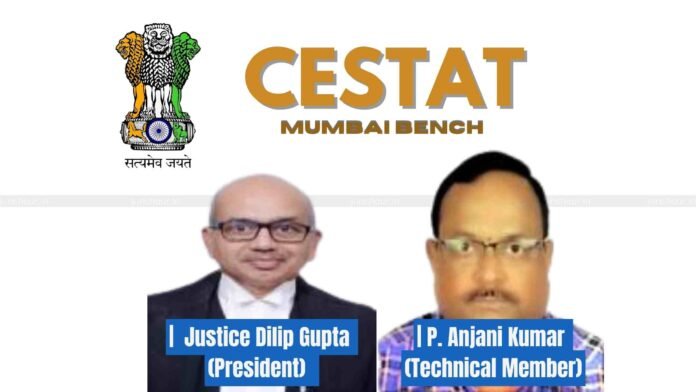
The bench of Justice Dilip Gupta (President) and P. Anjani Kumar (Technical Member), allowed the appeals filed by M/s Haji’s International and its partner, quashing the order passed by the Commissioner of Customs (Exports), Mumbai, which had ordered recovery of drawback along with penalties.
The case pertained to exports of garments made between January 2012 and December 2016 under 699 shipping bills, where the exporter had claimed duty drawback at the All Industry Rate under Section 75 of the Customs Act. The drawback amount of ₹7.73 crore had already been disbursed after assessment and issuance of Let Export Orders.
Subsequently, based on a Directorate of Revenue Intelligence (DRI) investigation into alleged fake invoicing by a third party, the department issued a show cause notice in December 2022 seeking recovery of drawback under Rule 16 and Rule 16A of the Drawback Rules, 1995.
The Commissioner confirmed the demand, ordered confiscation of goods, and imposed penalties on both the exporter and its partner.
The central issue before the Tribunal was whether recovery proceedings could be initiated under Rule 16 of the Drawback Rules, 1995 after those rules had ceased to exist with effect from 01.10.2017 upon the introduction of the Drawback Rules, 2017.
The Tribunal noted that Rule 20 of the 2017 Rules expressly provides for repeal and saving, and only certain limited situations were preserved. Crucially, recovery of erroneously granted drawback under Rule 16 of the 1995 Rules was not one of the saved provisions.
The Tribunal held that the 1995 Drawback Rules ceased to operate from 01.10.2017, and no recovery proceedings could be initiated under those rules thereafter unless specifically saved. Rule 20(2) of the 2017 Rules reflects a “different intention” by selectively saving only certain rights and proceedings, thereby excluding recovery actions under Rule 16. Section 159A of the Customs Act, which generally saves repealed provisions, would not apply where the new rules demonstrate a contrary intention.
Rejecting the Commissioner’s reliance on Section 159A, the Tribunal emphasized that the show cause notice was issued only in December 2022, long after the repeal of the 1995 Rules, and therefore, the proceedings were not “pending” at the time of repeal.
The Tribunal further held that the exporter had claimed drawback at the notified All Industry Rate, which had been duly assessed and granted by customs authorities. Such drawbacks cannot be denied merely on allegations of fake procurement invoices, particularly when export transactions and realization of foreign exchange were substantiated through Bank Realization Certificates.
The Tribunal also found that reliance on third-party statements was flawed as the procedural safeguards under Section 138B of the Customs Act were not followed.
The Tribunal ruled that confiscation under Section 113 was not sustainable as the goods had already been exported. Consequently, penalties under Sections 114 and 114AA could not be imposed. There was no evidence to show that the exporter or its partner had knowingly used false documents.
The Tribunal allowed both appeals and granted complete relief to the exporter and its partner.
Case Details
Case Title: M/s. Haji’s International Versus Commissioner of Customs (Export)
Citation: JURISHOUR-1098-CES-2026(MUM)
Case No.: CUSTOMS APPEAL NO. 87556 OF 2024
Date: 30.04.2026
Counsel For Petitioner: J.C. Patel and Ms. Shamita Patel, Advocates
Counsel For Respondent: C.S. Vinod, Authorized Representative
Read More: Vague SCN and Double Taxation Unsustainable: CESTAT Quashes Service Tax Demand on Coaching Institute

