
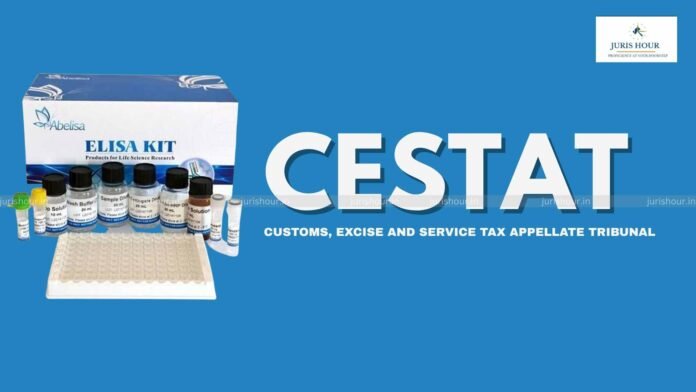
The Customs, Excise and Service Tax Appellate Tribunal (CESTAT), New Delhi, has held that individual components of an ELISA diagnostic kit cannot claim the concessional customs duty available to the complete ELISA kit merely because they are functionally indispensable to it.
Setting aside the Commissioner (Appeals)’ order, the bench of Dr. Rachna Gupta (Officiating President) and Hemambika R. Priya (Technical Member) has ruled that QuantiFERON (QFT) blood collection tubes are not entitled to the 5% concessional Basic Customs Duty (BCD) available under Notification No. 50/2017-Customs, as the exemption specifically applies to ELISA kits and not to their individual components.
The decision came in a batch of 11 departmental appeals arising from separate Bills of Entry filed between September 2023 and July 2024. The Tribunal allowed all appeals filed by the Customs Department and reversed the relief granted to the importer.
Buy Now: Service Tax Judgement E-Compilation : June 2026
The importer had brought into India QFT Tubes, specialized blood collection tubes used in tuberculosis diagnostic testing. Initially, the goods were classified under Custom Tariff Heading (CTH) 3002 9020, attracting a concessional customs duty of 5% under Entry 166(A) of Notification No. 50/2017-Customs, which covers certain diagnostic kits and equipment, including ELISA kits listed in List 3.
However, Customs authorities reclassified the imported goods under CTH 3822 1990 as “other diagnostic reagents,” resulting in a 10% Basic Customs Duty. The importer paid the differential duty to secure clearance of the goods but subsequently argued that even under the revised tariff classification, the goods continued to qualify for the concessional rate because they formed an integral part of ELISA kits.
The Commissioner (Appeals) accepted this argument and extended the exemption, prompting the Department to challenge the order before the Tribunal.
The Customs Department argued that the exemption notification must be interpreted strictly, particularly where it grants fiscal benefits. It contended that the notification expressly grants concession to ELISA kits, not to individual parts or components imported separately.
The Department emphasized that the QFT Tubes and ELISA kits were imported under different Bills of Entry and at different times, demonstrating that the imported goods were not complete diagnostic kits. According to the Department, functional interdependence cannot substitute for the statutory requirement that the imported goods themselves must answer the description contained in the exemption notification.
It further relied on several Supreme Court decisions, including Collector of Customs v. Dilip Kumar & Co., Hindustan Lever Ltd., Rajasthan Spinning Mills, and the recent Commissioner of Customs (Import) v. Welkin Foods, to argue that exemption notifications cannot be expanded beyond their express wording and that end use is generally irrelevant unless the tariff entry specifically refers to it.
The importer argued that the QFT Tubes are specialized blood collection tubes coated with peptide antigens that are indispensable for tuberculosis testing using ELISA technology. Blood samples collected through these tubes undergo incubation before being tested on ELISA plates for interferon detection.
According to the importer, the ELISA plates and QFT Tubes are functionally inseparable, and one has no practical utility without the other. It was also submitted that prior to September 2023, Customs had consistently extended the exemption to the imported goods.
The importer further relied upon judicial precedents supporting a liberal interpretation of beneficial exemption notifications and argued that integral components of a complete system should receive the same benefit available to the finished diagnostic kit.
The Tribunal disagreed with the Commissioner (Appeals) and accepted the Department’s interpretation of the notification.
It observed that Entry 166(A) of Notification No. 50/2017 specifically grants concessional duty to diagnostic kits and equipment, including ELISA kits, but does not extend that benefit to individual components of such kits. Had the legislature intended to cover individual parts, it would have expressly provided so in the notification.
The Bench noted that technical literature itself established that QFT Tubes are merely one of several components forming part of an ELISA kit. Merely because the tubes are specially coated for use in ELISA-based testing does not transform them into an ELISA kit.
Rejecting the reasoning based on functional interdependence, the Tribunal held that functional necessity cannot override the plain language of an exemption notification. Exemption notifications must be interpreted strictly, and benefits cannot be extended beyond their literal scope.
The Tribunal also rejected the argument that the ultimate use of the imported goods justified the exemption.
Referring to the Supreme Court’s recent ruling in Welkin Foods, it observed that classification and exemption under customs law are determined by the nature of the goods at the time of import and not by their eventual use, unless the tariff entry specifically incorporates end-use requirements.
Accordingly, the Tribunal held that QFT Tubes remain blood collection tubes at the time of import, notwithstanding their intended use in ELISA-based diagnostic testing. Since the exemption notification covers the complete ELISA kit and not its separately imported components, the benefit could not be extended to the importer.
Allowing all 11 departmental appeals, the CESTAT set aside the Order-in-Appeal dated 8 May 2025 and restored the denial of concessional customs duty on the imported QFT Tubes. The Tribunal also disposed of the Department’s stay applications as infructuous following the final decision.
Membership Required to Access Case Details & Order Copy
To view the complete Case Details and Download Order Copy, you must have an active membership. Please subscribe to continue.
Read More: No Interest on Refund if Service Tax Refund Is Granted Within 3 Months: CESTAT

