
The Customs, Excise and Service Tax Appellate Tribunal (CESTAT), New Delhi, has set aside the denial of CENVAT credit of ₹5.25 lakh to a manufacturer, holding that the Department’s case was based primarily on uncorroborated third-party statements while the documentary evidence submitted by the assessee remained unrebutted.
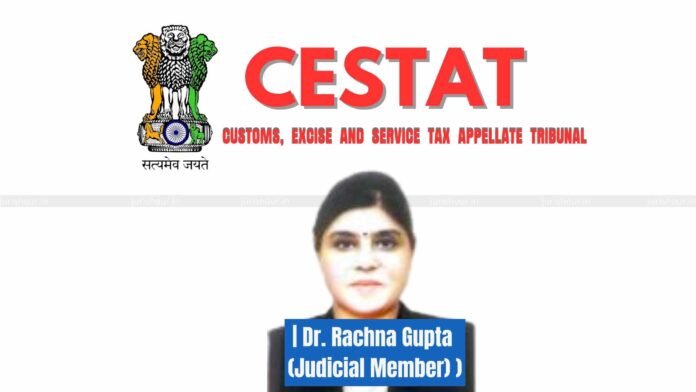
The bench of Dr. Rachna Gupta Judicial Member) observed that the Department had neither conducted an inquiry with the transporter named in the goods receipt nor investigated the assessee directly. The denial of CENVAT credit merely on the basis of third-party data and oral statements could not be sustained, particularly when the Department had failed to comply with Section 9D of the Central Excise Act, 1944.
The appellant/assessee is engaged in manufacturing copper powder, copper wire rope, copper wire and other products. The dispute arose from an investigation initiated against M/s Metal Alloy Industries, which was registered with the Central Excise Department for manufacturing copper rods, re-melted copper ingots and other goods.
Buy Now: 130 GST Judgments – E-Magazine July 2026
According to the Department, intelligence indicated that Metal Alloy Industries was fraudulently availing and passing on CENVAT credit despite lacking the necessary manufacturing facilities. The investigation allegedly revealed that the concern manufactured lead ingots only once, during February 2016, and did not manufacture any other goods at any other point.
The Department alleged that Metal Alloy Industries obtained invoices showing the purchase of inputs without physically receiving the goods and subsequently passed the credit through invoices to various manufacturers and dealers without actually supplying the goods.
Based on the investigation, the Department alleged that the assessee had fraudulently availed CENVAT credit on copper ingots purportedly supplied by M/s Bhiwadi Cylinders Pvt. Ltd. A show-cause notice dated September 3, 2020 proposed the disallowance and recovery of ₹5,25,245, along with applicable interest under Section 11AA of the Central Excise Act and an equivalent penalty under Section 11AC(1)(c).
The proposals in the notice were confirmed by the adjudicating authority through an order dated October 25, 2021. The Commissioner (Appeals) subsequently rejected the assessee’s appeal, prompting it to approach the CESTAT.
Before the Tribunal, the appellant submitted that sufficient evidence had been produced to demonstrate that copper ingots supplied under the relevant invoice were received at its factory and used in manufacturing finished products.
The appellant relied upon invoices, goods receipts issued by MAA Shakumbari Logistics Pvt. Ltd. and entries in its statutory RG 23A Part-II register. It argued that neither the original adjudicating authority nor the Commissioner (Appeals) had properly considered this documentary evidence.
The Commissioner (Appeals) had proceeded on the ground that Bhiwadi Cylinders could not have supplied the goods to the appellant because it had not received those goods from Metal Alloy Industries. The transaction was consequently treated as a paper transaction involving no actual movement or receipt of goods.
Examining the record, the CESTAT found that the Department had not extended its investigation to MAA Shakumbari Logistics Pvt. Ltd., the transporter identified in the goods receipt, to verify the allegation that no goods had been transported.
The Tribunal noted that the goods receipt placed on record had not been disputed by the adjudicating authorities. According to the order, the transport document showed the movement of copper ingots from Bhiwadi Cylinders to the appellant. The corresponding invoice also recorded the supply of copper ingots by Bhiwadi Cylinders to the assessee, with Metal Alloy Industries named as the manufacturer.
CESTAT observed that the Department had not produced any independent evidence and had relied upon oral statements recorded during the investigation. It held that documentary evidence must prevail over oral evidence in such circumstances.
The Tribunal further stated that where the Department sought to rely upon oral statements without corroborative documentary evidence, it was required to comply with Section 9D of the Central Excise Act. The provision lays down the conditions under which statements recorded during an inquiry or investigation may be treated as relevant evidence in adjudication proceedings.
In the present case, the Tribunal found that the prescribed procedure under Section 9D had admittedly not been followed.
CESTAT also addressed the Department’s reliance on the alleged absence of manufacturing facilities at the registered premises of the suppliers. It observed that nothing had been placed on record to demonstrate that the Department investigated or questioned the officers who had granted Central Excise registrations to those entities.
“In such circumstances, the allegations of the department are held to be bald without any cogent proof for the same,” the Tribunal observed.
The Bench held that the burden of proving the allegation rested upon the Department. That burden had not been discharged and, in fact, the Department’s case stood contradicted by the documentary evidence produced by the appellant.
Significantly, the Tribunal noted that no inquiry had been conducted with the appellant, its statement had never been recorded and its factory premises had not been searched. There was also no dispute that the appellant was manufacturing and clearing finished goods upon payment of Central Excise duty.
Relying upon its earlier decision in R.N. Metals v. Commissioner of Customs, Excise and CGST, Jaipur, the Tribunal held that CENVAT credit could not be denied to the appellant merely on the basis of data or statements relating to third parties.
Accordingly, CESTAT set aside the order of the Commissioner (Appeals) and allowed the assessee’s appeal, thereby overturning the demand for reversal of CENVAT credit of ₹5,25,245, along with the associated interest and penalty.
Membership Required to Access Case Details & Order Copy
To view the complete Case Details and Download Order Copy, you must have an active membership. Please subscribe to continue.

