
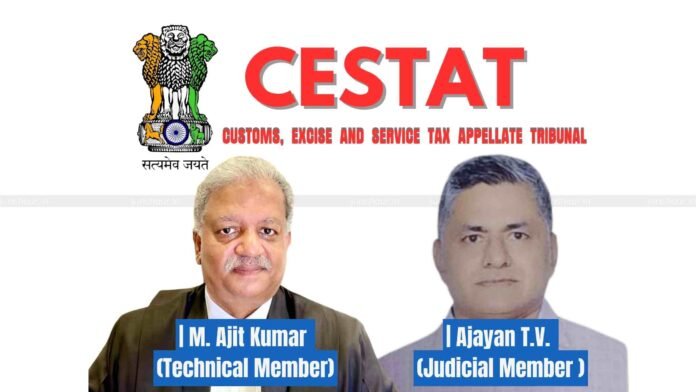
The Customs, Excise and Service Tax Appellate Tribunal (CESTAT), Chennai, has held that materials used and transferred in the course of executing a works contract cannot be treated as “trading” or an “exempted service” for the purpose of Rule 6 of the CENVAT Credit Rules, 2004.
The bench of Ajayan T.V. (Judicial Member) and M. Ajit Kumar (Technical Member) has observed that the Build-Own-Operate-Transfer (BOOT) contract in question was a single, indivisible contract, encompassing design, construction, commissioning, and maintenance of the water transmission project. The reimbursement of material costs to subcontractors formed part of the overall contract price and did not amount to trading of goods.
The appeal arose from an Order-in-Original passed by the Principal Commissioner of Service Tax, Chennai, which had alleged wrongful availment of common input service credit by the assessee during the period 2010–11 to 2014–15. The Department contended that the appellant had failed to maintain separate accounts or reverse proportionate credit under Rule 6, treating the material component of the works contract as “trading activity.”
The appellant, engaged in works contract, management consultancy, and maintenance services, had executed a long-term water supply project for Indian Oil Corporation at Paradip on a Build-Own-Operate-Transfer (BOOT) basis. The Department’s case was that the value of goods transferred during execution of the contract constituted trading, thereby attracting the provisions of Rule 6 relating to exempt services.
Rejecting this approach, the Tribunal emphasized that the dominant nature of the contract was a works contract involving supply of labour and services, and not a contract for sale of goods. It noted that merely because property in goods passes during execution does not convert the transaction into a sale or trading activity.
The Bench undertook an extensive analysis of jurisprudence, including landmark Supreme Court rulings, to reiterate that the “dominant intention test” must be applied to distinguish between a contract of sale and a works contract. It observed that in a works contract, transfer of property in goods is incidental to execution and cannot be artificially segregated to treat it as an independent trading activity.
On the issue of CENVAT credit, the Tribunal found that the appellant had maintained separate records and availed credit only on input services used for taxable output services. It further noted that there was no evidence to show that the credit had been wrongly availed. The Department’s attempt to classify deemed sale of goods as “exempt service” was held to be legally untenable.
The Tribunal categorically ruled that Rule 6(3) of the CENVAT Credit Rules would not apply, as there was no exempted service involved. Consequently, the demand raised under Rule 6(3A), along with interest and penalties, was set aside.
The Tribunal granted consequential relief to the appellant and held that no case for penalty was made out.
Case Details
Case Title: IL & FS Water Ltd. Versus Commissioner of GST & Central Excise
Citation: JURISHOUR-1035-CES-2026(CEN)
Case No.: Service Tax Appeal No. 40556/2017
Date: 30.04.2026
Counsel For Appellant: R. Viswanathan, Chartered Accountant
Counsel For Respondent: M. Selvakumar, Authorised Representative

