
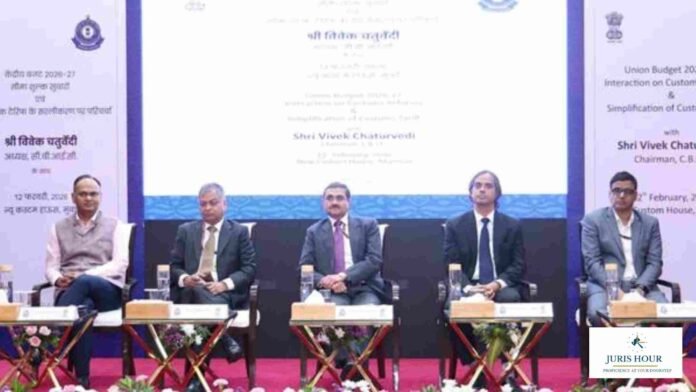
The Central Board of Indirect Taxes and Customs (CBIC) held an interactive outreach session with key stakeholders from trade and industry at the New Custom House, Mumbai, as part of its ongoing efforts to strengthen trust-based governance and streamline indirect tax administration.
The session was presided over by Shri Vivek Chaturvedi, Chairman, CBIC, and Shri Yogendra Garg, Member (IT, Taxpayer Services & Technology), CBIC. Senior officers, including the Principal Chief Commissioners of Mumbai Customs and GST, Joint Secretary (Customs), Commissioner (Customs & Export Promotion), Commissioner (GST Policy Wing), and other departmental officials, were also present.
The interaction brought together representatives from trade associations, chambers of commerce, exporters, importers, custodians, customs brokers, and logistics service providers to deliberate on recent policy reforms and operational improvements.
Focus on Trust-Based Governance and Budget 2026–27 Reforms
In his address, Chairman Vivek Chaturvedi outlined the reform measures introduced in the Union Budget 2026–27, emphasizing the government’s shift towards trust-based governance in indirect taxation. He explained the policy changes announced in the Budget and highlighted how Customs authorities are actively working to simplify procedures, reduce compliance burdens, and enhance transparency.
He underscored that the reforms are aligned with the broader vision of facilitating trade, improving compliance efficiency, and supporting economic growth.
Integrated Digital Ecosystem for Faster Clearances
Shri Yogendra Garg, Member (IT, Taxpayer Services & Technology), spoke about the benefits of creating a single, integrated digital ecosystem connecting all export-import stakeholders, including other participating government agencies. He noted that such integration would enable faster cargo clearances, improved data sharing, enhanced predictability for businesses, and better planning capabilities.
The digital integration, he added, would also strengthen the objectives of the government’s flagship Make in India initiative by creating a more seamless trade facilitation environment.
FAQs Released for Public Facilitation
The Joint Secretary (Customs) informed participants that CBIC has released detailed FAQs to help stakeholders understand the newly introduced initiatives and policy changes. These FAQs have been made available on the official website of the Central Board of Indirect Taxes and Customs to ensure wider accessibility and ease of reference.
The stakeholder interaction was followed by a media briefing, where officials addressed queries and elaborated on implementation aspects of the reforms.
Sensitisation of Field Officers
On the sidelines of the event, Shri Chaturvedi also interacted with officers and staff serving at the operational level in Mumbai Customs, including those at the Airport, Courier Terminal, and CGST formations. The interaction aimed at sensitising field officers to the objectives of the reform initiatives and reinforcing the importance of efficient implementation to enhance ease of doing business for trade and industry.
The outreach underscores CBIC’s continued focus on collaborative engagement with stakeholders and its commitment to modernising India’s indirect tax and customs administration framework.

