
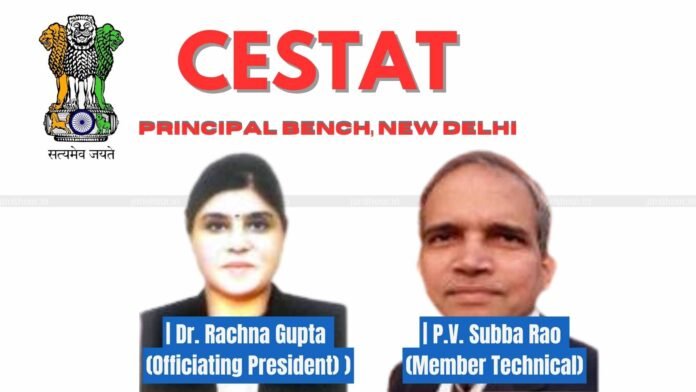
The New Delhi Bench of the Customs, Excise and Service Tax Appellate Tribunal (CESTAT) has held that the dispute involves factual verification requiring reconciliation between figures disclosed in the balance sheets and those reported in ST-3 returns.
The Bench of Dr. Rachna Gupta (Judicial Member) and P.V. Subba Rao (Technical Member) has remanded the matter to the adjudicating authority for fresh consideration after granting the assessee an adequate opportunity to produce documentary evidence.
The assessee/appellant company was engaged in providing residential construction services and was registered under the service tax law during the period 2013 to 2017. Acting on intelligence, the Anti-Evasion Branch of the department initiated an investigation and obtained the company’s balance sheets and ST-3 returns. The department repeatedly sought party-wise income details and other records through letters and summons. However, according to the department, the assessee failed to furnish the required information.
Buy Now: Customs Duty Judgements E-Compilation – June 2026
Consequently, a show cause notice dated October 30, 2018 was issued demanding Service tax of ₹6,72,71,775; Recovery of CENVAT credit of ₹3,49,15,271; Equal penalty on the company; and ₹1 lakh penalty each on the two directors for allegedly withholding information with an intention to evade service tax.
The principal argument advanced by the assessee was that the service tax demand had been raised solely because of differences between the receipts reflected in the balance sheets and those declared in the ST-3 returns.
The company explained that the two sets of figures were prepared under entirely different legal frameworks. While the balance sheets were prepared in accordance with Accounting Standard AS-7, the ST-3 returns were filed following the Point of Taxation Rules applicable under the Finance Act. Therefore, a mere difference in figures could not automatically establish suppression or short payment of service tax.
Regarding the denial of CENVAT credit, the assessee contended that although it had availed the benefit of Notification No. 26/2012-ST, it had claimed credit only where legally permissible. It argued that the notification prohibited credit only on inputs, whereas there was no restriction on availing CENVAT credit relating to input services.
The appellants further argued that the extended limitation period was wrongly invoked because the company had been regularly registered, filing returns and paying service tax.
The Tribunal identified two core issues requiring adjudication: Whether the service tax demand based on the difference between receipts reflected in the balance sheets and ST-3 returns was sustainable. Whether CENVAT credit had been wrongly availed in violation of Notification No. 26/2012-ST.
On the first issue, the Bench observed that the Commissioner had rejected the assessee’s explanation because supporting documents regarding advances, adjustment of advances and payment of service tax were not produced.
However, the Tribunal noted that ST-3 returns are prepared under the Point of Taxation Rules whereas balance sheets may legitimately follow different accounting standards, making reconciliation necessary before any tax liability could be determined. The Bench held that the assessee should be given an opportunity to produce relevant documents to reconcile the two sets of figures before any demand is confirmed.
With respect to the CENVAT credit dispute, the Tribunal acknowledged the settled legal position that an assessee paying service tax at an abated rate under Notification No. 26/2012-ST cannot avail CENVAT credit on inputs.
However, the appellant maintained that the disputed credit related only to input services, which were not barred under the notification. The Commissioner had rejected this claim because the assessee failed to establish the nexus between the input services and the taxable output services.
The Tribunal held that this issue also involves factual verification and therefore requires fresh examination by the adjudicating authority.
Holding that both issues involve factual disputes requiring verification of documents, the CESTAT set aside the impugned order without expressing any opinion on the merits of the case.
The Tribunal remanded the matter to the Commissioner for fresh adjudication, directing that the appellants be afforded a reasonable opportunity to present all relevant records and evidence before a fresh decision is taken. Consequently, all three appeals were allowed by way of remand.
Membership Required to Access Case Details & Order Copy
To view the complete Case Details and Download Order Copy, you must have an active membership. Please subscribe to continue.

