
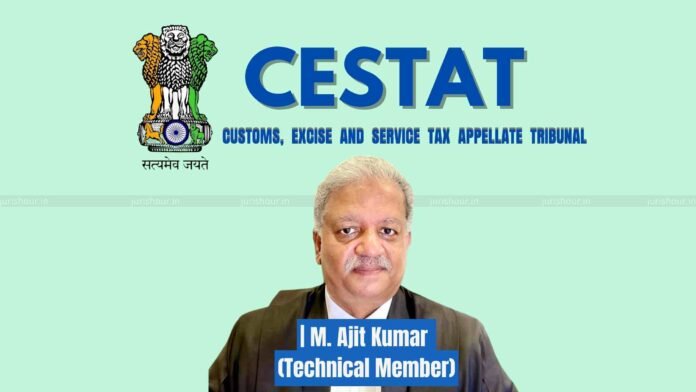
The Chennai Bench of the Customs, Excise & Service Tax Appellate Tribunal (CESTAT) has held that an importer cannot be denied the opportunity to seek reassessment and consequential refund merely because an exemption notification was not claimed at the time of self-assessment of the Bill of Entry.
The bench of M. Ajit Kumar (Technical Member) has directed the Customs department to treat the importer’s earlier representation as a request for amendment under Section 149 of the Customs Act, 1962, and process the reassessment accordingly. The department should avoid adopting a “hyper technical view” and instead function as a “trade facilitator.”
The dispute arose after the importer cleared imported gold jewellery through a Bill of Entry dated 10 May 2013 by classifying the goods under Customs Tariff Heading 71131930 and paying Basic Customs Duty and Special Additional Duty (SAD) at the normal applicable rates. Subsequently, the importer realised that the goods were eligible for concessional SAD benefit under Notification No. 12/2012-CE dated 17 March 2012, which had not been claimed during self-assessment.
The importer approached the Assistant Commissioner seeking reassessment of the Bill of Entry so as to avail the exemption benefit. However, the request was rejected on 6 January 2014 on the ground that the original self-assessment had not been challenged in appeal and therefore could not be reconsidered.
Following this rejection, the importer filed a refund claim of ₹12.61 lakh contending that excess duty had been paid due to inadvertent non-claiming of the exemption notification. The refund claim was rejected by the original authority on procedural grounds, including non-submission of certain documents such as the duplicate Bill of Entry, Chartered Accountant certificate regarding unjust enrichment, and Central Excise certificate regarding CENVAT credit.
The Commissioner (Appeals) later rejected the appeal on the ground of limitation, resulting in the matter reaching the Tribunal.
Before the Tribunal, the importer argued that the reliance placed by Customs authorities on the Supreme Court judgment in Priya Blue Industries Judgment was misplaced because the present case involved self-assessment without any speaking or appealable assessment order. The importer contended that under Section 17(4) of the Customs Act, the proper officer has power to reassess duty where self-assessment is found to be incorrect, including cases where an exemption notification was inadvertently not claimed.
The importer also relied on the Supreme Court decision in ITC Ltd. Judgment, as well as various High Court and Tribunal decisions recognising that errors in self-assessment can be corrected through statutory provisions such as Sections 149 and 154 of the Customs Act.
The Revenue, on the other hand, argued that no refund could be granted unless the Bill of Entry was first reassessed through appellate proceedings. It further contended that refund authorities could not sit in appeal over a valid assessment order.
After considering the rival submissions, the Tribunal noted that the importer had acted with due diligence and good faith in pursuing the claim, even though the department considered the adopted procedure to be improper.
The Tribunal extensively relied on earlier judicial precedents, including decisions of the Telangana High Court and Madras High Court, which recognised that amendment of Bills of Entry under Section 149 is one of the legally permissible mechanisms for altering assessments.
Referring to the Madras High Court judgment in Neyveli Lignite Corporation India Limited, the Tribunal reiterated that Sections 149 and 154 provide statutory machinery for correcting assessments and operate alongside the appellate remedy under Section 128.
The Tribunal ultimately set aside the impugned order and directed that the importer’s earlier letter dated 23 September 2013 be treated as a request for amendment of the Bill of Entry under Section 149 of the Customs Act. It further directed the jurisdictional Assistant Commissioner to process the request based on documentary evidence available at the time of clearance of goods.
Importantly, the Tribunal observed that considering the long lapse of time, the department should not adopt a hyper-technical approach but instead act as a trade facilitator. It directed the authority to follow principles of natural justice and complete the entire exercise within ninety days.
The appeal was accordingly disposed of in favour of the importer.
Case Details
Case Title: Nathella Sampath Jewellery Pvt. Ltd. Versus Commissioner of Customs
Citation: JURISHOUR-1133-CES-2026(CHE)
Case No.: Customs Appeal No. 41563 of 2016
Date: 05.05.2026
Counsel For Appellant: Ieswarya, Advocate
Counsel For Respondent: O.M. Reena, Authorised Representative

