
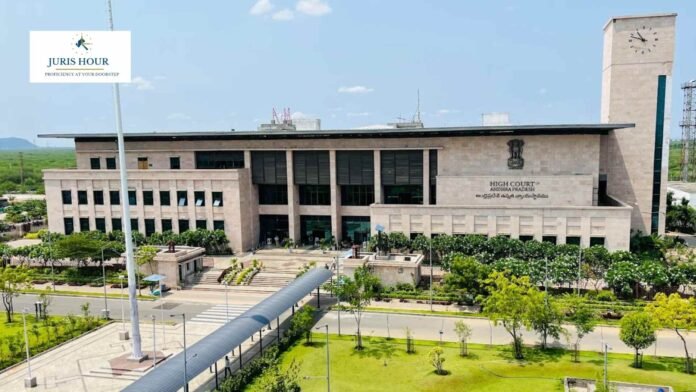
The Andhra Pradesh High Court has held that a GST assessment order issued without the signature of the Assessing Officer is legally invalid and cannot be sustained in law. While setting aside the assessment order, the Court remanded the matter for fresh adjudication after granting the taxpayer an opportunity of hearing, subject to the condition that 20% of the disputed tax is deposited within six weeks.
A Division Bench comprising Justice R. Raghunandan Rao and Justice T.C.D. Sekhar passed the order while deciding a writ petition challenging a GST assessment order issued in Form GST DRC-07 for the financial year 2022-23.
The dispute arose over the GST rate applicable to works contract services executed for a State Government department. The taxpayer argued that the authorities had incorrectly levied GST at 18% on works contracts, whereas Notification No. 24/2017-Central Tax (Rate) prescribed a concessional rate of 12% for such contracts until the benefit was withdrawn through Notification No. 3/2022-Central Tax (Rate), effective from July 18, 2022. The petition also alleged that interest and penalty were imposed without giving credit for the tax deducted at source (TDS), rendering the proceedings illegal.
Buy Now: GST Judgements E-Compilation – June 2026
The taxpayer contended that the assessment order was not signed by the Assessing Officer and was therefore void. The petitioner also challenged the consequential recovery proceedings initiated through Form GST DRC-16.
The High Court observed that the issue was no longer res integra. It referred to its earlier decisions where it had consistently held that an assessment order lacking the signature of the Assessing Officer is invalid.
The Bench relied upon its earlier judgments in A.V. Bhanoji Row v. Assistant Commissioner (ST), SRK Enterprises v. Assistant Commissioner, and SRS Traders v. Assistant Commissioner ST, wherein it was held that the requirement of signature on an assessment order is mandatory and cannot be dispensed with. The Court also clarified that Sections 160 and 169 of the Central Goods and Services Tax Act, 2017, which deal with procedural irregularities and service of notices, cannot cure such a fundamental defect.
The State opposed the writ petition on the ground that the taxpayer had approached the Court after an inordinate delay.
The taxpayer explained that the assessment order had never been served through conventional means and that the department claimed service merely by uploading the order on the GST portal. According to the petitioner, the order had never come to its knowledge in time.
The Government Pleader argued that Section 169(1)(d) of the CGST Act recognizes uploading of orders on the GST portal as a valid mode of service and therefore the taxpayer was deemed to have been served.
While examining the issue, the High Court noted that numerous registered taxpayers have approached courts claiming that they could not access orders uploaded on the GST portal due to lack of awareness or because authorized representatives failed to inform them.
The Bench acknowledged that, ordinarily, ignorance of law or inability to access the portal would not justify condonation of delay. However, it also recognized the practical challenges faced by taxpayers after the introduction of the GST regime and the complete shift to an online compliance system.
The Court referred to differing judicial opinions on whether uploading an order on the GST portal alone constitutes sufficient service and observed that such issues continue to create hardship for taxpayers.
Balancing the interests of taxpayers and tax administration, the High Court held that where an assessment order suffers from a patent legal defect, delayed writ petitions may still be entertained, provided the taxpayer deposits 20% of the disputed tax.
Accordingly, the Court set aside the unsigned assessment order and remanded the matter to the Assessing Officer for fresh adjudication after providing the petitioner a reasonable opportunity of hearing. The Court directed that the taxpayer must deposit 20% of the disputed tax within six weeks, while clarifying that any payments already made after the assessment order would be adjusted towards this requirement.
The Bench further directed that the period between the filing of the writ petition and the receipt of the High Court’s order by the Assessing Officer shall be excluded while computing limitation. It also clarified that all legal and factual issues remain open for consideration during the fresh assessment proceedings.
Membership Required to Access Case Details & Order Copy
To view the complete Case Details and Download Order Copy, you must have an active membership. Please subscribe to continue.

