
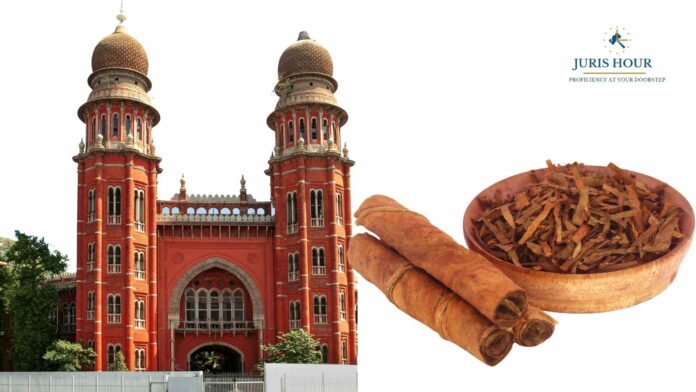
The Madurai Bench of the Madras High Court has set aside a GST order that sought to reclassify a tobacco product and recover more than ₹1.31 crore in compensation cess, holding that the activity undertaken by the assessee did not amount to “manufacture” under the GST law.
The bench of Justice G.R. Swaminathan ruled that merely sprinkling jaggery water on tobacco leaves and processing them without adding flavours or other substances does not result in the emergence of a new product with a distinct character or use.
The petitioner/assessee, a registered partnership firm engaged in the tobacco business, had classified its product under HSN 24039990 and paid compensation cess at the rate applicable to that classification. According to the firm, the tobacco sold by it had not undergone any manufacturing process that altered the essential character of the raw material.
The GST department disagreed and directed the firm to reclassify the product under HSN 24039910, contending that the product was a manufactured tobacco product attracting a higher compensation cess liability. Consequently, the department passed an order confirming a compensation cess demand of ₹1,31,98,398 along with interest and imposing a penalty of ₹13,19,840.
The impugned order held that the final product manufactured and cleared by the petitioner was correctly classifiable under HSN 2403 99 10 for compensation cess purposes. Based on this classification, the authority confirmed the alleged short payment of cess for the period April 2020 to March 2021 and imposed consequential interest and penalty.
The High Court noted that the very same issue had already been considered by a Division Bench of the Madras High Court in W.A.(MD) No. 746 of 2025. The Division Bench had extensively examined whether tobacco subjected only to cutting, sprinkling of jaggery water, drying and packing could be treated as a manufactured product.
The earlier judgment relied on the landmark decision in Pachiappa Chettiar v. State of Madras (1963), where it was held that such limited processing does not convert raw tobacco into a different commercial commodity. The Division Bench had observed that manufacture requires transformation into a new product having a distinct name, character or use. Mere treatment of tobacco with jaggery water to keep it soft does not satisfy this test.
The Court emphasized that if flavours, fragrances or other ingredients were added, the resulting product could qualify as a manufactured tobacco product. However, where the activity is confined to sprinkling jaggery water and preparing the tobacco for sale without changing its essential nature, the product remains “unmanufactured tobacco.”
Referring to the statutory definition of “manufacture” under Section 2(72) of the CGST Act, the Court reiterated that manufacture requires processing that results in the emergence of a new product having a distinct name, character and use. Since the tobacco remained tobacco even after processing and continued to be capable of the same use, no manufacturing activity could be said to have occurred.
The judgment also drew support from the Supreme Court’s decisions in Union of India v. Delhi Cloth and General Mills Co. Ltd. and Crane Betel Nut Powder Works v. CCE. The Supreme Court has consistently held that every change resulting from labour or treatment does not amount to manufacture unless a commercially distinct product emerges.
Applying these principles, the High Court observed that the petitioner’s process was even less extensive than the process examined in Crane Betel Nut Powder Works, where the Supreme Court had still concluded that no new product had come into existence.
The Court further noted that the department had not alleged the addition of any substance other than jaggery water. The petitioner had repeatedly asserted that no other material was added and had even challenged the department to subject the product to laboratory testing. The department, however, did not dispute the factual assertion or conduct such testing.
According to the Court, the controversy was therefore a pure question of law rather than a disputed question of fact. Since the factual position was undisputed and covered by binding precedent, there was no need for remand or further investigation.
Allowing the writ petition, the Madras High Court set aside the impugned GST order and held that so long as the assessee confines its activities to those approved in Pachiappa Chettiar, the product would continue to be classified as unmanufactured tobacco under CETH 2401 20 90. Consequently, the demand of ₹1.31 crore compensation cess, interest and penalty could not survive.
Membership Required to Access Case Details & Order Copy
To view the complete Case Details and Download Order Copy, you must have an active membership. Please subscribe to continue.

