
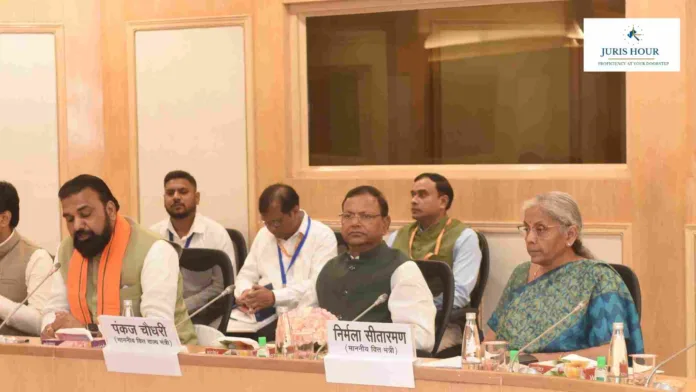
Union Minister for Finance and Corporate Affairs Nirmala Sitharaman chaired a crucial meeting of the Group of Ministers (GoMs) constituted by the GST Council on Compensation Cess, Health & Life Insurance, and Rate Rationalisation at Vigyan Bhawan, New Delhi.
The meeting was attended by Union Minister of State for Finance, the Chief Minister of Goa, the Deputy Chief Minister of Bihar, and finance ministers representing states in the three GoMs.
Addressing the gathering, Sitharaman underlined that the proposals of the Central Government are designed to usher in the “next generation of GST reforms” as part of India’s larger vision of becoming Atmanirbhar Bharat.
Three Pillars of GST Reforms
The Finance Minister laid out the reforms on three key pillars:
1. Structural Reforms
- Correction of inverted duty structures to reduce accumulation of input tax credit.
- Resolution of classification issues to simplify compliance and minimise disputes.
- Ensuring stability and predictability in GST policy, enabling businesses to plan long-term with confidence.
2. Rate Rationalisation
- Streamlining of tax rates to ease the burden on the common man, farmers, the middle class, and MSMEs.
- Simplification of the tax regime with transparency and growth orientation.
- Greater affordability of essential and aspirational goods to stimulate consumption and make them accessible to a wider population.
3. Ease of Living & Doing Business
- Introduction of seamless, tech-driven and time-bound GST registration.
- Deployment of pre-filled returns to reduce errors, mismatches and compliance burden.
- Faster, automated refunds to improve liquidity for businesses.
Sitharaman highlighted that these reforms will not only benefit taxpayers and industry but also enhance India’s ease of doing business rankings and strengthen economic resilience.
Cooperative Federalism at the Core
The Finance Minister emphasised the Centre’s commitment to building consensus with states before rolling out the reforms. “The Government remains committed to implementing GST reforms in the spirit of cooperative federalism, with active engagement and support of the states,” she noted.
Officials present at the meeting indicated that the GoMs will deliberate further on the proposals and submit their recommendations to the GST Council in the coming weeks. The Council’s final decision will pave the way for one of the most significant overhauls of GST since its implementation in 2017.
If approved, the reform package could mark a transformative moment in India’s indirect tax system, bringing it closer to the government’s stated objective of making GST simpler, transparent, and more citizen- and business-friendly.

