
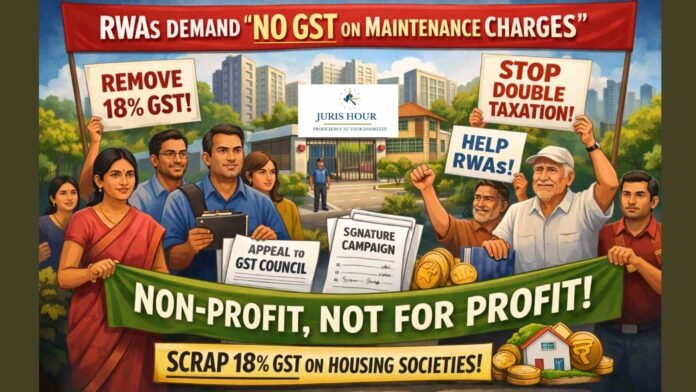
Several Resident Welfare Associations (RWAs) across Hyderabad’s growing residential hubs have stepped up their demand for relief from the 18% Goods and Services Tax (GST) levied on maintenance charges. Prominent bodies such as the Federation of Gated Communities, Cyberabad, the Tellapur Neighbourhood Association, and the United Federation of RWAs (UFRWAs) have jointly submitted a representation to the GST Council in New Delhi, seeking a complete exemption.
Table of Contents
Rising Costs Push RWAs Into GST Net
In their submission, RWAs highlighted that escalating living costs and increasing operational expenses have forced many housing societies to cross the GST applicability threshold. Under current rules, societies with annual collections exceeding ₹20 lakh are required to levy GST on maintenance charges billed to residents.
According to the associations, this threshold is now routinely breached due to inflationary pressures and the scale of modern gated communities, thereby bringing a large number of RWAs under the tax ambit.
“No Profit, No Loss” Bodies Should Not Be Taxed
RWAs have strongly argued that they are non-profit, community-led entities that operate strictly on a “no profit, no loss” basis. Their primary role is to manage essential services such as security, housekeeping, water supply, and upkeep of common infrastructure.
They contend that applying GST to such activities is unjustified, as these are not commercial transactions but collective arrangements among residents to meet shared expenses.
“Residents are essentially pooling their own money for basic services like cleaning and security. Treating this as a taxable commercial activity is not appropriate,” said Sai Ravi Shankar, President of the Federation of Gated Communities, Cyberabad.
Concerns Over Double Taxation
A key concern raised by RWAs is the issue of double taxation. Residents already pay property tax and other statutory levies to local authorities. Imposing GST on maintenance charges, they argue, adds another layer of financial burden without offering any additional service or benefit.
The associations emphasized that maintenance collections should not be classified as revenue but rather as cost-sharing contributions with no embedded profit margin.
Impact on Large Residential Clusters
The issue is particularly significant in rapidly urbanizing areas such as Tellapur and Osmansagar, where large gated communities dominate the residential landscape. RWAs estimate that around 30 such communities, comprising nearly 25,000 housing units, exist in these regions alone. Of these, nearly 40% are already paying GST on maintenance charges.
With more societies expected to cross the threshold in the coming years, RWAs fear the financial strain on middle-class households will intensify.
Campaign Gains Momentum
To strengthen their case, several RWAs have also initiated a signature campaign opposing the GST levy. The campaign has already garnered around 10,000 signatures, with organizers aiming to reach 50,000 in the coming weeks.
In addition, representatives from these associations are planning to meet officials from the Union Ministry of Finance and GST authorities to push for policy changes.
Call for Policy Reconsideration
RWAs have urged the government to recognize maintenance charges as non-commercial, cost-sharing arrangements and exclude them from GST. They believe that such a move would offer meaningful relief to urban residents without significantly impacting government revenues.
As discussions gain traction, the matter is likely to come under consideration in future deliberations of the GST Council, especially amid growing concerns over urban cost of living.

