
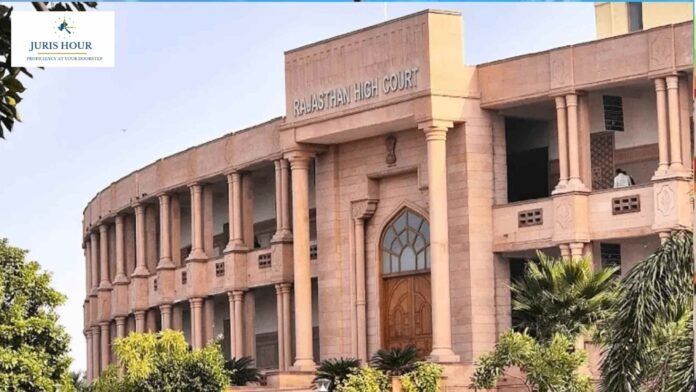
The Rajasthan High Court has partly allowed a writ petition concerning denial of Input Tax Credit (ITC) under Section 16(4) of the Central Goods and Services Tax Act, 2017, directing the competent GST authority to reconsider the taxpayer’s rectification application in light of the subsequently inserted Sections 16(5) and 16(6) and the government’s Circular dated October 15, 2024.
The bench of Justice Pushpendra Singh Bhati and Justice Praveer Bhatnagar quashed the disputed adjudication and rectification orders only to the extent they concerned liability arising under Section 16(4).
The bench of the department was directed to re-examine the taxpayer’s claim strictly under the amended statutory framework and the relevant circular.
Buy Now: E-Magazine: 1000+ Landmark GST Judgments (2017–2026)
The proceedings arose from an Order-in-Original followed by a corrigendum dated January 9, 2024. The taxpayer had approached the High Court seeking to have those proceedings set aside. It also challenged an order dated December 22, 2025 and sought acceptance of its rectification application dated April 3, 2025.
Originally, the petition also raised a constitutional challenge to Section 16(2)(c) of the CGST Act, 2017 and the corresponding provision of the Rajasthan GST Act, contending that the provision violated Articles 14, 19 and 300-A of the Constitution.
However, that aspect of the litigation did not survive by the time the High Court considered the case.
The petitioner informed the Bench that, following the Supreme Court’s subsequent judgment in Bhandari Scrap Traders v. Union of India & Ors., decided on July 24, 2026, the challenge to the constitutional validity of Section 16(2)(c) was no longer being pressed.
According to the High Court’s order, the Supreme Court had not accepted the constitutional challenge to Section 16(2)(c). Consequently, the petitioner restricted its case before the Rajasthan High Court to a narrower question concerning rectification of liability arising under Section 16(4).
The High Court subsequently recorded that the Supreme Court had upheld the view that no ground had been made out either to declare Section 16(2)(c) unconstitutional or to read down the provision, and that the special leave petitions had accordingly been dismissed.
Accordingly, the Division Bench made it clear that the constitutional validity of Section 16(2)(c) did not require examination in the present proceedings.
The central surviving controversy was whether the liability earlier imposed with reference to Section 16(4) needed to be revisited following the subsequent insertion of sub-sections (5) and (6) into Section 16.
The petitioner argued that the October 31, 2023 Order-in-Original had imposed liability, among other grounds, with reference to Section 16(4). In view of the subsequent statutory changes, it contended that the portion of liability specifically attributable to Section 16(4) required reconsideration under the amended legal framework and the Circular dated October 15, 2024.
The taxpayer’s case was therefore not directed against the entire original adjudication at this stage. Rather, it sought segregation and reconsideration of the component of liability attributable to Section 16(4).
This distinction assumed significance because the same Order-in-Original had dealt with liabilities under other provisions as well, including Section 16(2)(c).
The assessee submitted that although liability under Section 16(4) formed part of the same adjudication order that also dealt with Section 16(2)(c), the rectification claim concerning Section 16(4) should have been separately examined.
The taxpayer relied upon the October 15, 2024 circular, which, as recorded by the High Court, clarifies implementation of the provisions contained in Sections 16(5) and 16(6).
The assessee expressly clarified that no relief was being sought concerning liability arising under Section 16(2)(c). Its constitutional challenge to that provision was abandoned, leaving only the rectification of Section 16(4) liability for consideration.
The tax department did not oppose sending the matter back to the competent authority for the limited purpose of considering rectification of liability arising under Section 16(4).
The department submitted that any such rectification should be considered strictly in accordance with law and the Circular dated October 15, 2024.
The Bench took note of this stand while deciding that the surviving issue could appropriately be reconsidered administratively.
The Division Bench held that, following the changed legal position and the limited submissions made by the petitioner, the only issue remaining for consideration was the claim for rectification of liability arising under Section 16(4).
The Court observed that this claim had to be examined in terms of the subsequent statutory provisions and the Circular dated October 15, 2024. Since the respondents did not oppose the limited remand, the Court found it appropriate to leave the matter for reconsideration by the competent authority within that statutory and administrative framework.
The High Court did not set aside the entire GST adjudication.
The High Court consequently directed the competent authority to reconsider the taxpayer’s rectification application dated April 3, 2025, but only to the specified extent.
The authority must examine the claim for rectification of Section 16(4) liability strictly in accordance with Sections 16(5) and 16(6) and the Circular dated October 15, 2024.
All pending applications in the writ proceedings were disposed of.
Membership Required to Access Case Details & Order Copy
To view the complete Case Details and Download Order Copy, you must have an active membership. Please subscribe to continue.
Read More: Mere Misclassification of Eligible ITC Across IGST, CGST, SGST Heads Can’t Sustain Tax Demand: GSTAT

