
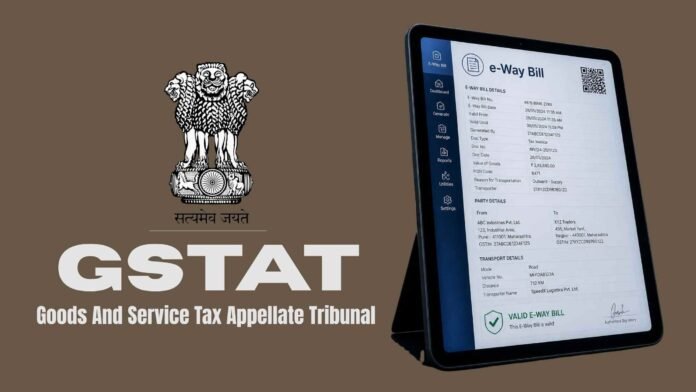
The GST Appellate Tribunal (GSTAT), Lucknow Bench has held that procedural e-way bill lapse alone cannot justify penalty where genuine transaction and absence of tax evasion are established.
The bench of Santosh Kumar Shrivastava (Judicial Member) and Arvind Kumar (Technical Member) allowed an appeal concerning a penalty imposed for movement of motorcycles without an E-Way Bill at the time of interception, holding that a bona fide procedural lapse, in the absence of any material indicating an intention to evade tax, cannot by itself sustain a penalty under Section 129(3) of the Central Goods and Services Tax Act, 2017 and the corresponding provisions of the Uttar Pradesh GST Act.
The bench set aside the penalty of Rs. 2,63,330 and directed refund of the amount deposited, subject to verification of payment and statutory requirements. The order was pronounced on August 19, 2026.
Buy Now: 130 GST Judgments – E-Magazine July 2026
The proceedings arose from the interception of a vehicle carrying motorcycles and spare parts by the Mobile Squad, State Tax, Gonda. The appellant was a registered proprietorship concern engaged in the purchase and sale of motorcycles and spare parts.
According to the Tribunal’s order, the vehicle bearing registration number UP32 DN 2873 was intercepted on January 20, 2025, at approximately 7:25 A.M. The vehicle was carrying motorcycles covered by tax invoices. At the precise time of interception, however, an E-Way Bill had not yet been generated.
The E-Way Bill was subsequently generated at approximately 7:34 A.M.—about nine minutes after interception—and was produced before the inspecting authority. The appellant maintained that the goods were supported by genuine tax invoices and other transaction records and that the delay in generation of the E-Way Bill was a bona fide procedural error rather than an attempt to transport unaccounted goods or evade GST.
Proceedings were initiated under Section 129 of the CGST/UPGST Acts. The Proper Officer imposed a penalty of ₹2,63,330, comprising CGST of ₹1,31,665 and SGST of ₹1,31,665.
The appellant challenged the penalty before the First Appellate Authority. However, the appeal was dismissed and the penalty was confirmed. The taxpayer thereafter approached the GSTAT seeking setting aside of the orders and refund of the amount deposited pursuant to the penalty proceedings.
The principal issue before the Tribunal was whether the mere absence of an E-Way Bill at the precise moment of interception, when the document was generated only about nine minutes later and the underlying transaction was otherwise genuine and fully traceable, could justify imposition of penalty under Section 129.
The Tribunal noted that movement of goods without an E-Way Bill constitutes a procedural violation because Rule 138(1) mandates generation of the document in the prescribed circumstances. At the same time, the Tribunal examined whether the particular lapse in the present case demonstrated any intention to evade tax.
The distinction between a technical or procedural violation and conduct actually indicating tax evasion became central to the Tribunal’s determination.
Before the Tribunal, the appellant argued that the motorcycles were covered by genuine purchase and sale invoices and that the transaction was between registered dealers.
It was further submitted that the motorcycles were highly identifiable goods because they carried engine and chassis numbers and were also subject to registration with the Regional Transport Office. According to the appellant, these circumstances made the movement and ownership of the goods readily traceable.
The appellant also relied upon purchase invoices, tax invoices, challans, ledgers and bank statements to establish the genuineness of the transaction. It argued that there was no excess quantity, undervaluation, wrong classification, fake consignee, suppression of transaction or movement of unaccounted goods.
Most importantly, the appellant highlighted the extremely short interval between interception and generation of the E-Way Bill. The document was generated at approximately 7:34 A.M., only around nine minutes after the vehicle was intercepted at 7:25 A.M.
The appellant therefore contended that the lapse was attributable to a bona fide human error and could not reasonably be treated as evidence of an intention to evade tax.
The appellant relied upon several decisions of the Allahabad High Court dealing with E-Way Bill lapses and the requirement of circumstances indicating tax evasion before severe penal consequences are imposed.
In M/s Uttam Electric Store v. State of U.P. & 2 Others, decided on July 26, 2024, the Allahabad High Court was cited as having recognised that where an E-Way Bill lapse is attributable to a bona fide human error and there is no material indication of tax evasion, proceedings under Section 129 cannot be sustained mechanically.
The appellant also relied upon M/s Osr Creation v. State of U.P. & 2 Others, decided on January 27, 2025, where the effect of an E-Way Bill lapse was considered in light of the factual circumstances, particularly where the requisite document was subsequently produced.
Another precedent cited was M/s Vishnu Singh v. State of U.P. & Others, decided on February 20, 2025, concerning the relevance of bona fide human error where the surrounding circumstances did not establish tax evasion.
The appellant additionally referred to decisions including Kunal Aluminium Company v. State of Himachal Pradesh, Shyam Sel and Power Ltd. v. State of U.P. and Falguni Steels v. State of U.P., contending that a technical E-Way Bill violation, without the requisite element of intent to evade tax, should not automatically result in a penalty.
The departmental representative opposed the appeal and contended that the appellant admittedly did not possess a valid E-Way Bill at the time the vehicle was intercepted.
According to the department, the statutory requirement had to be complied with at the relevant point in time. The subsequent generation of the E-Way Bill, it was argued, could not retrospectively validate the movement of the goods.
The department also relied upon a judgment referred to in the order of the First Appellate Authority and sought dismissal of the appeal.
After considering the rival submissions and the material on record, the GSTAT acknowledged that the E-Way Bill was generated only after interception. The Tribunal therefore accepted that there had been a procedural lapse on the part of the appellant.
However, the Tribunal did not stop its analysis at the existence of the procedural violation. It examined the surrounding circumstances to determine whether the lapse was connected with an attempt to evade tax.
The Tribunal found that the E-Way Bill was generated within approximately nine minutes of interception and was immediately produced before the authorities. The goods were motorcycles that could be identified through their invoice particulars, engine numbers and chassis numbers and were also subject to RTO registration.
The Tribunal further noted that the transaction was supported by purchase and sale invoices, challans, ledger accounts and bank records. There was no material on record showing discrepancy in quantity, value or classification. Equally, there was no independent material indicating suppression, clandestine movement, undervaluation, fake documentation or unaccounted goods.
The Tribunal’s reasoning effectively distinguished between a failure to comply with an E-Way Bill requirement at the relevant point in time and an actual attempt to evade GST.
While the Tribunal accepted that the E-Way Bill should have been generated before the movement of the goods, it found the factual circumstances insufficient to establish that the taxpayer had deliberately attempted to evade tax.
The timing of the subsequent E-Way Bill generation was particularly significant. The document was generated within approximately nine minutes and was made available to the inspecting authority. In the Tribunal’s assessment, this conduct was inconsistent with a clandestine attempt to move unaccounted goods.
The Tribunal therefore characterised the matter as a bona fide procedural lapse rather than conduct forming part of an attempt to evade tax.
The departmental representative had relied upon a decision in B.M. Computers v. Uttar Pradesh. The GSTAT, however, found that the facts of that case were materially different.
According to the Tribunal, the case cited by the department involved an unfilled Part B of the E-Way Bill and movement of goods for a different destination. In the present case, by contrast, the dispute was confined to the generation of the E-Way Bill after interception.
The Tribunal therefore held that the precedent relied upon by the department did not govern the facts of the present appeal.
The Tribunal set aside the order dated February 4, 2025 passed by the Proper Officer under Section 129(3) of the CGST/UPGST Acts, under which the penalty of ₹2,63,330 had been imposed.
The consequential order passed by the First Appellate Authority, which had confirmed the penalty, was also set aside.
The Tribunal further directed that the amount of ₹2,63,330 deposited by the appellant pursuant to the impugned proceedings be refunded in accordance with law, subject to verification of payment and fulfilment of statutory requirements.
Membership Required to Access Case Details & Order Copy
To view the complete Case Details and Download Order Copy, you must have an active membership. Please subscribe to continue.
Read More: Toll Plaza Data Not Mandatory for ITC Refund: GSTAT

