
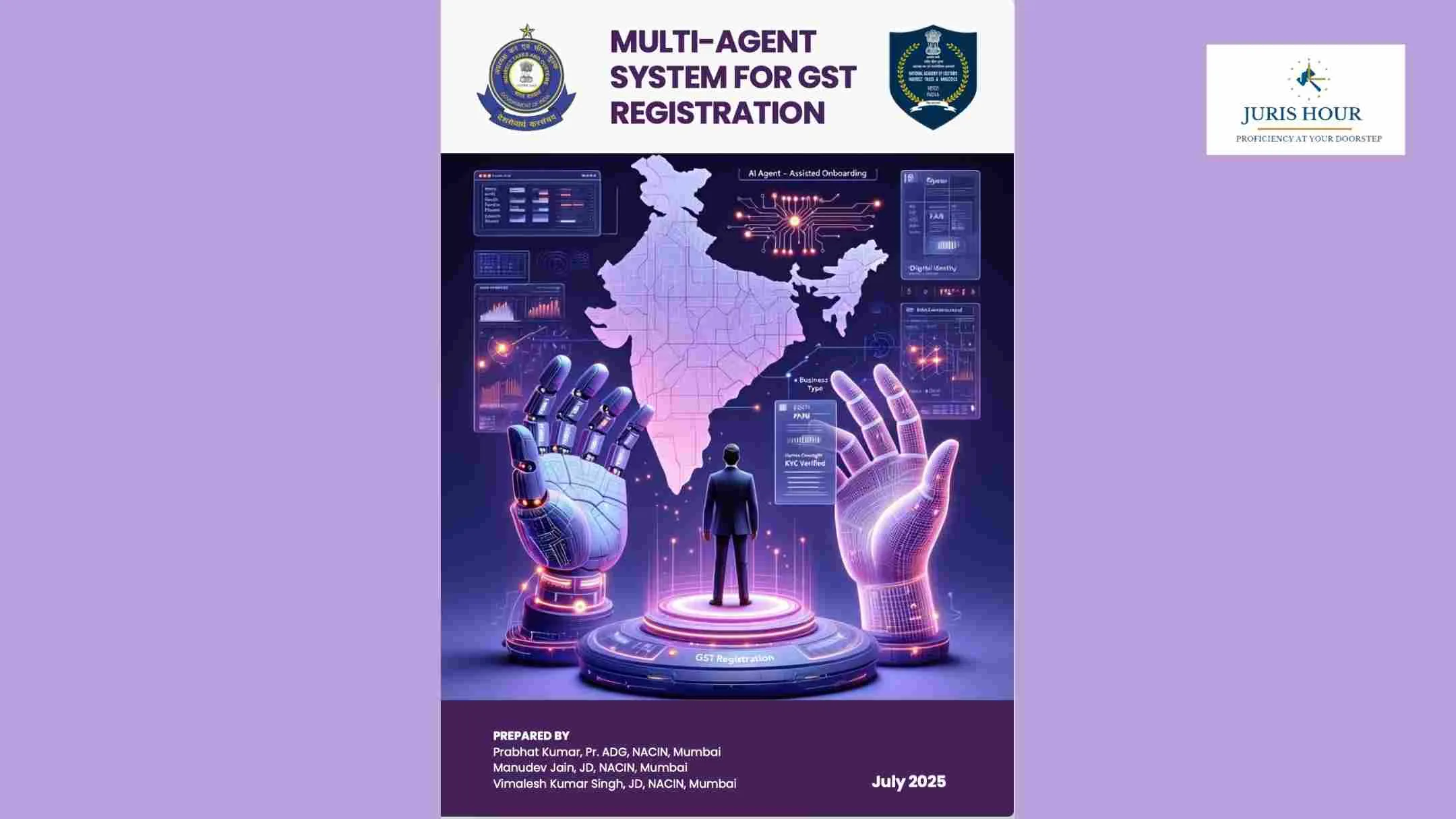
In a major step towards transforming India’s GST registration framework, the National Academy of Customs, Indirect Taxes and Narcotics (NACIN), Mumbai, has unveiled a comprehensive proposal to overhaul the current system using Artificial Intelligence (AI).
Titled “Multi-Agent System for GST Registration,” the report has been authored by Prabhat Kumar, Principal Additional Director General (Pr. ADG), NACIN, Mumbai, along with Joint Directors Manudev Jain and Vimalesh Kumar Singh. The report proposes the deployment of a Multi-Agent System (MAS)-powered Automated Document Authentication System (ADAS) to address rising GST-related fraud and streamline the registration process.
The proposal comes in response to alarming figures for the financial year 2024–25, during which 25,009 fake firms were identified, linked to fraudulent Input Tax Credit (ITC) claims amounting to ₹61,545 crore. The authors point out that the current manual GST registration verification process is time-consuming, error-prone, and lacks standardization across officers. It also suffers from a lack of real-time access to authoritative data sources, which allows fraudsters to exploit the system using non-verifiable mobile numbers, fake utility bills, forged property documents, and stolen identities.
To tackle these vulnerabilities, the proposed ADAS framework utilizes a network of AI-driven autonomous agents, each designed to perform specific tasks within the verification process. These include the Database Management Agent (DMA), which interfaces with external sources such as the NPCI’s Bharat Bill Payment System (BBPS), the Indian Cyber Crime Coordination Centre (I4C), the DIGIT Customs Offence Database, and state property registries to validate utility, telecom, property, and identity information in real-time. The Field Extractor Agent (FEA) uses optical character recognition and natural language processing to extract structured data from uploaded documents, while the Field Matching Agent (FMA) cross-verifies these fields with external databases.
Further strengthening the verification system, the Document Forgery Detection Agent (DFDA) employs deep learning models like Vision Transformers to detect document tampering, and the Signature Verification Agent (SVA) analyzes signature patterns across documents to flag forged or inconsistent signatures. At the heart of the system is the Risk Assessment Agent (RAA), which compiles inputs from all agents to generate a unified risk score and present it through a real-time dashboard, enabling officers to make informed decisions quickly and consistently.
The MAS operates through a secure Model Context Protocol (MCP), ensuring seamless, standardized communication between all agents and enabling real-time collaboration. This digital ecosystem is designed to replace the current reactive, officer-dependent model with an automated, proactive, and data-driven verification pipeline.
To implement this vision, the report outlines a phased roadmap involving API integration with trusted databases, deployment of AI pipelines for document analysis, and establishment of a GPU-enabled national compute infrastructure. The authors emphasize the need for a dedicated task force comprising AI engineers, GST experts, and system architects to oversee deployment, governance, and training.
Concluding the report, Prabhat Kumar highlights that the ADAS system represents a paradigm shift in India’s digital governance model. By enabling cross-verification from trusted data sources and automating the detection of fraud indicators, the system aligns with the objectives of the Government’s Digital India mission. The MAS-based system not only promises to protect government revenue but also paves the way for a scalable, transparent, and tamper-resistant model that can be replicated across various public-sector platforms.
The NACIN report makes it clear that the future of GST registration lies in intelligent automation and inter-agency collaboration—tools that are not just optional enhancements but necessary components for building fraud-proof, next-generation governance infrastructure.

