
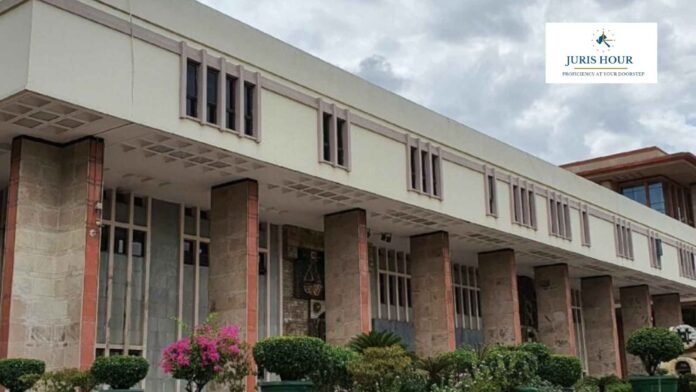
The Delhi High Court has held that the existence of earlier State GST proceedings concerning Input Tax Credit (ITC) does not, by itself, establish that subsequent Central GST proceedings relate to the “same subject matter” under Section 6(2)(b) of the Central Goods and Services Tax Act, 2017 (CGST Act).
The Bench of Justice Anil Khetarpal and Justice Shail Jain considered the validity of a consolidated Show Cause Notice (SCN) covering multiple financial years and held that merely covering more than one financial year does not, by itself, render such a notice without jurisdiction.
BUY NOW: 500+ CGST Notifications (2017–2025) | Clickable Index E-Magazine | Hyperlinked Original PDFs
The appellant/assessee is engaged in the export of readymade garments and has been registered under GST since July 1, 2017.
According to the judgment, DGGI and the Directorate General of Revenue Intelligence (DRI) had jointly developed intelligence regarding alleged fraudulent availment of ITC on invoices issued by non-existent and fictitious entities. The alleged ITC was stated to have been utilised towards payment of IGST on exports, followed by consequential availment of IGST refunds.
Searches were conducted at the relevant premises on September 11, 2019 and October 18, 2019, and statements of a director of the company were recorded under Section 70 of the CGST Act.
Before the DGGI proceedings culminated, the State GST authorities had already initiated proceedings against the taxpayer.
A Show Cause Notice dated September 23, 2023 was issued under Section 73 of the Delhi Goods and Services Tax Act, 2017 (DGST Act) for FY 2017-18, alleging availment of ineligible ITC from cancelled or non-existent suppliers. The proceedings resulted in an order dated December 22, 2023 confirming demand along with interest and penalty.
A second SCN dated December 11, 2023 was issued under Section 73 of the DGST Act for FY 2018-19 concerning alleged wrongful availment of ITC. This proceeding culminated in an order dated April 9, 2024 confirming demand, interest and penalty.
The DGGI issued an SCN dated July 29, 2024 under Section 74 of the CGST Act.
The notice covered the period from FY 2017-18 (July onwards) to FY 2019-20 and proposed recovery of ITC amounting to ₹7,81,78,980, comprising: IGST – ₹4,46,05,885, CGST – ₹1,67,86,547, and SGST – ₹1,67,86,547.
The notice also proposed applicable interest and penalties.
The petitioner subsequently sought clear and legible copies of the relied-upon documents as well as non-relied-upon documents. A corrigendum to the SCN was issued on December 23, 2024.
The order confirmed the demand of ₹7,81,78,980 under Section 74(9) of the CGST Act, read with the relevant provisions of the DGST Act and IGST Act, along with applicable interest.
The adjudicating authority also imposed substantial penalties, including a penalty of ₹7,81,78,980 concerning the alleged fraudulent availment and utilisation of ITC and another penalty of ₹6,51,63,242 concerning alleged fraudulent availment of IGST refund.
The principal argument raised by the assessee was that the DGGI proceedings were barred by Section 6(2)(b) of the CGST Act.
The provision provides that where a proper officer under the State GST or Union Territory GST law has initiated proceedings on a subject matter, proceedings should not subsequently be initiated by a Central GST officer on the same subject matter.
The petitioner argued that State GST authorities had already initiated proceedings concerning wrongful availment of ITC for the period July 2017 to March 2019 and that those proceedings had culminated in orders confirming demand.
According to the petitioner, the subsequent DGGI proceedings substantially concerned the same period and alleged ITC availment and utilisation. It therefore contended that the subsequent Central proceedings were prohibited by Section 6(2)(b).
The petitioner also relied upon DGGI guidelines dated February 8, 2024 and various judicial decisions, including Toyota Kirloskar Motors Pvt. Ltd. v. Union of India, Rajesh Mittal v. Union of India and Aastha Apparels Pvt. Ltd. v. Directorate General of GST Intelligence, to support its argument against parallel proceedings.
The department opposed the writ petition, primarily on the ground that the petitioner had an efficacious alternative statutory remedy of appeal under Section 107 of the CGST Act.
The department pointed out that the original SCN had already culminated in the Order-in-Original dated January 31, 2025. Therefore, according to the respondents, the petitioner should challenge the adjudication order before the competent appellate authority rather than invoke the extraordinary writ jurisdiction of the High Court.
On the merits of Section 6(2)(b), the Revenue argued that the State GST and DGGI proceedings arose in materially different factual and legal circumstances.
The State proceedings concerned specific ITC discrepancies, including alleged ITC availed from cancelled dealers. In contrast, the DGGI investigation concerned alleged fraudulent ITC availment from 20 non-existent suppliers, its utilisation towards IGST liability on exports and consequential IGST refunds.
The department therefore argued that a mere overlap in the broad subject of ITC or financial periods could not establish that the proceedings concerned the same “subject matter”.
The High Court first examined whether it should entertain the writ petition after the proceedings had culminated in an adjudication order.
The Court noted that the statutory scheme provides a remedy of appeal against an Order-in-Original under Section 107 of the CGST Act.
According to the Court, the existence of an efficacious alternative statutory remedy is a material consideration when exercising discretionary jurisdiction under Article 226 of the Constitution.
Importantly, the Court observed that although the writ petition may initially have been filed when the SCN was pending, the situation changed once the adjudicatory proceedings concluded and the Order-in-Original was passed.
The Court relied upon its earlier decision in PEI Industries v. Union of India & Ors., where it had declined to entertain a challenge to an Order-in-Original involving an argument based on Section 6(2)(b), in view of the statutory appellate remedy.
The Court nevertheless examined the petitioner’s Section 6(2)(b) objection.
It noted that Section 6(2)(b) prohibits initiation of Central GST proceedings where State GST proceedings have already been initiated “on a subject matter”, but stressed that the expression “same subject matter” is crucial.
The Court held that the mere fact that two proceedings: concern the same assessee; relate to the same general period; or involve ITC, does not automatically mean that they concern the same subject matter.
The High Court referred to the Supreme Court’s decision in M/s Armour Security (India) Ltd. v. Commissioner, CGST, Delhi East Commissionerate & Anr., 2025 INSC 982.
The Supreme Court had explained that “subject matter” refers to the tax liability, deficiency or obligation arising from a particular contravention that the Department seeks to assess or recover.
The Delhi High Court noted that the statutory bar would be attracted where two proceedings are, in substance, directed towards the same or overlapping tax liability, deficiency or obligation arising from the same contravention.
Conversely, proceedings relating to distinct infractions would not become the same subject matter merely because the tax liability or obligation may be similar.
The Court highlighted the two-fold test laid down by the Supreme Court.
The relevant considerations are:
First, whether an authority has already proceeded against the assessee in respect of an identical tax liability or alleged offence, based on the same facts.
Second, whether the demand or relief sought in the two proceedings is identical.
Applying this framework, the High Court compared the State GST proceedings with the DGGI proceedings.
The Court noted that the State GST SCN dated September 23, 2023 related to FY 2017-18 and alleged availment of ineligible ITC from cancelled or non-existent suppliers.
The subsequent State GST SCN dated December 11, 2023 related to FY 2018-19 and also concerned alleged wrongful availment of ITC.
The DGGI proceedings, however, arose from an investigation into alleged fraudulent ITC availment based on invoices issued by fictitious or non-existent entities and the alleged utilisation of that ITC towards exports and IGST refunds. The DGGI SCN was issued under Section 74 and covered FY 2017-18 (July onwards) to FY 2019-20.
The Court therefore found a distinction in the nature of the allegations forming the foundation of the two proceedings.
It observed that the State proceedings were undertaken under Section 73 concerning alleged ineligible ITC, whereas the DGGI proceedings under Section 74 involved allegations of fraudulent availment and utilisation of ITC based on invoices issued by fictitious/non-existent entities, followed by utilisation towards exports and IGST refunds.
The petitioner had also challenged the DGGI’s decision to issue a single consolidated SCN covering multiple financial years.
The High Court rejected the argument that a multi-year SCN is automatically without jurisdiction.
Relying upon its earlier decision in Ambika Traders through Proprietor Gaurav Gupta v. Additional Commissioner, Adjudication DGGSTI, CGST Delhi North, the Court considered the statutory framework under Sections 73 and 74, including the provisions dealing with determination of tax and limitation.
It concluded that the mere fact that an SCN under Section 74 covers more than one financial year cannot, by itself, render the notice without jurisdiction.
The Court clarified that this does not mean that every aspect of a consolidated SCN covering multiple financial years is automatically valid.
Issues such as: whether the demand for a particular financial year is within the prescribed limitation period; whether the ingredients of Section 74 are satisfied; and whether the demand quantified for individual periods is legally sustainable, remain open for examination in the appropriate statutory proceedings.
The Court ultimately found that the petitioner had not demonstrated a patent jurisdictional infirmity warranting intervention under Article 226 after the proceedings had culminated in an Order-in-Original.
The Court emphasised that determining whether Section 6(2)(b) applies required examination of the precise allegations, liabilities and material underlying both the State and Central proceedings.
Such factual and evidentiary examination, according to the Court, was more appropriately undertaken by the competent appellate authority, particularly because a statutory appeal was available.
The Court distinguished the case from one involving a pure jurisdictional objection raised at the threshold before adjudication had concluded.
The Delhi High Court consequently dismissed the writ petition.
It held that the petitioner has an efficacious statutory remedy of appeal under Section 107 of the CGST Act against the Order-in-Original dated January 31, 2025.
The Court clarified that its observations regarding Section 6(2)(b) and the consolidated SCN were confined to the examination of the writ challenge and would not prevent the petitioner from raising all permissible grounds before the competent appellate authority.
Membership Required to Access Case Details & Order Copy
To view the complete Case Details and Download Order Copy, you must have an active membership. Please subscribe to continue.

