
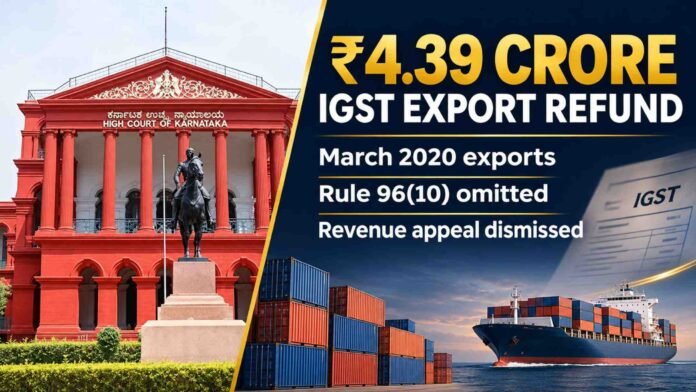
The Karnataka High Court has upheld a direction to grant a refund of ₹4,38,95,926 in Integrated Goods and Services Tax (IGST) paid on exports of finished goods in March 2020.
The bench of Chief Justice Vibhu Bakhru and Justice K.S. Hemalekha dismissed the Revenue’s appeal after applying a Supreme Court ruling that proceedings under Rule 96(10) of the Central Goods and Services Tax (CGST) Rules could not continue after the rule was omitted without a saving clause.
Buy Now: 210+ GST Judgments E-Magazine – October 2026
The Bench condoned the department’s 142-day delay in filing the appeal and then dismissed it on merits.
The Assistant Commissioner of Central Tax, East Division, Bengaluru, rejected the company’s refund application by an order dated 21 July 2025 under Rule 96 of the CGST Rules read with Section 54 of the CGST Act, 2017. The company challenged both the refund rejection and Rule 96(10) before the High Court.
Rule 96(10) had restricted refunds of IGST paid on exports where specified concessional or exemption notifications had been availed. Notification No. 20/2024–Central Tax dated 8 October 2024 omitted the sub-rule. In the writ petition, a Single Judge followed the Karnataka High Court’s earlier ruling in Hikal Limited v. Union of India and directed grant of the refund on 15 December 2025.
The department argued on appeal that the omission operated prospectively and therefore did not affect refund claims for earlier periods. The dispute turned on whether the department could still rely on the omitted provision because the exports took place in March 2020.
During the hearing, the department’s counsel placed the Supreme Court’s decision in Goodluck India Limited v. Union of India, 2026 SCC OnLine SC 1523, before the Bench. The Supreme Court had applied the Constitution Bench decision in Kolhapur Canesugar Works Ltd. v. Union of India, (2000) 2 SCC 536, to hold that pending proceedings under the omitted rule could not continue without a provision preserving them.
The Supreme Court noted that the rule-making authority had included neither a saving clause to preserve proceedings under Rule 96(10) nor a sunset clause to keep the provision alive for a limited period. It also explained that the recommendation for a prospective omission was advisory and did not bind the rule-making authority. The Division Bench applied that reasoning and found no ground to interfere with the refund direction.
Following Goodluck India, the circular clarified that the omission of Rule 96(10) would take effect retrospectively from 23 October 2017 and directed field formations to deal with pending proceedings in line with the Supreme Court judgment.
For exporters with pending disputes over earlier tax periods, the Karnataka ruling shows how that principle applies to a refund rejection. The fact that IGST was paid on exports before 8 October 2024 did not allow the department to sustain this rejection under the omitted Rule 96(10).
Membership Required to Access Case Details & Order Copy
To view the complete Case Details and Download Order Copy, you must have an active membership. Please subscribe to continue.

