
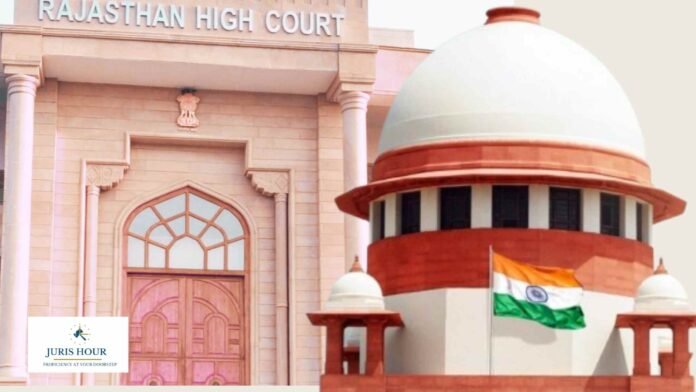
The Supreme Court has taken up the challenge against the Rajasthan High Court’s landmark ruling which held that toll collection rights granted under a Build-Operate-Transfer (BOT) highway concession agreement constitute non-monetary consideration for a taxable works contract under the Goods and Services Tax (GST) regime.
The bench of Justice B.V. Nagarathna and Justice Joymalya Bagchi have issued notice on the Special Leave Petition (SLP) keeping the controversy over GST ability of BOT toll highway projects alive.
The matter assumes significance for infrastructure developers and concessionaires across India as it concerns the GST treatment of BOT (Toll) road projects executed for the National Highways Authority of India (NHAI), where developers recover their investment through toll collection instead of receiving direct monetary payments.
Buy Now: GST Judgements E-Compilation – June 2026
Background: Rajasthan High Court Upheld ₹16.36 Crore GST Demand
The litigation originated from a concession agreement executed between CG Tollway Ltd. and NHAI for six-laning the Kishangarh-Udaipur-Ahmedabad stretch of National Highway-79 under the National Highways Development Programme (NHDP) on a BOT (Toll) basis.
Under the agreement, the concessionaire was responsible for designing, financing, constructing, operating and maintaining the highway before transferring it back to NHAI upon expiry of the concession period. Instead of receiving construction payments from NHAI, the company was granted the exclusive right to collect toll from road users during the concession period.
The construction work itself had been subcontracted to IRB Infrastructure Developers Ltd., while CG Tollway retained the concession rights and operational responsibilities.
Following an internal GST audit, the tax authorities alleged that the concessionaire had failed to discharge GST liability of over ₹16.36 crore. A show cause notice was issued and the adjudicating authority eventually confirmed the demand along with applicable interest and penalty. The appellate authority affirmed the order, leading the company to approach the Rajasthan High Court.
Petitioner’s Case Before the High Court
Before the High Court, CG Tollway argued that no taxable supply had been made to NHAI since the authority had not made any payment for construction services.
According to the petitioner, the only benefit received under the concession agreement was the right to collect toll from road users, which enjoys exemption under Entry 23 of Notification No. 12/2017-Central Tax (Rate). The company also relied upon CBIC Circular No. 150/06/2021-GST to contend that GST was not payable where no annuity payments were received from NHAI.
The petitioner further argued that taxing the transaction would amount to double taxation because GST had already been discharged by the subcontractor, IRB Infrastructure Developers Ltd., on the construction activity. It also cited instances where GST authorities in Gujarat and Karnataka had reportedly dropped similar audit objections.
State’s Stand
The State opposed the writ petition by asserting that the concession agreement represented a taxable supply under Section 7 of the CGST Act.
According to the department, the arrangement was essentially a barter transaction. Instead of monetary consideration, the concessionaire received valuable commercial rights—including the exclusive right to collect toll, operate the highway and enjoy other contractual benefits—in exchange for constructing and maintaining the road.
The State argued that the statutory definition of “consideration” under the CGST Act expressly includes payments made “whether in money or otherwise,” thereby covering non-monetary commercial rights.
Rajasthan High Court’s Findings
The Division Bench of Justice Arun Monga and Justice Sandeep Shah accepted the State’s interpretation after examining the statutory definitions of “consideration,” “works contract” and “supply” under Sections 2(31), 2(119) and Section 7 of the CGST Act.
The Court held that consideration under GST is not confined to cash payments and expressly extends to valuable rights granted under contractual arrangements.
Examining the concession agreement, the Bench observed that NHAI had granted the concessionaire several commercially valuable rights, including:
- Exclusive authority to collect toll from road users.
- Leave and licence over project land.
- Rights to operate and maintain the highway.
- Commercial exploitation of project infrastructure during the concession period.
The Court further observed that these rights constituted valuable non-monetary consideration received in exchange for construction and maintenance services rendered to NHAI.
Rejecting the argument of double taxation, the High Court distinguished between the contract executed between NHAI and CG Tollway Ltd. and the separate subcontract executed with IRB Infrastructure Developers Ltd. Since there was no contractual relationship between NHAI and the subcontractor, the contractor-subcontractor taxation principle did not apply.
Holding that the transaction possessed all the characteristics of a barter arrangement, the High Court concluded that the concessionaire had received commercially valuable rights instead of monetary payment, making the transaction taxable as a works contract service under GST.
Accordingly, the Court upheld the GST demand exceeding ₹16.36 crore along with interest and penalty.
Supreme Court Takes Up the Challenge
The legal position, however, is now set to undergo further judicial scrutiny.
CG Tollway Limited has challenged the Rajasthan High Court’s judgment before the Supreme Court by filing a Special Leave Petition (Civil) No. 22162 of 2026 arising out of the High Court’s judgment dated May 22, 2026.
On 23 June 2026, a Bench comprising Justice B.V. Nagarathna and Justice Joymalya Bagchi considered the matter. After hearing the petitioner’s counsel, the Supreme Court issued notice to the respondents, made the notice returnable on 3 August 2026, and also directed issuance of notice on the petitioner’s interim applications. The Court further permitted the petitioner’s counsel to serve the Central Agency in respect of the Union of India.
Importantly, the Supreme Court’s order is procedural in nature. The Court has not stayed the Rajasthan High Court judgment nor expressed any opinion on the merits of the GST dispute at this stage. The issuance of notice merely signifies that the Supreme Court has found the challenge fit for consideration and will hear the parties before deciding the substantial questions of law involved.
Why the Case Matters
The outcome of the appeal could have significant ramifications for infrastructure developers executing BOT (Toll) projects across the country.
The principal issue before the Supreme Court is whether the right to collect toll under a concession agreement constitutes taxable non-monetary consideration for construction services supplied to NHAI or whether such arrangements fall outside GST because the concessionaire merely exercises an exempt statutory right to collect toll.
The eventual decision is likely to determine the GST treatment of numerous BOT highway concession agreements and clarify the taxability of barter-style infrastructure arrangements where consideration is received in the form of valuable commercial rights rather than direct monetary payments.
Membership Required to Access Case Details & Order Copy
To view the complete Case Details and Download Order Copy, you must have an active membership. Please subscribe to continue.

