
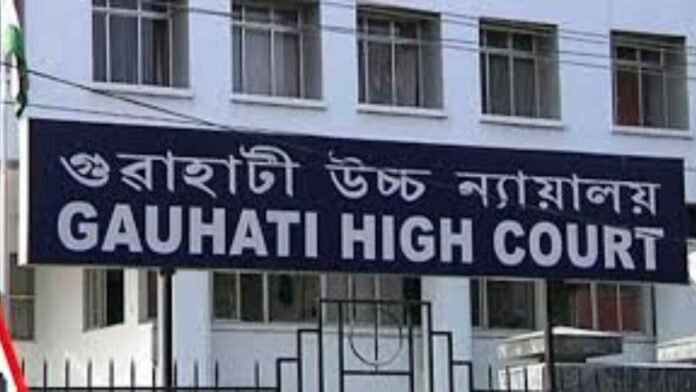
The Gauhati High Court has granted bail to the Director of a construction company who was arrested in connection with alleged wrongful availment of Input Tax Credit (ITC) under the Assam Goods and Services Tax Act, 2017.
The bench of Justice Parthivjyoti Saikia observed that the prosecution case was primarily based on documentary evidence that had already been seized by the investigating authorities and that continued judicial custody would serve no useful purpose.
The applicant had been arrested in a case registered under Section 132(5) of the Assam GST Act, which deals with serious GST offences involving tax evasion and fraudulent availment of tax credit.
The department alleged that the company had wrongfully received and utilized input tax credit on the basis of fabricated tax invoices without actual receipt or supply of goods or services. According to the State Tax Department, the accused knowingly availed fraudulent ITC from non-existent and bogus taxpayers involving approximately ₹88.94 lakh and further availed ineligible ITC amounting to about ₹13.23 crore, causing substantial loss to the government exchequer.
The prosecution claimed that the transactions reflected deliberate tax evasion and warranted arrest under the provisions of the GST law.
The company was engaged in the execution of a National Highways and Infrastructure Development Corporation Limited (NHIDCL) project involving the four-laning of the Jorhat–Jhanji National Highway. For execution of the project, the company had entered into an arrangement with another contractor. Under the agreement, operational support, logistics coordination, and supply of materials were to be provided for carrying out the work.
The company contended that substantial payments were made through banking channels to the contractor and that disputes subsequently arose regarding financial claims, account reconciliation, and release of payments.
A major aspect of the defence revolved around nine e-invoiced works contract invoices reportedly generated in February 2025 having a total value exceeding ₹67.43 crore and involving GST of more than ₹10.28 crore. These invoices were allegedly uploaded in GST returns and reflected in statutory records.
The company argued that the contractor subsequently and unilaterally issued corresponding credit notes without its knowledge or consent. According to the defence, these credit notes were generated through the supplier’s GST registration and return filing mechanism without authorization from the recipient company.
It was further submitted that only one of the nine credit notes was accepted, while the remaining eight were rejected. The company also alleged that the supplier later amended invoices and credit notes in GST records, reducing the taxable value of the invoices to a nominal amount of ₹0.01 per invoice. These actions, according to the company, distorted GST records, affected GSTR-2B data and resulted in artificial negative ITC consequences.
The company claimed to have approached tax authorities seeking intervention and had filed a complaint against the supplier in March 2026, following which inspection and search operations were conducted at the supplier’s premises.
The petitioner received a notice under Section 35(3) of the BNSS requiring his appearance before authorities. The defence stated that he was outside Guwahati on the specified date and could not appear. Subsequently, he was arrested on 28 May 2026 under Section 69 of the Assam GST Act.
Seeking bail, senior counsel for the petitioner argued that the entire prosecution case was founded on documentary records that had already been seized or were electronically available to the authorities. Therefore, further custodial detention was unnecessary.
The High Court noted that the prosecution case rested substantially on documentary evidence and that all relevant records had already been secured by the investigating agency. The Court also observed that the offence under Section 132(5) of the GST Act carries a maximum punishment of five years.
The Court emphasized that the accused had already spent more than fifteen days in custody and held that continued detention would not advance the investigation. Instead, it would adversely affect the petitioner’s business operations.
Accordingly, the Court concluded that the petitioner no longer deserved to remain in judicial custody and allowed the bail application.
The Gauhati High Court directed the release of the petitioner on furnishing a bail bond of ₹25,000 along with one surety of the like amount to the satisfaction of the Chief Judicial Magistrate, Kamrup (Metropolitan), Guwahati. The bail application was accordingly disposed of.
Membership Required to Access Case Details & Order Copy
To view the complete Case Details and Download Order Copy, you must have an active membership. Please subscribe to continue.

