
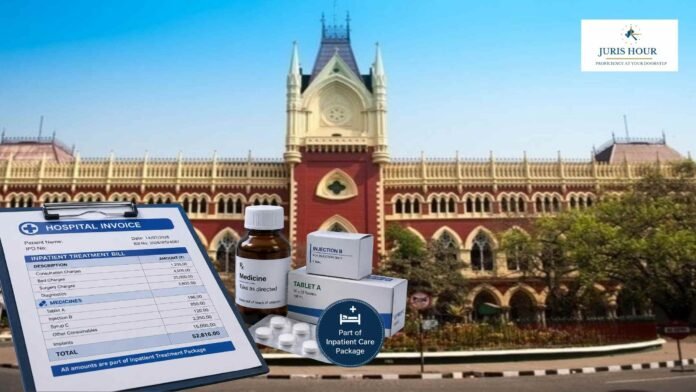
The Calcutta High Court has granted interim protection in a dispute involving the taxation of medicines and consumables supplied to inpatients.
The bench of Justice Smita Das De has restrained the State GST authorities from taking coercive action against the hospital while it examines the legality of invoking Section 76 of the West Bengal GST Act, 2017 on medicines billed at Maximum Retail Price (MRP) as part of exempt healthcare services.
The petitioner/assessee operates a chain of multi-specialty hospitals and is registered under the West Bengal GST Act for providing healthcare services. The hospital challenged an order dated 25 February 2026, passed under Section 76 of the WBGST Act, through which the State GST authorities demanded tax on medicines and consumables supplied to admitted patients.
Buy Now: GST Judgements E-Compilation – June 2026
The hospital explained that, for inpatient treatment, it raises a consolidated bill covering consultation fees, bed charges, surgery, diagnostics, medicines, consumables, implants, and other treatment-related charges. Although medicines are shown separately in the invoice and billed at MRP, they form part of the overall inpatient treatment package, which is claimed to be an exempt healthcare service.
The writ petition raises important questions concerning the interaction between exempt healthcare services and Section 76 of the GST law.
The principal issues include whether Section 76 permits the department to demand GST merely because medicines are billed at MRP, even though healthcare services are exempt and no GST is separately charged from patients. Whether separately mentioning medicines and consumables in an inpatient invoice converts them into an independent taxable supply of goods, or whether they continue to remain part of a composite supply of exempt healthcare services.
Senior counsel appearing for the petitioner argued that inpatient healthcare constitutes a composite supply under Section 2(30) of the GST Act, with healthcare services being the principal supply. Consequently, all ancillary components—including medicines, consumables, room rent, implants and diagnostic services—inherit the exemption available to healthcare services.
The hospital emphasized that it never collected GST separately from patients. According to the petitioner, charging medicines at MRP was merely a commercial policy adopted to maintain uniform pricing and did not amount to collecting GST. Therefore, Section 76—which applies only where tax has actually been collected but not deposited with the Government—could not be invoked.
The petitioner further contended that treating medicines supplied during inpatient treatment as independent taxable sales was contrary to the statutory concept of composite supply under GST.
To support its argument regarding MRP-based billing, the hospital relied upon the Supreme Court’s decision in Deputy Commissioner of Commercial Taxes v. Hindustan Lever Limited.
The Supreme Court had observed that businesses are entitled to adopt uniform retail pricing across India as a matter of commercial policy. According to the petitioner, merely charging a uniform MRP inclusive of taxes does not establish that sales tax or GST has actually been collected from customers. The pricing strategy, it argued, is distinct from the legal question of tax collection.
The petitioner also cited a recent Division Bench judgment in Spanv Medisearch Lifesciences Pvt. Ltd. v. Union of India, where it was held that once healthcare services constitute an exempt composite supply, authorities cannot initiate proceedings merely because medicines were supplied at MRP as part of that composite service.
Additionally, Narayana Hrudayalaya relied upon an order passed by the Additional Commissioner of Central Tax, Mysore Commissionerate, in its own case in October 2025. That order examined whether Section 76 applied to medicines supplied to inpatients and discussed the distinction between medicines forming part of an inseparable treatment package and medicines sold independently.
The State opposed the writ petition primarily on the ground of maintainability, contending that the impugned order was appealable under Section 117 of the GST Act and that the petitioner ought to pursue the statutory appellate remedy.
On merits, the State argued that although healthcare services are exempt under Entry 74 of the relevant exemption notification, the invoices showed medicines being billed separately at MRP. According to the department, the MRP necessarily included the GST component, meaning that tax had effectively been collected from patients. Since Section 76 applies even where the underlying supply is exempt, the department maintained that the demand was legally sustainable.
The court observed that the dispute presents a significant legal conflict between two competing GST principles.
On one hand, inpatient healthcare is claimed to be an exempt composite supply where medicines and consumables are merely incidental to treatment. On the other hand, the tax department contends that separately billing medicines at MRP indicates an independent taxable supply and collection of tax.
Recognising that the matter requires detailed consideration, the Court directed the State to file its affidavit-in-opposition within four weeks, with the petitioner being granted three weeks thereafter to file its reply. The matter has been listed for further hearing on 3 September 2026.
Pending further adjudication, the High Court granted interim protection to the hospital by restraining the State GST authorities from taking any coercive steps or giving effect to the impugned order until the next date of hearing.
Membership Required to Access Case Details & Order Copy
To view the complete Case Details and Download Order Copy, you must have an active membership. Please subscribe to continue.
Read More: Delhi High Court Quashes GST Special Audit, DRC-01 After Dept. Misses Statutory Deadline U/s 73

