
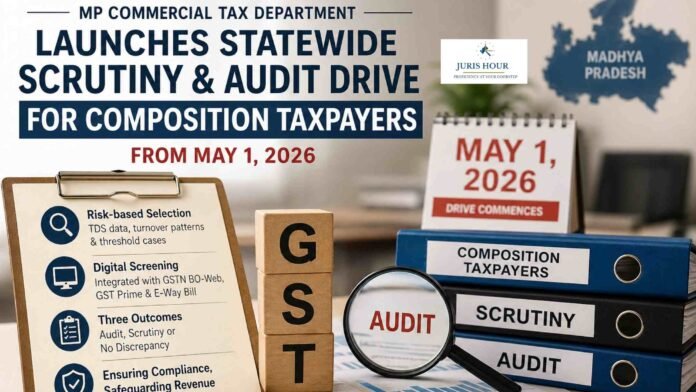
The Office of the Commissioner of Commercial Tax, Madhya Pradesh has issued detailed instructions initiating a statewide scrutiny and audit exercise of composition taxpayers under the GST regime. The drive will commence in a phased manner from May 1, 2026, with the primary objective of ensuring compliance with statutory provisions and safeguarding revenue under the Madhya Pradesh Goods and Services Tax Act, 2017.
Under Section 10 of the GST Act, eligible taxpayers are permitted to opt for the composition scheme subject to prescribed turnover limits. The instructions reiterate that suppliers of goods are eligible up to an aggregate turnover of ₹1.50 crore, while service providers under Section 10(2A) are eligible up to ₹50 lakh. The scheme operates within the framework of Rules 3 to 7 of the MP GST Rules, 2017, which govern conditions, tax payment, and return filing requirements.
The department has adopted a risk-based approach for selecting taxpayers for scrutiny and audit. Taxpayers have been shortlisted based on parameters such as the presence of TDS deductions, turnover levels nearing the eligibility threshold, and turnover patterns over the past three financial years indicating possible discrepancies. This indicates a focused compliance strategy targeting cases where misuse of the composition scheme is more likely.
To streamline the process, a structured digital workflow has been implemented through a departmental portal. Officers are required to log into the “Composition Taxpayer Screening – 2024-25” module, where allocated cases will be displayed. Data must be verified using multiple sources, including GSTN BO-Web, GST Prime, and E-Way Bill systems, before recording findings. Officers are required to enter details such as discrepancy amounts, reasons, and remarks, and once submitted, no further modifications will be allowed, ensuring accountability.
Buy Now: GST Searches: Case Laws In Favour And Against the Department (Updated Till January 2026)
Each case will be categorized into one of three outcomes—selected for audit, selected for scrutiny, or no discrepancy. In cases selected for audit, proceedings will be initiated through issuance of ADT-01, while scrutiny cases will involve issuance of notice in FORM GST ASMT-10. Cases with no discrepancies will be closed on the portal after submission.
During audit and scrutiny, officers have been directed to focus on key compliance areas, including eligibility under the composition scheme, accuracy of declared turnover, reconciliation with TDS data and returns, classification between goods and services, and verification through E-way bill data. Additional checks will include examination of expenses such as electricity, rent, and employee costs to validate turnover declarations, as well as ensuring correct tax payment under the composition scheme.
The department has also set clear performance expectations, mandating that at least 10% of allocated cases be processed every month. Progress and performance will be reviewed on a weekly basis at senior levels to ensure effective implementation of the exercise.
Upon completion of scrutiny or audit, cases may result in withdrawal of composition benefits where violations are detected. Further proceedings under Sections 73, 74, or 74A of the GST Act may also be initiated for recovery of tax, interest, and penalties.
The instructions underline strict accountability, stating that any negligence or laxity in carrying out the exercise will render the concerned officers personally responsible. The SOP thus reflects a strong enforcement stance by the Madhya Pradesh tax department, aimed at tightening oversight and preventing misuse of the composition scheme.

