
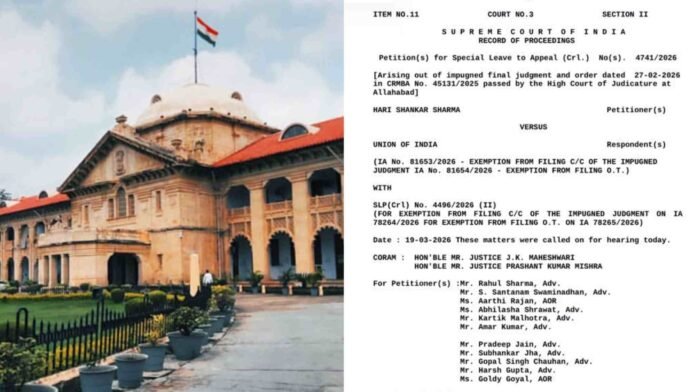
In a striking development raising critical questions on the scope of constitutional remedies in GST arrests, the Allahabad High Court has allowed a habeas corpus petition filed by an accused in a GST Input Tax Credit (ITC) fraud case—despite the fact that his bail had earlier been rejected by the same High Court and a Special Leave Petition (SLP) is pending before the Supreme Court.
The ruling brings into focus a fundamental legal question: Is a writ of habeas corpus maintainable when an accused is already in judicial custody pursuant to a court order?
What is Habeas Corpus?
A writ of habeas corpus is one of the most important constitutional safeguards of personal liberty. It can be invoked immediately when:
- A person is detained illegally or without authority of law,
- Mandatory legal procedures are violated during arrest or detention, or
- A person is held beyond permissible limits of custody.
The purpose of the writ is to secure release from unlawful detention by requiring authorities to justify the legality of custody. It is rooted in Article 21 of the Constitution, ensuring protection against arbitrary deprivation of liberty.
However, traditionally, courts have held that habeas corpus is not maintainable when a person is in judicial custody pursuant to a valid court order, unless such order is shown to be without jurisdiction, mechanical, or patently illegal.
Buy Now: GST Monthly E-Compilation : March 2026
Earlier Bail Rejection in GST ITC Fraud Case
Notably, the same High Court had earlier rejected the bail applications of three accused—Hari Shankar Sharma, Deepak Jain and Sushant Goyal—in connection with a large-scale GST ITC fraud.
A bench led by Justice Samit Gopal had observed that the allegations involve fraudulent availment and circulation of fake ITC through non-existent firms. The offence resulted in substantial loss to the public exchequer, and economic offences form a distinct class requiring a stricter judicial approach.
On these grounds, the Court had refused to grant bail, emphasizing the seriousness of the alleged racket.
Habeas Corpus Petition Filed Despite Judicial Custody
Subsequently, one of the accused approached the High Court by way of a habeas corpus petition challenging his arrest by DGGI authorities, and the remand order passed by the Magistrate under Section 132 of the CGST Act.
Importantly, the petitioner was already in judicial custody pursuant to a remand order, and therefore not detained without authority in the conventional sense. This made the maintainability of habeas corpus a central issue in the case.
Core Allegation: Violation of Arrest Safeguards
The petitioner argued that no “grounds of arrest” were supplied at the time of arrest. Arrest memo and related documents were either incomplete or not furnished. Mandatory safeguards under Section 69 of the CGST Act and Supreme Court judgments were violated.
The department on the other hand, argued that the petitioner was in judicial custody under a valid remand order. Habeas corpus is not maintainable in such circumstances, relying on Gautam Navlakha v. NIA.
High Court’s Key Findings
After examining the record, the Division Bench found serious procedural lapses: “Grounds of arrest” were not properly supplied at the time of arrest and were later produced separately, Arrest memo lacked crucial details such as place of arrest and proper endorsement, “Jama-talashi” memo was incomplete and deficient, and the Magistrate passed the remand order mechanically without verifying compliance of legal safeguards.
The Court held that the violations go to the root of personal liberty and cannot be treated as mere technical defects.
JURIS HOUR’S EXCLUSIVE COVERAGE IN THIS CASE ARE AS FOLLOWS:
Case Details
Case Title: Hari Shankar Sharma Versus DGGI
Case No.: Habeas Corpus Writ Petition 369 of 2026
Date: 21/04/2026

