
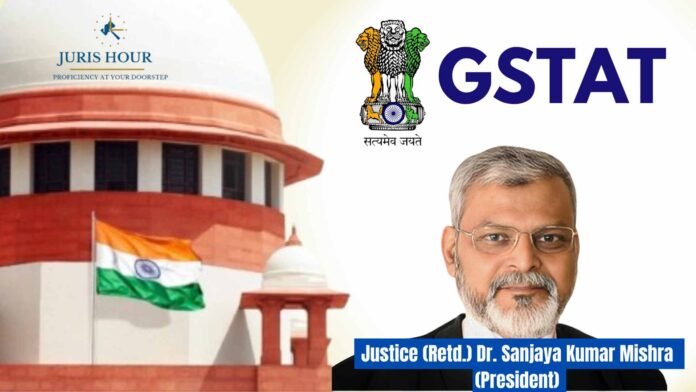
The Supreme Court has directed the President of the Goods and Services Tax Appellate Tribunal (GSTAT) to give priority to a taxpayer’s appeal after noting that, despite its constitution, the Tribunal was not yet fully functional for registering and hearing cases.
The Bench of Justice Ahsanuddin Amanullah and Justice Sheel Nagu disposed of a Special Leave Petition (SLP) while granting liberty to the petitioner to mention the matter before the President of the GSTAT for urgent registration, numbering of the appeal, and consideration of interim relief.
The petitioner had challenged a January 16, 2026 judgment of the Allahabad High Court, which declined to entertain its writ petition on the ground that the GST Appellate Tribunal had been constituted and that the appropriate remedy was to approach the Tribunal under Section 112 of the Central Goods and Services Tax (CGST) Act.
Buy Now: Supreme court Judgements E-Compilation – JUNE 2026
Before the Supreme Court, however, the petitioner argued that although the Tribunal had formally been constituted, it had not become fully operational. According to the latest information available on the Tribunal’s website, appeals were not even being registered or assigned case numbers, making the statutory remedy effectively unavailable.
The Supreme Court acknowledged the concern and observed that the GST Appellate Tribunal had been created to reduce the burden on High Courts by providing a specialised appellate forum for GST disputes. While expressing the expectation that the Tribunal would soon become fully functional, the Bench recognised the practical difficulties faced by litigants during the transition.
Instead of reopening the High Court proceedings, the Court disposed of the SLP with specific directions permitting the petitioner to approach the President of the GSTAT for registration and numbering of the appeal; early listing of the matter; and consideration of any application for interim relief.
The Bench further observed that the Tribunal, being recently constituted, may face a heavy workload. Nevertheless, considering that the matter had already reached the final stage before the High Court, the Court held that the case deserved priority treatment.
Expressing confidence in the Tribunal’s leadership, the Supreme Court stated that it had “no doubt” the President of the GST Appellate Tribunal would take appropriate action if the matter was mentioned for urgent listing.
The Allahabad High Court had originally entertained the writ petition because the GST Appellate Tribunal had not been constituted, leaving taxpayers without an effective appellate remedy. However, after the Central Government notified the Tribunal’s procedural rules, constituted the Tribunal, and appointed its President and Members, the High Court held that the statutory appellate mechanism had become available.
Accordingly, the High Court disposed of the writ petition with liberty to the petitioner to file an appeal before the GSTAT, extending the time for filing until June 30, 2026, and directing that any appeal filed within that period should not be rejected on the ground of limitation. It also directed the Tribunal’s Registry to notify defects, if any, within three weeks, with thirty days granted to cure such defects.
Membership Required to Access Case Details & Order Copy
To view the complete Case Details and Download Order Copy, you must have an active membership. Please subscribe to continue.
Read More: Why Did ICAI Put Its Big 4 Disclosure Rules on Hold?

