
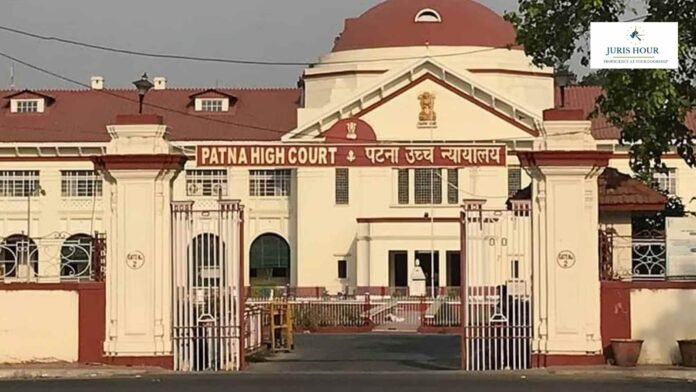
The Patna High Court has held that GST authorities cannot cancel a taxpayer’s registration without providing a meaningful opportunity of personal hearing as mandated under Section 75(4) of the CGST/BGST Act.
Setting aside the cancellation of a contractor’s GST registration, the bench of Justice Rajeev Ranjan Prasad and Justice Sunil Dutta Mishra ruled that the authorities acted in violation of the principles of natural justice by issuing only a show cause notice and proceeding to cancel the registration without fixing the required dates for personal hearing.
The GST department had issued a show cause notice alleging that the petitioner had failed to furnish GST returns for a continuous period of six months. Subsequently, by an order the registration of the petitioner was cancelled. The petitioner later sought revocation of the cancellation, but the application was rejected, and both the first and second appeals were dismissed on the ground of limitation.
Buy Now: GST Judgements E-Compilation – June 2026
Before the High Court, the petitioner explained that the delay in filing returns occurred due to extraordinary personal circumstances. The petition stated that the petitioner’s accountant was suffering from dengue, while the petitioner’s son had been murdered during the relevant period, leaving the proprietor unable to attend to tax compliances.
The petitioner argued that all pending GST returns had already been filed on 14 July 2023 after payment of the applicable late fees. Despite this, the department subsequently issued a show cause notice in the revocation proceedings demanding details of returns and payments, without considering the fact that the returns had already been uploaded on the GST portal.
The Court noted that the respondents failed to specifically deny the petitioner’s assertion that the pending returns had been filed before the revocation proceedings commenced. It observed that this material fact remained substantially uncontroverted in the department’s counter affidavit.
The Bench observed that the petitioner had informed the jurisdictional Superintendent regarding the exceptional circumstances that prevented timely filing of returns, including illness and the tragic death of his son. Despite receiving this communication, the authorities neither examined the GST portal nor considered the petitioner’s explanation before rejecting the revocation request.
The Court held that the authorities proceeded “in utmost haste” without applying their mind to the material already available on record, including the updated returns that had been filed before issuance of the revocation show cause notice.
A central issue before the Court was whether the department had complied with the statutory requirement of granting a personal hearing.
The Bench recorded that, apart from issuing the initial show cause notice, no separate notice granting an opportunity of personal hearing had been issued. It further observed that, under the settled legal position, the authorities are required to fix at least three dates for personal hearing before passing such adverse orders.
Holding that Section 75(4) embodies the principles of natural justice, the Court concluded that the cancellation order and the rejection of the revocation application were liable to be quashed on this ground alone.
The department argued that although the impugned order did not contain a Document Identification Number (DIN), a later CBIC Circular dated 9 June 2025 clarified that communications generated through the GST common portal need only carry a valid Reference Number (RFN).
The High Court rejected this contention. It held that the subsequent circular could not retrospectively validate defects in communications issued at a time when quoting the DIN was mandatory. The Court also noticed that the show cause notice issued during the revocation proceedings did not even disclose the name or designation of the issuing authority, further undermining its legality.
Although the appellate authorities had dismissed the petitioner’s appeals solely on the ground of limitation, the High Court held that such orders could not survive once the foundational cancellation proceedings themselves were found to suffer from jurisdictional errors and violation of natural justice.
The Court observed that wrongful cancellation of GST registration has severe consequences affecting the livelihood and business of a registered taxpayer, warranting interference under the writ jurisdiction.
Allowing the writ petition, the Patna High Court set aside the GST registration cancellation order; the order rejecting the revocation application; the appellate orders dismissing the appeals on limitation; and the consequential orders arising from the cancellation proceedings.
The Court directed the GST authorities to restore the petitioner’s registration forthwith. It further imposed litigation costs of ₹15,000 on the department, observing that the authorities ignored the returns already filed, failed to consider the petitioner’s explanation, and rejected the revocation application without proper application of mind.
Membership Required to Access Case Details & Order Copy
To view the complete Case Details and Download Order Copy, you must have an active membership. Please subscribe to continue.

