
HomeGSTGST Reforms Aim to Keep the Common Man's Plate Affordable and Full

GST Reforms Aim to Keep the Common Man’s Plate Affordable and Full

Published on

🚀 Stay Connected With JurisHour

WhatsApp X Telegram

In a move aimed at curbing food inflation and ensuring nutritional security for all, the Central Board of Indirect Taxes and Customs (CBIC) has reiterated its commitment to keeping essential food items either tax-exempt or under the lowest GST slab of 5%.

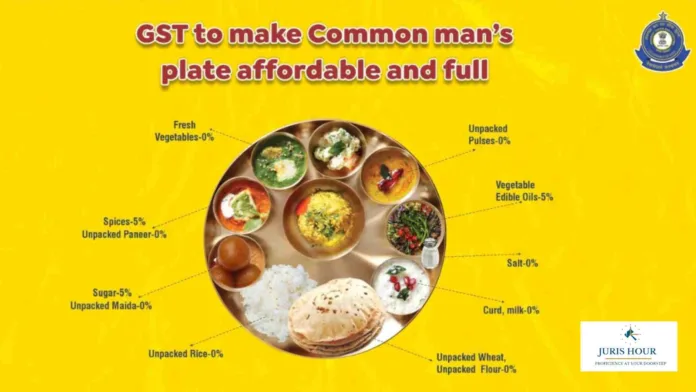
 A recently circulated infographic by tax authorities highlights how the Goods and Services Tax (GST) structure has been designed to make the average Indian meal more affordable.

According to the visual, a majority of food staples—such as fresh vegetables, unpacked pulses, rice, wheat, flour, milk, curd, and salt—remain exempt from GST, ensuring that these everyday essentials do not bear any indirect tax burden. Items like unbranded maida, unbranded besan, milk, eggs, unbranded natural honey, and unpacked paneer are also part of this tax-free bracket.

Meanwhile, a minimal 5% GST is levied only on a limited set of commonly used food items, including sugar, edible oils, roasted coffee beans, tea, skimmed milk powder, and domestic LPG. The same slab applies to packed and branded paneer, milk food for babies, and PDS kerosene.

The initiative, branded as “GST to make Common man’s plate affordable and full”, visually presents a traditional Indian thali, emphasizing how most of its components are not burdened by GST. Authorities underscore that this thoughtful structuring ensures nutritional sustenance for low- and middle-income households without causing additional financial stress.

The Central Board of Indirect Taxes and Customs (CBIC) has spearheaded this awareness campaign to reinforce public understanding that the GST regime is not just a revenue tool but also a facilitator of equitable growth and food accessibility.

As inflation and food security remain pressing concerns globally, India’s GST policy on food offers a model where taxation is balanced with social welfare considerations.

Read More: GSTAT Non-Constitution: Madhya Pradesh High Court Stays Recovery Subject To Payment of Rs. 3.53 Crores

Mariya Paliwala
Mariya Paliwalahttps://www.jurishour.in/
Mariya is the Senior Editor at Juris Hour. She has 7+ years of experience on covering tax litigation stories from the Supreme Court, High Courts and various tribunals including CESTAT, ITAT, NCLAT, NCLT, etc. Mariya graduated from MLSU Law College, Udaipur (Raj.) with B.A.LL.B. and also holds an LL.M. She started her career as a freelance tax reporter in the leading online legal news companies.

Latest articles

Supreme Court Ruling Revives Scrutiny of Pre-2016 Benami Transactions; Retrospective Confiscation Powers Upheld

The Supreme Court has reignited nationwide scrutiny of old benami transactions by holding that...

JURISHOUR | TAX LAW DAILY BULLETIN : 10 May, 2026

Here’s the Tax Law Daily Bulletin for May 10, 2026.GSTSERVICES TO FOREIGN UNIVERSITIES NOT...

Madras HC Waives Requirement Of 10% Pre Deposit Of Penalty And Allow Appeals To Be Filed Without Pre-Deposit

The Madras High Court has waived requirement of 10% pre-deposit of penalty and allow...

DRI Complaint Before Special Court Not Governed By Private Complaint Procedure: Delhi HC

The Delhi High Court has upheld the conviction and 10-year rigorous imprisonment sentence imposed...

More like this

Supreme Court Ruling Revives Scrutiny of Pre-2016 Benami Transactions; Retrospective Confiscation Powers Upheld

The Supreme Court has reignited nationwide scrutiny of old benami transactions by holding that...

JURISHOUR | TAX LAW DAILY BULLETIN : 10 May, 2026

Here’s the Tax Law Daily Bulletin for May 10, 2026.GSTSERVICES TO FOREIGN UNIVERSITIES NOT...

Madras HC Waives Requirement Of 10% Pre Deposit Of Penalty And Allow Appeals To Be Filed Without Pre-Deposit

The Madras High Court has waived requirement of 10% pre-deposit of penalty and allow...