
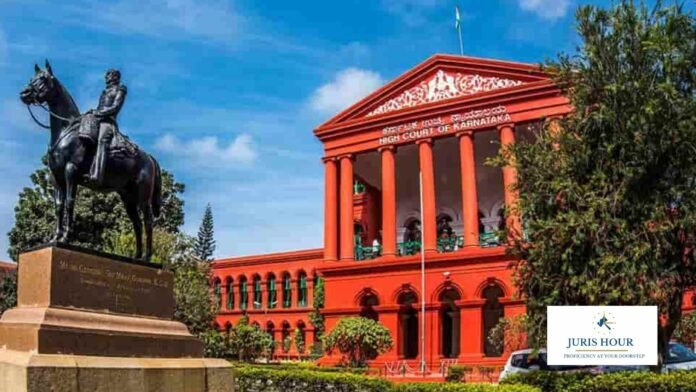
The Karnataka High Court has restored GST adjudication proceedings involving a demand of more than ₹3.83 crore after observing that the tax authority failed to consider the assessee’s contention that its changed registered address had already been updated on the GST portal.
The bench of Justice B.M. Shyam Prasad has observed that the assessee must be given an opportunity to respond to the allegations contained in the show-cause notice and produce documents supporting its claim. The relief was made conditional upon the company depositing 10% of the disputed tax by September 21, 2026.
The Court consequently interfered with the adjudication order dated November 27, 2025, the subsequent rectification order dated March 10, 2026, and the garnishee notice issued in Form GST DRC-13 on July 4, 2026. The proceedings were restored to the Deputy Commissioner of Commercial Taxes for fresh consideration.
Buy Now: 150 + Judgments On GST – E-Compilation For August 2026
The petitioner, a private limited company, was engaged in providing employment and labour supply services as well as management consultancy services. Its services were classified under SAC 998519 and SAC 998311.
GST proceedings were initiated against the company under Section 73 of the Karnataka Goods and Services Tax Act and the Central Goods and Services Tax Act, read with the relevant provisions of the Integrated Goods and Services Tax Act.
An intimation in Form GST DRC-01A was issued on September 12, 2025, followed by a show-cause notice in Form GST DRC-01 on September 23, 2025.
The proceedings concerned three principal allegations. First, the department noticed a difference between the turnover and tax particulars declared in GSTR-9 and GSTR-3B. Second, the company had reported zero-rated turnover but allegedly failed to produce complete books of accounts and supporting records, including Foreign Inward Remittance Certificates or Bank Realisation Certificates. Third, it had declared inward supplies and claimed input tax credit without producing valid supporting documents.
According to the adjudicating authority, the company did not respond to the notices and failed to furnish the books of accounts and records called for during the audit. The authority recorded that reminders and endorsements were issued through the GST portal and were also sent to the registered email address.
In the absence of a response, the proposals contained in the show-cause notice were confirmed through an adjudication order dated November 27, 2025.
The company subsequently filed a rectification application explaining that its operations had declined during the financial years 2023-24 and 2024-25. It claimed that members of its administrative staff had left the organisation without handing over credentials for its old email accounts, as a result of which GST-related emails sent to those accounts were not monitored.
It also argued that the notices and reminders were dispatched to its former address even though it had ceased operations from that location. The company maintained that it had officially updated its new registered address on the GST portal, changing it from Basaveshwara Nagar to K.R. Puram in Bengaluru.
The rectification application was nevertheless rejected. The tax authority held that it was the company’s responsibility to provide and regularly update its email address and other contact particulars. It also observed that the company’s address had remained unchanged and that the intimation, show-cause notice and reminders had been sent to the available address.
Following the rejection of the rectification application, the department issued a garnishee notice in Form GST DRC-13 to the company’s bankers, directing them to hold an amount of ₹3,83,84,857.
The company then approached the Karnataka High Court challenging the original adjudication order, the rectification order and the bank attachment notice.
The company contended that it had voluntarily discharged the liability arising from the alleged input tax credit mismatch through Form GST DRC-03 dated April 12, 2022.
Its counsel argued that the company’s non-participation in the adjudication proceedings was attributable to bona fide reasons and was not deliberate. Because the notices had been sent to its former physical and email addresses, the company was allegedly unaware of the proceedings.
It further submitted that it possessed documents necessary to answer the department’s allegations, including Letters of Undertaking supporting its claim relating to zero-rated supplies. Copies of these documents were furnished to the office of the State’s counsel during the pendency of the writ petition.
The company contended that if the voluntary payment made through DRC-03, the Letters of Undertaking and the other supporting records were examined, there would be no basis for sustaining the tax demand or the consequential interest.
The State’s counsel acknowledged before the Court that the company had produced copies of the Letters of Undertaking in support of its claim concerning zero-rated supplies.
The High Court noted that the adjudicating authority had confirmed the proposals in the show-cause notice essentially because the company failed to produce the required documents despite the opportunities allegedly granted to it.
However, the Court also found that the authority had not considered the company’s specific case that it had uploaded the change of its registered address on the GST portal. The company claimed to have changed its address from Basaveshwara Nagar to K.R. Puram in Bengaluru before the impugned communications were issued.
The Court also took note of the fact that the company had now produced the Letters of Undertaking, claimed to have voluntarily discharged the liability relating to the mismatch and expressed its willingness to submit further records establishing the genuineness of its transactions.
The Court concluded that the company should be granted an opportunity to respond to the propositions contained in the show-cause notice. However, the Court decided that such an opportunity should be granted only upon compliance with specified conditions.
The High Court restored the proceedings to the Deputy Commissioner of Commercial Taxes for fresh consideration.
The restoration was made subject to the company depositing 10% of the tax under dispute by September 21, 2026. The deposit will remain subject to the final outcome of the restored adjudication proceedings.
The Court permitted the company to submit a certified copy of its order along with documents demonstrating the genuineness of the disputed transactions. It was also directed to file a reconciliation explaining the differences identified by the department.
Membership Required to Access Case Details & Order Copy
To view the complete Case Details and Download Order Copy, you must have an active membership. Please subscribe to continue.
Read More: GST ITC Can’t Be Blocked U/R 86A Without Giving Taxpayer an Opportunity: Karnataka High Court

