
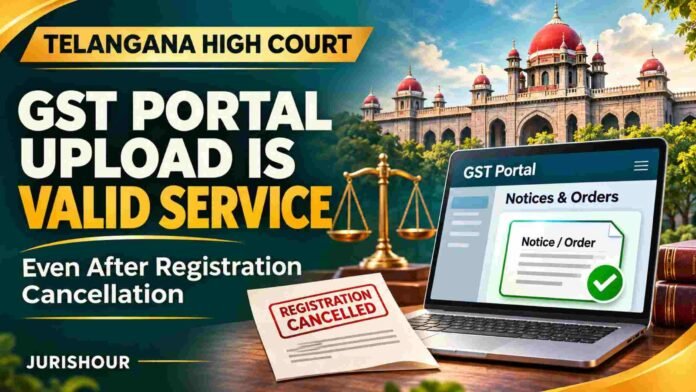
The Telangana High Court has dismissed a petition challenging a GST adjudication order, holding that making notices and orders available on the GST portal is a permissible mode of service under Section 169(1)(d) of the Central Goods and Services Tax Act, 2017.
The bench of Acting Chief Justice P. Sam Koshy and Justice Suddala Chalapathi Rao found that the taxpayer had failed to provide sufficient reasons for its delay in approaching the Court, even after admittedly becoming aware of the impugned orders in September 2025.
Buy Now: 210+ GST Judgments E-Magazine – October 2026
The company challenged Order-in-Original concerning the financial year 2019-20, along with the consequential DRC-07 dated September 3, 2024.
According to the company, the dispute arose from input tax credit claimed in excess of the amounts reflected in returns filed by its suppliers. It maintained that it had paid the tax component mentioned in the purchase invoices.
The company argued that the department had not followed the procedure contemplated under Sections 42(3) and 42(5) of the CGST Act. Its submission was that a mismatch required notice to both the supplier and the recipient, and that recovery from the recipient could follow only if the supplier failed to rectify the mismatch.
It further contended that the department should first have proceeded against the suppliers before taking action against the recipient in relation to Section 16(2)(c). The company relied on the Suncraft Energy litigation and the Madras High Court’s decision in D.Y. Beathel Enterprises.
The High Court did not decide these ITC-related arguments on their merits. Its decision rested on service through the portal and the delay in challenging the orders.
The company stated that it had cancelled its GST registration in 2022 and had furnished an alternate address for receiving official communications in its cancellation application in Form REG-16.
Despite this, it alleged, the department sent physical notice to its old office address, which was no longer in use following closure of the office.
The company maintained that no show-cause notice had been served at the addresses mentioned in its cancellation application. It argued that the failure to communicate at the revised address deprived it of an opportunity to contest the proceedings and violated the principles of natural justice.
It also submitted that, after filing its GST-9C return in December 2023 for FY 2022-23, it was no longer actively monitoring the GST portal.
According to the company, it discovered the impugned order only in September 2025 while checking a show-cause notice relating to a separate transaction. On examining the portal, it found the earlier order under the “Notices and Orders” heading.
The department argued that the notices and impugned orders had been made available through the GST portal, constituting valid service under Section 169(1)(d) of the CGST Act.
It maintained that separate physical service at the revised address was therefore unnecessary.
The department also opposed the petition on the ground of delay, pointing out that the orders had been passed in 2024. It argued that a belated writ petition could not be used to circumvent the statutory remedy.
In support, it relied on the Supreme Court’s decision in Assistant Commissioner (CT), LTU, Kakinada v. Glaxo Smith Kline Consumer Healthcare Ltd.
The High Court held that service of notices and orders through the web portal is permissible under Section 169(1)(d).
Since the impugned orders had been made available on the GST portal in accordance with the statutory procedure, the company could not contend that there had been no service at all.
The Bench also noted the company’s express admission that it had become aware of the orders in September 2025.
Once it acquired knowledge of the orders, the Court reasoned, the company ought to have taken appropriate steps to challenge them without further delay. However, it had not placed sufficient reasons before the Court to explain its delay in seeking relief.
Referring to the Glaxo Smith Kline Consumer Healthcare decision, the Bench recognised that writ jurisdiction may be exercised in appropriate cases involving lack of jurisdiction or violation of natural justice.
However, the availability of an alternative statutory remedy and the delay in approaching the Court remained relevant considerations when deciding whether to entertain a petition.
In the present case, the orders dated back to 2024, and the company admittedly knew of them by September 2025. In the absence of a sufficient explanation for the subsequent delay, the Bench found no justification for entertaining the challenge at that late stage.
The Court accordingly dismissed the writ petition without costs. Pending miscellaneous petitions, if any, were also closed.
Membership Required to Access Case Details & Order Copy
To view the complete Case Details and Download Order Copy, you must have an active membership. Please subscribe to continue.
Read More: Supplies To SEZ Developers Before December 2008 Eligible For CENVAT Relief: Karnataka High Court

