
Ask Jurishour AI

Generic selectors
Exact matches only
Search in title
Search in content
Post Type Selectors
tdb_templates
saswp_reviews
saswp-collections
saswp_rvs_location
tdc-review-email
web-story-font
web-story
googlesitekit_email
tds_locker
tds_email
saswp
mailpoet_page
mailpoet_email
tdcpt_tunes
tdc-review
pronamic_payment
pronamic_gateway
pronamic_pay_subscr
wpcode
HomeGSTGST Portal Enables Online Application for Unbarring of Barred Returns

GST Portal Enables Online Application for Unbarring of Barred Returns

Published on

🚀 Stay Connected With JurisHour

WhatsApp X Telegram

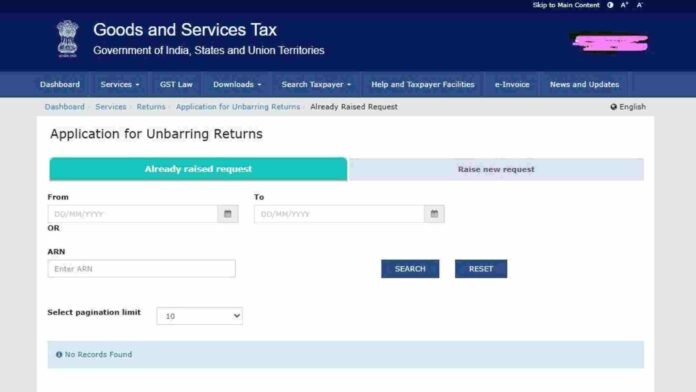
The Goods and Services Tax Network (GSTN) has operationalised a new online facility titled “Application for Unbarring Returns” on the GST portal, offering registered taxpayers a formal mechanism to seek unblocking of GST returns that have been system-barred due to prolonged non-compliance.

Under Rule 59(6) of the CGST Rules, read with Sections 39 and 47 of the CGST Act, the GST system automatically bars the filing of returns where a registered person fails to furnish returns for a continuous period of three years. Once this system-level barring is triggered, the relevant return period becomes non-editable, and the taxpayer is technically prevented from filing the pending return, effectively halting further compliance.

To address this issue, GSTN has now enabled an online application process allowing taxpayers to seek relief. The application can be filed through the GST portal by navigating to Services → Returns → Application for Unbarring Returns. This move is expected to streamline the process and reduce dependency on manual representations or offline follow-ups with tax authorities.

As part of the application, taxpayers are required to clearly state the reasons for non-filing of returns for the barred period. The application is then electronically routed to the Jurisdictional Assessing Officer (AO) for examination. This ensures that the request is evaluated by the competent authority having jurisdiction over the taxpayer.

Upon being satisfied with the reasons provided and the overall compliance position, the Assessing Officer may approve the application for unbarring. Once approved, the GST system automatically makes the previously barred return available for filing, enabling the taxpayer to regularise past non-compliance.

Read More: Assessment Order Invalid if Passed by Officer Lacking Pecuniary Jurisdiction: ITAT

Mariya Paliwala
Mariya Paliwalahttps://www.jurishour.in/
Mariya is the Senior Editor at Juris Hour. She has 7+ years of experience on covering tax litigation stories from the Supreme Court, High Courts and various tribunals including CESTAT, ITAT, NCLAT, NCLT, etc. Mariya graduated from MLSU Law College, Udaipur (Raj.) with B.A.LL.B. and also holds an LL.M. She started her career as a freelance tax reporter in the leading online legal news companies.

Latest articles

JURISHOUR | TAX LAW DAILY BULLETIN : 18 SEPTEMBER, 2026

Here’s the Tax Law Daily Bulletin for September 18, 2026.GSTMADRAS HIGH COURT QUASHES GST CLASSIFICATION...

Dept’s Stand on Export Quota Premium, Rejects CBDT O.M. to Extend S. 80HHC Benefit

The Supreme Court has dismissed a batch of civil appeals concerning the tax treatment...

Conditional Court Deposit Doesn’t Stop Interest: Supreme Court  Calls for Uniform Rules on Litigation Deposits

The Supreme Court of India has held that a deposit made by an award-debtor...

Circumstantial Evidence Failed to Form Complete Chain: Supreme Court Acquits 4 Murder Accused 

The Supreme Court has acquitted four accused persons in a 2001 murder case from...

More like this

JURISHOUR | TAX LAW DAILY BULLETIN : 18 SEPTEMBER, 2026

Here’s the Tax Law Daily Bulletin for September 18, 2026.GSTMADRAS HIGH COURT QUASHES GST CLASSIFICATION...

Dept’s Stand on Export Quota Premium, Rejects CBDT O.M. to Extend S. 80HHC Benefit

The Supreme Court has dismissed a batch of civil appeals concerning the tax treatment...

Conditional Court Deposit Doesn’t Stop Interest: Supreme Court  Calls for Uniform Rules on Litigation Deposits

The Supreme Court of India has held that a deposit made by an award-debtor...