
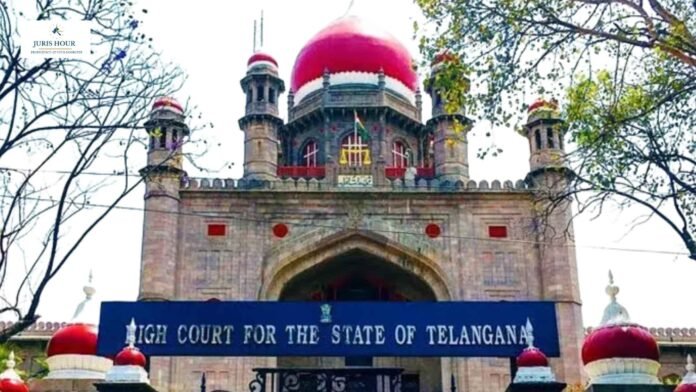
The Telangana High Court has dismissed a writ petition challenging GST penalty proceedings involving allegedly fraudulent input tax credit of ₹17.27 crore, rejecting the contention that the authorities lacked jurisdiction because a circular assigning functions under Section 122 of the Central Goods and Services Tax Act, 2017 was issued after the show-cause notice and adjudication order.
The Bench of Acting Chief Justice P. Sam Koshy and Justice Narsing Rao Nandikonda held that the Joint Commissioner who passed the adjudication order was the same officer designated to deal with matters exceeding ₹2 crore under the allocation of functions discussed in the judgment. Referring to Section 160 of the CGST Act, the Court concluded that the proceedings could not be invalidated on the jurisdictional ground advanced by the taxpayer.
Buy Now: 160+ GST E-Magazine September 2026
The bench left the substantive objections to the penalties open for consideration in a statutory appeal.
The appellant/assessee is a proprietary concern trading in two-wheeler and three-wheeler automobile spare parts, came under investigation by the Directorate General of GST Intelligence, Hyderabad Zonal Unit.
According to the Revenue, the concern issued invoices without corresponding supplies of goods, facilitating the passing on of irregular input tax credit to recipient entities. Investigators visited its premises on May 24, 2022, and recorded statements of Parth Goyal, who was stated to be managing the business, including statements dated May 24, 2022, and January 23, 2023.
The investigation also involved statements from recipient businesses, vehicle owners whose registration details appeared in e-way bills, and other persons associated with the transactions. The department alleged that the goods shown as supplied did not correspond with the nature of business carried on by certain recipients.
On the basis of the statements, invoices and other material collected, the department alleged violations relating to the issuance of tax invoices and the reporting of outward supplies and tax liability.
A show-cause notice issued in February 2025 proposed a penalty under Section 122(1)(ii), quantified at ₹17,27,04,518, representing the input tax credit allegedly passed on without actual supplies. An order-in-original followed on October 15, 2025.
The central argument before the High Court concerned the assignment of functions to a “proper officer” under the CGST Act.
The taxpayer relied on Section 2(91), which defines the expression, and Section 5 governing the exercise of powers by central tax officers. It argued that no valid assignment of the relevant functions under Section 122 existed when the notice was issued or when the adjudication order was passed.
Particular reliance was placed on CBIC Circular No.254/11/2025-GST dated October 27, 2025. Since both impugned actions preceded that circular, the taxpayer contended that the proceedings were without jurisdiction from their inception.
The show-cause notice had been issued by the Additional Director, DGGI, Hyderabad Zonal Unit, while the order-in-original was passed by the Joint Commissioner, Hyderabad GST.
The High Court acknowledged that the October 27, 2025 circular was issued after both the notice and the adjudication order.
However, it observed that the circular designated the Joint Commissioner as the proper officer competent to issue notices and undertake consequential adjudication in matters involving amounts exceeding ₹2 crore. The amount in the present proceedings exceeded that threshold, and the adjudication order had been passed by the Joint Commissioner.
The Bench reasoned that the adjudicating officer and the officer assigned functions for the relevant monetary category were the same. It therefore rejected the jurisdictional objection by referring to Section 160.
That provision protects proceedings from invalidation merely because of a mistake, defect or omission where they are, in substance and effect, consistent with the purposes and requirements of the Act.
The Revenue had also relied on the coordinate Bench’s decision in Alokadci Holdings Pvt. Ltd. v. Commissioner of Central Tax, which discussed Section 160, along with circulars dated June 19, 2017, and July 6, 2022.
On this reasoning, the Court declined to hold the notice and adjudication order without jurisdiction on the ground urged by the taxpayer.
The taxpayer raised several additional objections to the proceedings.
It argued that personal hearing notices had been returned by the postal authorities with the endorsement “addressee left”, demonstrating that no effective notice or meaningful opportunity of hearing had been provided. It also questioned the manner in which the show-cause notice was addressed.
The concern disputed the voluntariness and evidentiary value of statements recorded during the investigation, alleging that they had been obtained under coercion or duress.
Another contention was that a standalone penalty under Section 122(1)(ii) could not be imposed without a prior or concurrent determination of the alleged tax liability or evasion under Section 74.
The taxpayer further argued that penalties could not be sustained in respect of input tax credit already reversed by recipient entities, since the Revenue had allegedly been made good.
It also challenged the imposition of a penalty on the concern under Section 122(1)(ii) alongside a penalty on Parth Goyal under Section 122(1A) for the same transactions. According to the taxpayer, this amounted to impermissible double penalisation, including a violation of Article 20(2) of the Constitution.
The High Court did not adjudicate these substantive objections.
Having rejected the jurisdictional challenge, the Bench held that the order-in-original was appealable and that the remaining issues could appropriately be raised before the competent appellate authority.
The Court expressly clarified that it had not expressed any opinion on the merits. Consequently, the judgment does not finally determine whether invoices were issued without supplies, whether the disputed statements were reliable, or whether the individual penalties were legally sustainable.
The taxpayer was granted liberty to pursue an appeal in accordance with law and raise the available grounds before the appellate authority.
The Bench also addressed limitation for a possible appeal. It directed that the period spent pursuing the writ petition would be liable to exclusion, in accordance with law, subject to the applicability of Section 14 of the Limitation Act, 1963.
Membership Required to Access Case Details & Order Copy
To view the complete Case Details and Download Order Copy, you must have an active membership. Please subscribe to continue.

