
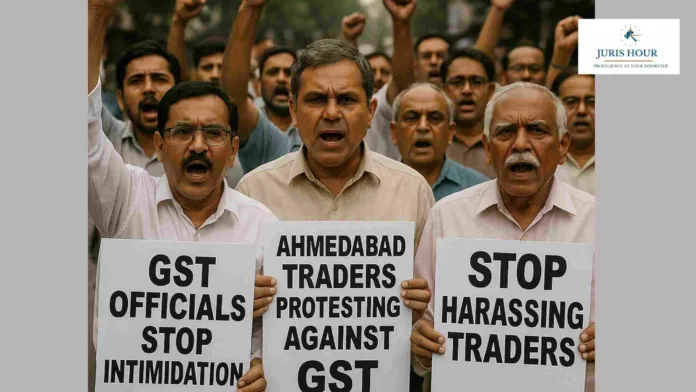
In a concerning development that has sent shockwaves across the business community, multiple Ahmedabad traders have accused GST officials of misusing the provisions of Section 67(1) of the Central Goods and Services Tax (CGST) Act, 2017.
Under Section 67(1) of the Central Goods and Services Tax Act, 2017, if a senior GST officer (not below the rank of Joint Commissioner) has reasons to believe that a taxpayer has hidden any sales or stock, wrongly claimed more input tax credit than allowed, or broken GST rules to evade tax, or if any person involved in transporting or storing goods is keeping goods without paying tax or maintaining records in a way that could lead to tax evasion, then the officer can authorize another GST officer in writing to inspect the taxpayer’s business premises or any place where such goods are kept.
The traders allege that under the pretext of conducting search and seizure operations, officers are creating an atmosphere of fear and harassment among small and medium enterprises.
According to sources, teams of GST officers have been visiting shops and establishments in key business hubs of the city, allegedly threatening traders with sealing of premises and legal action if they fail to comply with arbitrary demands. It is alleged that officials are leveraging their authority to extort money by invoking Section 67(1), which permits search and inspection of premises to prevent tax evasion.
Several traders claim they were coerced into closing their shops during peak business hours. In many instances, the officials reportedly confiscated records and threatened to seize goods if traders did not “settle matters.” This has not only disrupted business operations but also led to significant financial losses for several shop owners, particularly those dealing in textiles, electronics, and consumer goods.
Speaking to this reporter, a local trader on condition of anonymity said “The officials came without any prior notice. They told us that our records were suspicious and that they would seal the shop if we didn’t cooperate. When we asked for clarity, they cited Section 67(1). They kept our shop closed for hours and hinted we could ‘resolve’ the issue informally.”
Business associations and market committees have expressed outrage over the alleged misuse of power. Several have demanded that the Chief Commissioner of GST take immediate cognizance of the complaints and ensure accountability.
In a formal representation, trader associations have requested that officials refrain from such intimidation tactics. Instead of forcing traders to shut down their premises, they have urged that any required clarifications or document verifications be conducted in the GST office itself to avoid unnecessary panic and disruption of livelihood.
A senior representative of the Gujarat Chamber of Commerce and Industry stated “We understand that the authorities have the right to act against genuine tax evasion. However, using search provisions indiscriminately to pressurize honest traders is unacceptable. This shakes the trust between the business community and the administration.”
The representation also highlights that if such practices are not curtailed immediately, it could further erode confidence in the GST system and hamper compliance.
Traders have appealed to the Chief Commissioner to issue clear guidelines to field officers to exercise restraint and ensure that any enforcement action is based on credible evidence rather than arbitrary suspicion or personal interest.
While the GST Department has not issued an official statement so far, sources indicate that senior officials have taken note of the complaints and may review the recent enforcement activities in Ahmedabad.
This incident underscores the delicate balance between enforcement of tax laws and protection of traders’ rights — a balance that many now believe is being increasingly tilted in the wrong direction.

