
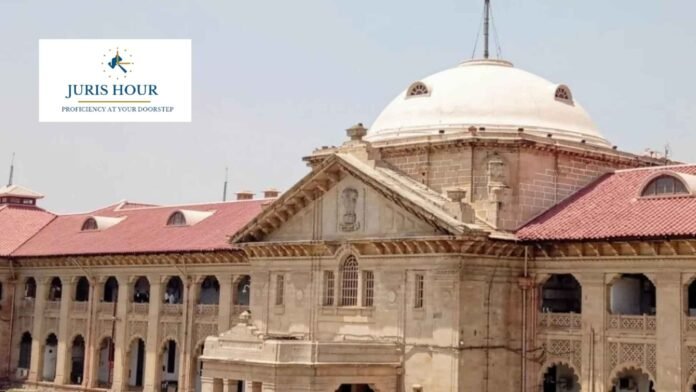
The Allahabad High Court has held that scrutiny of returns under Section 61 of the Goods and Services Tax Act is not an invariable condition precedent for issuing a show-cause notice under Section 74A where the proceedings originate from independent verification indicating that the suppliers were bogus or non-existent.
The bench of Justice Shekhar B. Saraf and Justice Abdhesh Kumar Chaudhary observed that Sections 61 and 74A operate in separate fields. While scrutiny under Section 61 may eventually lead to proceedings under Section 74A, every notice under Section 74A need not necessarily be preceded by return scrutiny or issuance of Form GST ASMT-10.
Buy Now: E-Magazine: 1000+ Landmark GST Judgments (2017–2026)
The court challenging a show-cause notice dated July 9, 2026, which proposed the denial of input tax credit, along with tax, interest and penalty, on the allegation that works purportedly subcontracted to 18 firms were bogus and non-existent.
The petitioner is registered under the GST law and is engaged in supplying works-contract services. It claimed to have executed large-scale subcontract works for NCC Limited in Bihar, Jharkhand, Uttar Pradesh and Maharashtra.
The projects included excavation and diaphragm-wall construction for an irrigation project in Bihar, development of distribution infrastructure under the Revamped Distribution Sector Scheme, installation of smart prepaid meters and rural water-supply works. According to the petitioner, the individual contract values ranged from approximately ₹1.24 crore to ₹8.43 crore.
For the financial year 2025-26, portions of these works were further subcontracted on a back-to-back basis to 18 GST-registered contractors.
The petitioner claimed to possess work orders, tax invoices, measurement sheets, completion records, bank statements showing payments through banking channels, GSTR-2A and B2B invoice summaries, GST registration records and declarations from the subcontractors confirming execution of the work, receipt of consideration and payment of GST.
The GST department, however, issued the notice under Section 74A(1), alleging that the subcontracted works appeared to be bogus and non-existent and that the petitioner had wrongfully availed ITC on the basis of fictitious documents and invoices without any actual movement of goods.
Instead of replying to the notice, the petitioner approached the High Court under Article 226 of the Constitution.
The company initially sought a declaration that Section 16(2)(c) of the Central GST Act and the corresponding provision of the Uttar Pradesh GST Act were unconstitutional. Alternatively, it sought the reading down of the provision so that ITC would not be denied to a bona fide recipient that had paid the tax component to the supplier and satisfied the remaining statutory conditions.
During the hearing, however, the petitioner did not press the constitutional challenge in view of the Supreme Court’s decision in Bhandari Scrap Traders v. Union of India, dismissing the challenge to the Gujarat High Court’s ruling in Maruti Enterprises v. Union of India.
The High Court noted that the Supreme Court’s decision confirmed the constitutional validity of Section 16(2)(c). ITC is available only when the supplier has actually paid the corresponding GST to the government, and the statutory condition cannot be diluted or read down. ITC, the court reiterated, is a conditional statutory benefit and not an absolute or vested right.
The petitioner argued that the department had bypassed the mandatory procedure prescribed under Section 61 of the GST Act and Rule 99 of the GST Rules. It contended that the officer should first have issued Form GST ASMT-10, allowing the company to explain or reconcile the alleged discrepancy, before commencing proceedings under Section 74A.
Rejecting the argument, the High Court explained that Section 61 is a pre-adjudicatory and verification mechanism dealing with scrutiny of returns already filed by a registered taxpayer. Such proceedings do not, by themselves, result in confirmation or recovery of a tax demand.
Sections 73 and 74A, on the other hand, operate independently whenever tax has not been paid or has been short-paid or ITC has been wrongly availed or utilised.
The material necessary to initiate adjudication proceedings may emerge from several sources, including scrutiny of returns, audit, special audit, inspection, search, seizure or independent verification of the antecedents of suppliers or subcontractors.
The court held that Section 61 is neither the sole nor the exclusive gateway through which the department must pass before initiating proceedings under Section 73 or Section 74A.
In the present case, the petitioner’s returns were never selected for scrutiny under Section 61. The impugned notice was stated to be based on independent verification suggesting that the 18 subcontractors from whom the petitioner claimed to have received works-contract services were bogus and non-existent.
Consequently, the obligation under Rule 99 to issue an ASMT-10 notice did not arise.
The bench observed that the words “where it appears to the proper officer” used in Section 74A give the proper officer the authority to act upon credible information from different sources. The expression is not confined to information discovered during scrutiny of returns under Section 61.
The court clarified, however, that where the proper officer possesses only return-based discrepancy material and no independent source of information, compliance with Section 61 and Rule 99 may constitute a mandatory procedural safeguard. Non-compliance in such cases may expose the subsequent Section 74A proceedings to a jurisdictional or procedural challenge.
The bench distinguished decisions of the Rajasthan, Orissa, Calcutta and Gauhati High Courts relied upon by the petitioner. In those cases, the departments had admittedly commenced scrutiny proceedings under Section 61 but either failed to issue the prescribed notice or proceeded further without properly considering the taxpayer’s explanation.
The present case stood on a different footing because no scrutiny proceeding had been initiated under Section 61.
The High Court observed that Section 61 and Section 74A lack “commutative property”: proceedings under Section 61 may lead to action under Section 74A, but proceedings under Section 74A do not invariably require prior invocation of Section 61.
It relied upon its earlier decision in Nagarjuna Agro Chemicals (P) Ltd. v. State of U.P., which held that scrutiny proceedings and proceedings under Section 74 are separate and distinct and that issuance of a notice under Section 61 is not a condition precedent for action under Section 74.
The court also referred to the Madras High Court’s decision in Mandarina Apartment Owners Welfare Association v. Commercial Tax Officer/State Tax Officer, holding that while an ASMT-10 notice becomes mandatory once scrutiny is undertaken and a discrepancy is found, the scrutiny exercise itself is not a prerequisite to adjudication proceedings.
The petitioner further argued that Section 74A(5)(ii), dealing with fraud, wilful misstatement or suppression of facts, had been invoked without the necessary foundational allegations.
The court rejected this contention after examining the notice. It found that the department had specifically alleged that the works said to have been subcontracted to the 18 firms were bogus, the firms were non-existent and the petitioner had availed substantial ITC on the strength of fictitious documents.
The notice alleged that the petitioner had shown receipt of inward supplies based on fake documents and invoices, without any actual movement of goods, and had deliberately utilised the ITC generated through such transactions.
According to the bench, an allegation that a chain of subcontracts and corresponding invoices had been structured around fictitious entities was, on its face, capable of constituting a fraudulent ITC claim and attracting Section 74A(5)(ii).
The court drew a distinction between the absence of foundational allegations and a dispute over the correctness of those allegations. While the former could raise a jurisdictional issue, the latter required factual adjudication by the competent GST authority.
Whether the subcontractors were genuinely registered and functional, whether they actually executed the work and whether the transactions were supported by work orders, measurement sheets, bank statements and GST returns were disputed factual questions.
The court held that these questions required examination of evidence and, if necessary, physical verification of the subcontractors’ existence and their capacity to undertake works of the stated value. Such an exercise fell within the adjudicating authority’s domain and could not be undertaken in summary writ proceedings.
The petitioner also relied on the Calcutta High Court’s decision in Suncraft Energy Private Limited v. Assistant Commissioner, State Tax, whose challenge by the department was dismissed by the Supreme Court.
It argued that ITC could not automatically be recovered from a bona fide recipient merely because the supplier had failed to deposit the tax. The department, it submitted, should first proceed against the defaulting supplier.
The Allahabad High Court held that reliance on Suncraft Energy was premature. That decision proceeded on the basis of a genuine and existing supplier that had charged and collected tax but failed to deposit it with the government.
The present notice, in contrast, questioned the very existence of the supplying entities and alleged that the underlying transactions were fictitious.
Whether the matter was governed by Suncraft Energy, the Supreme Court’s decision in Ecom Gill Coffee Trading Private Limited, or the exception concerning non-existent suppliers had to be decided by the adjudicating authority on the evidence produced by the parties.
The High Court reiterated that ordinarily a writ petition does not lie against a mere show-cause notice because the notice does not by itself create an adverse civil consequence.
Interference at the notice stage may be justified where fundamental rights are infringed, principles of natural justice are violated, the authority lacks jurisdiction or the validity of a statutory provision is under challenge.
The court found that none of these exceptional circumstances survived in the present case. The notice contained the necessary jurisdictional foundation, and the petitioner’s objections primarily involved disputed questions of fact.
The petitioner had also not filed any reply to the show-cause notice before approaching the High Court. Interference at this stage, the bench observed, would short-circuit the statutory adjudication process and require the court to pre-judge factual questions that had not yet been examined by the proper officer.
The court accordingly dismissed the writ petition but permitted the petitioner to submit a detailed response to the July 9, 2026 notice within four weeks.
It directed the adjudicating authority to consider the reply independently and in accordance with law, without being influenced by the High Court’s observations. The authority must provide an adequate opportunity of hearing and allow the petitioner to place its work orders, invoices, measurement sheets, banking records, GST returns and other supporting material on record.
Membership Required to Access Case Details & Order Copy
To view the complete Case Details and Download Order Copy, you must have an active membership. Please subscribe to continue.

