
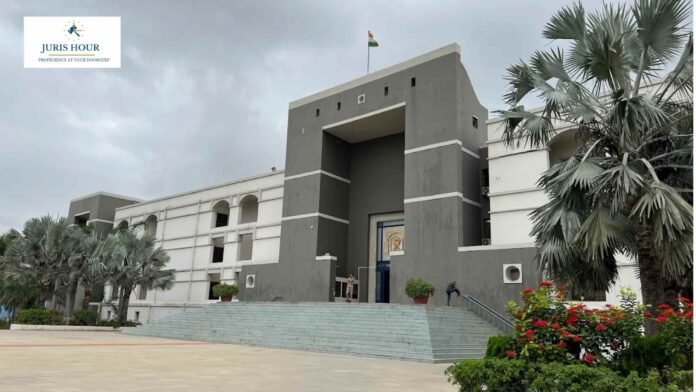
The Gujarat High Court has quashed a GST show cause notice and consequential adjudication order involving a demand of ₹47.87 lakh, holding that the department could not invoke one valuation provision in the show cause notice and subsequently confirm the demand by relying upon an altogether different valuation rule without giving the taxpayer an opportunity to meet the new case.
The bench of Justice A.S. Supehia and Justice Vaibhavi D. Nanavati found that while the show cause notice proceeded on the basis of Rule 28(a) of the Central Goods and Services Tax Rules, 2017, the adjudicating authority itself subsequently acknowledged that the provision had been incorrectly invoked and instead resorted to Rule 27(c) for determining the value of the services.
The bench observed that the change in the very basis of valuation, without giving the taxpayer an opportunity to address the applicability of Rule 27(c), caused “grave prejudice” to the petitioner. Consequently, both the original show cause notice and the adjudication order were set aside, though liberty was granted to the Revenue to initiate fresh proceedings by issuing a fresh show cause notice.
Buy Now: E-Magazine: 1000+ Landmark GST Judgments (2017–2026)
The case arose from a writ petition filed by a partnership firm engaged in providing construction services. The firm challenged an order dated March 30, 2026 passed under Section 74(9) of the Central Goods and Services Tax Act, 2017, raising tax and penalty aggregating to ₹47,87,271 — comprising ₹8,54,870 and ₹39,32,401 — along with interest.
The intelligence gathered by the Surat Commissionerate of CGST led the authorities to allege that the petitioner had supplied excavated soil valued at ₹1,70,97,395 in exchange for services received from a service provider. The department alleged that the transaction constituted a barter supply chargeable to GST and that the petitioner had undertaken the supply without issuing tax invoices.
The petitioner was initially called upon to pay ₹8,54,870 in tax along with interest and penalty through Form GST DRC-01A under Section 74(5) of the CGST Act. Subsequently, a show cause notice dated June 27, 2025 was issued under Section 74(1), seeking recovery of the amount.
The taxpayer submitted detailed written submissions on December 26, 2025 denying the allegations and contending, among other things, that GST at the rate of 5% had already been paid on the value of the excavated soil. The adjudicating authority, however, proceeded to confirm tax of ₹8,54,870 together with applicable interest and penalty, taking the total demand to ₹47,87,271 along with interest.
The petitioner argued that both the show cause notice and the subsequent adjudication order deserved to be quashed because the department itself was uncertain about whether Rule 27 or Rule 28 of the CGST Rules governed the valuation.
The show cause notice had invoked Rule 28(a) for determining the value of the excavated soil. However, during adjudication, the authority admitted that Rule 28(a) had been incorrectly invoked. Despite this conclusion, it proceeded to invoke Rule 27(c) and confirmed the demand by adopting a different method for determining the value of the services.
The petitioner objected that it had never been afforded an opportunity to address why or how Rule 27(c) could be applied to its case. It therefore contended that the adjudication order travelled beyond the foundation laid in the show cause notice.
The department was unable to controvert the factual position regarding the invocation of different provisions in the show cause notice and the adjudication order. The Revenue, however, submitted that the entire excavated soil had been utilised in the project itself, as allegedly admitted by the petitioner in its reply dated March 13, 2026.
The Bench noted that there was no dispute over the fact that different provisions of the CGST Rules had been invoked at the show cause notice stage and at the adjudication stage.
The show cause notice had invoked Rule 28(a) for determining the value of the excavated soil. The petitioner specifically responded that Rule 28(a) was inapplicable and that valuation based on open market value under that provision lacked legal basis because the notice had failed to allege or even indicate that the alleged supply of soil was made to any “related persons”.
Instead of ending the proceedings on that basis or putting the petitioner on notice about a different proposed valuation mechanism, the authority simultaneously invoked Rule 27(c) and confirmed the demand by resorting to a different valuation for determining the value of the services.
The High Court particularly emphasised that the petitioner had never been given an opportunity to meet the case relating to determination of value under Rule 27(c).
The Bench observed that the adjudicating authority did not approve the application of Rule 28(a), despite that being the provision specifically invoked in the show cause notice. At the same time, Rule 27(c), which ultimately formed the basis of the adjudication, had not been put to the petitioner for its response.
The Court held: “Moreover, the petitioner was never offered any opportunity to meet with the determination of value under Rule 27(c) of the CGST Rules, which was invoked and relied upon by the adjudicating authority.”
The Bench consequently concluded that the petitioner had suffered grave prejudice because of the manner in which the proceedings had been conducted.
On this ground alone, the High Court held that the impugned show cause notice was liable to be quashed. The Court also noted that the initial show cause notice itself could not survive once the adjudicating authority had concluded that Rule 28(a), on which that notice was founded, had been incorrectly invoked.
The Gujarat High Court quashed and set aside both the impugned adjudication order and the show cause notice dated June 27, 2025.
Membership Required to Access Case Details & Order Copy
To view the complete Case Details and Download Order Copy, you must have an active membership. Please subscribe to continue.

