
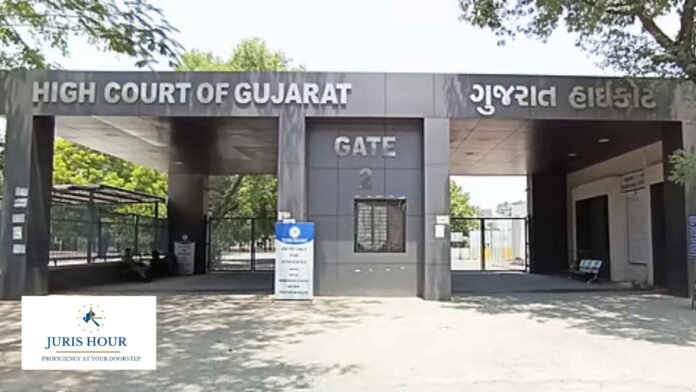
The Gujarat High Court has dismissed a writ petition challenging GST confiscation proceedings, holding that the taxpayer must pursue the statutory appeal under Section 107 of the Central Goods and Services Tax Act, 2017, after failing to establish any jurisdictional defect or violation of the principles of natural justice.
The bench of Justice A.S. Supehia and Justice Vaibhavi D. Nanavati found that the vehicle had been physically verified by an authorised proper officer, the relevant documents had been supplied, and the taxpayer’s written reply had been considered before the confiscation order was passed.
Buy Now: E-Magazine: 1000+ Landmark GST Judgments (2017–2026)
The petitioner, engaged in trading waste and scrap of cast iron, stated that it purchased goods under a tax invoice. The goods were further supplied directly to M/s A.K. Tools Industries and transported in a vehicle.
On February 13, 2025, the State Tax Officer intercepted the vehicle at Radhanpar Highway near Samakhiyali. Following verification, the authority issued a physical verification report in Form GST MOV-4 and a detention order in Form GST MOV-6.
A show-cause notice under Section 130 of the CGST Act followed on February 21, 2025, proposing confiscation of the goods. The proposed amounts included a penalty of ₹2,47,466, a fine of ₹13,74,812 in lieu of confiscation of the goods, and a fine of ₹2,47,468 in lieu of confiscation of the conveyance.
The taxpayer sought release of the goods and vehicle and requested certified copies of the documents. It subsequently objected to the proceedings on grounds of lack of jurisdiction and breach of natural justice.
The taxpayer initially approached the High Court through Special Civil Application No. 3929 of 2025.
By an interim order dated April 2, 2025, the Court directed release of the vehicle upon deposit of ₹5 lakh along with ₹13,74,812 representing the value of the goods. The goods and vehicle were released after the deposits were made.
An adjudication order under Section 130 was subsequently passed on May 24, 2025, which the taxpayer challenged by amending its petition.
On December 11, 2025, the High Court decided a group of petitions in M/s Panchi Traders v. State of Gujarat, which included the taxpayer’s earlier matter. The Court set aside the relevant notices and orders in Forms GST MOV-10 and MOV-11 and remanded the matters for reconsideration in light of its observations.
Following that remand, the authority issued a fresh show-cause notice on January 15, 2026. The taxpayer submitted its reply on February 9, 2026, and the authority passed the fresh confiscation order on March 2, 2026.
Before the High Court, the taxpayer argued that the proceedings violated Rule 138B of the CGST Rules, which governs verification of documents and conveyances.
It contended that the proper officer lacked the necessary authorisation from the Commissioner. It also argued that the same officer had issued both the notice and the adjudication order and could not act as a judge in his own case.
The taxpayer further alleged that the documents relied upon by the department had not been supplied with the show-cause notice, resulting in a violation of natural justice.
The State opposed the petition, submitting that the taxpayer had an effective statutory remedy through an appeal under Section 107. It maintained that neither a jurisdictional defect nor a denial of fair hearing had been established.
The State also referred to verification of the supplier’s premises, where the office was found closed, and the subsequent cancellation of the supplier’s GST registration.
After examining the record, the High Court rejected the challenge concerning the officer’s authorisation.
It found that physical verification of the conveyance had been carried out by a proper officer authorised by the Commissioner. Consequently, the Court held that there was no violation of Rule 138B.
The bench also referred to its earlier judgment concerning the statutory framework for interception, detention and confiscation. It noted that, following the remand, the proper officer issued a fresh notice and offered the taxpayer a personal hearing on January 22, 2026.
The taxpayer did not attend that hearing but submitted a written reply, which the authority considered before passing the impugned order.
The High Court also rejected the taxpayer’s allegation that the proceedings suffered from non-supply of relevant documents.
The bench recorded that documents relating to spot visits at M/s N.K. Trading and M/s A.S. Construction, along with the vehicle driver’s statement, had been supplied with the fresh notice. The orders cancelling the dealers’ registrations had also been furnished.
The Court noted that the adjudicating authority’s investigation had concluded that the dealers were engaged in illegal trading by receiving invoices from fake dealers without actual supply of goods. This was the department’s finding underlying the confiscation proceedings.
The bench further found that the verification and detention documents had been supplied to the person in charge of the conveyance, while the confiscation notice had been supplied to the taxpayer.
On this record, the Court found no denial of natural justice warranting interference in writ jurisdiction.
Relying on the Supreme Court’s decision in Assistant Commissioner of State Tax v. Commercial Steel Ltd., the High Court reiterated that an alternative remedy does not absolutely bar a writ petition under Article 226.
However, exceptional interference may be justified where there is a breach of fundamental rights, violation of natural justice, excess of jurisdiction, or a challenge to the validity of the statute or delegated legislation.
The bench held that none of these exceptions was established in the present case.
It also relied on the Delhi High Court’s decision in Powerline Air Express v. Principal Commissioner of Central Goods and Services Tax. That decision recognised that disputes concerning relied-upon documents, service of proceedings, consideration of replies and the reasoning of an adjudication order may require examination of the adjudicatory record within the statutory appellate process.
The Gujarat High Court adopted that reasoning, observing that grievances concerning non-supply of relied-upon documents fall within the appellate framework.
The High Court dismissed the writ petition and held that the taxpayer had an alternative remedy of filing an appeal before the competent appellate authority.
Membership Required to Access Case Details & Order Copy
To view the complete Case Details and Download Order Copy, you must have an active membership. Please subscribe to continue.

