
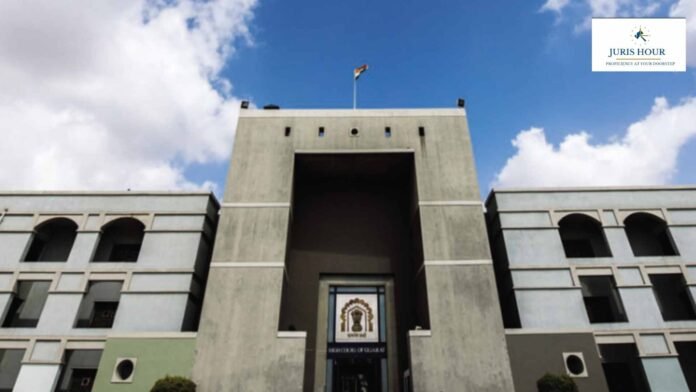
The Gujarat High Court has held that a taxpayer’s selection of “No” for personal hearing while filing a reply to a GST show cause notice cannot override the mandatory requirement under Section 75(4) of the GST law to provide an opportunity of hearing before passing an adverse order.
The bench of Justice A.S. Supehia and Justice Pranav Trivedi quashed a GST demand order issued under Section 74 of the Gujarat Goods and Services Tax Act, 2017, and remanded the matter for fresh adjudication.
The petitioner/assessee is engaged in the business of bitumen trading and imports and is registered under the GST regime. The dispute related to Financial Year 2018-19.
The proceedings began when the GST department issued an intimation in Form GST DRC-01A on January 25, 2025, proposing tax liability under Section 74(5) of the Act. The department quantified the alleged liability at the pre-notice stage itself, proposing: CGST: ₹35.29 lakh, SGST: ₹35.29 lakh and a Total tax demand: ₹70.59 lakh
The intimation also proposed interest and a 15% penalty. The company disputed both the allegations and the invocation of Section 74 at the pre-notice stage.
Subsequently, on June 20, 2025, the department issued a formal show cause notice in Form GST DRC-01 under Section 74 seeking recovery of tax, interest and penalty. The petitioner filed a detailed reply in Form GST DRC-06 on July 3, 2025 along with supporting documents uploaded on the GST portal.
Despite the reply, the adjudicating authority passed an order under Section 74(9) on November 4, 2025 and issued Form GST DRC-07, confirming the demand and directing payment by December 4, 2025.
The department argued that while filing the reply to the show cause notice, the taxpayer had selected the option indicating that no personal hearing was required. According to the department, since the taxpayer had declined the hearing, the adjudicating authority was justified in proceeding to decide the matter.
The central question before the Court was whether the GST authorities could pass an adverse order merely because the taxpayer had opted “No” for personal hearing in Form GST DRC-06, or whether Section 75(4) independently mandated the grant of a hearing before final adjudication.
Rejecting the State’s contention, the High Court held that the statutory mandate contained in Section 75(4) cannot be defeated by the option selected in an online form. The Bench observed that the taxpayer’s indication that no personal hearing was sought could not override the obligation cast upon the adjudicating authority by law.
The Court emphasized that it was incumbent upon the authorities to comply with Section 75(4) and provide an opportunity of hearing before passing an order adverse to the taxpayer.
The Bench relied upon its earlier decision in M/s Yadav Trailor Transport Co. v. Union of India, where it had reiterated the importance of adherence to principles of natural justice and the requirement of granting adequate hearing opportunities before final adjudication. The earlier judgment had stressed that a fair hearing is a fundamental legal requirement and forms part of the doctrine of audi alteram partem—the principle that no person should be condemned unheard.
Referring to settled law, the Court observed that proper notice and meaningful opportunity of hearing are essential ingredients of a valid adjudication process.
The Court concluded that the impugned order had been passed without affording the petitioner an effective opportunity of hearing. Such action, it held, amounted to a violation of the principles of natural justice and rendered the adjudication legally unsustainable.
Importantly, the Bench noted that under Section 75(4), GST authorities are required to provide opportunities of personal hearing before passing adverse orders. Since no such hearing was granted, the order could not be allowed to stand.
Allowing the writ petition, the Gujarat High Court quashed and set aside the GST demand order issued under Section 74; set aside the consequential DRC-07 summary order; and remanded the matter back to the adjudicating authority;
The court directed the authorities to pass a fresh order after providing an opportunity of hearing; and ordered completion of the exercise within twelve weeks.
The Court clarified that it had not examined the merits of the tax demand and that all issues remained open for fresh consideration by the adjudicating authority.
Membership Required to Access Case Details & Order Copy
To view the complete Case Details and Download Order Copy, you must have an active membership. Please subscribe to continue.
Read More: Why Are Gold Smugglers Making More Money Than Legal Importers?

