
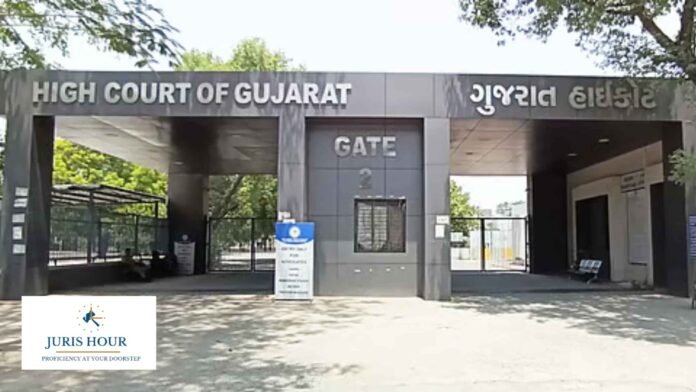
The Gujarat High Court has granted bail to an accused in a case involving alleged fraudulent availment of input tax credit (ITC) of ₹43–44 crore, observing that further investigation cannot continue endlessly and its pendency alone cannot justify refusal of bail.
The bench of Justice Hasmukh D. Suthar considered the maximum punishment of five years, the absence of any further recovery or discovery required from the accused, and the time likely to be taken for the trial. The order was passed on October 28, 2026.
Buy Now: 210+ GST Judgments E-Magazine – October 2026
The bench directed the applicant’s release on a personal bond of ₹25,000 with one surety of the same amount, subject to conditions protecting the investigation and ensuring his presence during trial.
The applicant approached the High Court under Section 483 of the Bharatiya Nagarik Suraksha Sanhita, 2023, seeking regular bail in proceedings registered by the Directorate General of GST Intelligence (DGGI), Surat Zonal Unit.
The case concerned alleged offences under Section 132 of the Central Goods and Services Tax Act, 2017, and Section 132 of the Gujarat Goods and Services Tax Act, 2017, read with Section 20 of the Integrated Goods and Services Tax Act, 2017.
The applicant had been in custody since August 1, 2026. The bail application was considered after the filing of the prosecution complaint, although the department maintained that further investigation remained underway.
Senior Advocate N.D. Nanavaty, assisted by advocate Kartik H. Bhatt, submitted that the applicant was merely an accountant and had been falsely implicated.
The defence argued that the department had already seized the books of account, relevant material and electronic devices. Consequently, it contended, there was no possibility of tampering with those materials and nothing further remained to be recovered or discovered from the applicant.
It also emphasised that the alleged offence carried a maximum punishment of five years and was triable by a Judicial Magistrate First Class. The applicant sought release subject to suitable conditions.
Opposing the application, Senior Standing Counsel Utkarsh Sharma disputed the claim that the applicant’s involvement was confined to accounting assistance.
The department alleged that the applicant had forged documents and obtained fraudulent registrations for two firms, M/s. Ganesh Trading and M/s. Prime Petrochem. According to its submissions, ITC of ₹43–44 crore had been availed without actual transactions.
The department further alleged that the persons in whose names the firms were registered had disowned their signatures on the documents. It relied on this circumstance to contend that the applicant had actively participated in the alleged offence.
It submitted that additional witness statements could reveal further involvement and that the alleged fraud amount might increase. It also expressed apprehensions about interference with electronic evidence and the applicant’s availability for trial.
Additional Public Prosecutor Rohan Shah adopted the department’s submissions on behalf of the State and opposed bail. Alternatively, the State sought stringent conditions if the Court decided to grant release.
After examining the investigation papers and the department’s affidavit, the High Court held that the continuation of investigation could not, by itself, justify keeping the applicant in custody.
The Court noted that the statutory period was over. It observed that the department’s intention to record statements of other witnesses was not sufficient to refuse bail merely because further investigation was pending.
The Court stated that “any investigation cannot go on endlessly”.
Its decision rested on the circumstances relevant to regular bail, including the applicant’s custody, the punishment prescribed, the status of recovery and the safeguards available through release conditions.
The High Court emphasised that, whether investigation was continuing or had concluded, courts must apply the triple test and impose suitable conditions to address legitimate apprehensions raised by the investigating agency.
It identified relevant considerations including the nature of the accusation, severity of punishment, prosecution material, risk of witness interference, likelihood of absconding, the accused’s circumstances and the larger public interest.
The Court also referred to the Supreme Court decision cited in the order as Vineet Jain v. Union of India while discussing bail in economic offences carrying limited sentences.
In the present case, it attached significance to the maximum punishment of five years and the fact that the offence was triable by a Judicial Magistrate First Class. It further recorded that nothing remained to be discovered or recovered from the applicant.
The High Court also considered the principles discussed in Sanjay Chandra v. Central Bureau of Investigation and Gudikanti Narasimhulu and Others v. Public Prosecutor, High Court of Andhra Pradesh.
It observed that the commencement and conclusion of the trial would take time. Continued incarceration in the circumstances, it reasoned, would amount to pre-trial conviction.
Applying the principle that bail is the rule and jail the exception, together with the protection of personal liberty under Article 21 of the Constitution, the Court found the case fit for grant of bail.
The applicant was directed to surrender his passport, if any, to the trial court within one week. He cannot leave Gujarat without the trial court’s prior permission.
He must mark his presence at the concerned police station twice a month for three months between 11 a.m. and 2 p.m. Thereafter, he must appear before the concerned authority whenever required.
The Court also required him to furnish his UIDAI number, contact numbers, passport particulars where applicable, email address and residential address to the investigating officer and the court when executing the bond. Any change of residence requires prior permission from the trial court.
The applicant must fully cooperate with further investigation and appear whenever summoned by the department. He was prohibited from contacting witnesses directly or indirectly, interfering with evidence, obstructing investigation or engaging in similar offences or other illegal activity.
He must attend court as required and must not prolong the trial. Breach of the conditions could result in cancellation of bail or other appropriate action.
The High Court clarified that release would be permitted only if the applicant was not required in connection with another offence. The competent court may modify or relax the conditions in accordance with law.
Membership Required to Access Case Details & Order Copy
To view the complete Case Details and Download Order Copy, you must have an active membership. Please subscribe to continue.

