
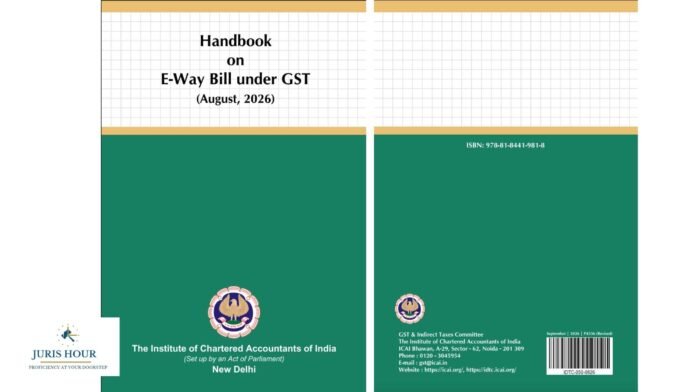
The Institute of Chartered Accountants of India (ICAI), through its GST & Indirect Taxes Committee, has issued the revised second edition of its handbook on e-way bills under GST, bringing together the legal framework, practical procedures and judicial developments concerning the movement of goods.
The publication identifies a crucial compliance issue for businesses: the requirement to generate an e-way bill is linked to the movement of goods and is not restricted to a sale or taxable supply. Goods sent for repairs, testing, exhibitions, job work, replacement or other business purposes may also attract the requirement, subject to the applicable thresholds and exemptions.
Buy Now: Legal & Taxation Combo – 4 Premium E-Magazines
The second edition is dated August 2026, and the publication states that its contents are updated up to August 15, 2026. It covers applicability, responsibility for generation, portal procedures, penalties, relevant judgments and frequently asked questions. The handbook provides professional guidance; it does not itself introduce new statutory requirements.
No Sale Does Not Automatically Mean No E-Way Bill
One of the handbook’s most significant explanations concerns goods moved without an immediate sale or transfer of ownership.
Businesses frequently transport goods between warehouses, send machinery for repairs, supply materials to job workers or move products to exhibitions. The handbook explains that such movements may require an e-way bill even though they do not result in a conventional sales transaction.
Depending on the nature of the movement, the accompanying document may be a tax invoice, delivery challan or another prescribed document.
The absence of a sale, therefore, cannot by itself be treated as an exemption from e-way bill compliance. The relevant inquiry is whether goods are being moved and whether the applicable conditions under the rules are satisfied.
₹50,000 Threshold Must Be Read With State Rules and Exceptions
The handbook explains that an e-way bill is ordinarily required for inter-State movement where the consignment value exceeds ₹50,000, subject to applicable exemptions.
For movement within a State or Union Territory, businesses must examine the relevant State or Union Territory rules and notifications. The publication separately discusses intra-State thresholds, recognising that the requirements may differ across jurisdictions.
It also distinguishes the nature of the supply from the actual movement of goods. A transaction classified as an inter-State supply under GST does not necessarily involve goods crossing a State boundary. This distinction can affect the threshold applicable to the movement.
Another crucial point concerns the calculation of consignment value. The handbook explains that the value includes the applicable GST and cess charged in the relevant document. Where an invoice covers both taxable and exempt goods, the value of the exempt supply is excluded for this purpose in accordance with the rule.
Businesses should consequently assess the prescribed consignment value rather than rely only on the pre-tax price of the goods.
Inter-State Job Work Can Require an E-Way Bill Below ₹50,000
The publication highlights an important exception to the general threshold: goods sent by a principal in one State or Union Territory to a job worker in another may require an e-way bill irrespective of consignment value.
The handbook discusses generation by the principal and the role of a registered job worker, depending on who causes the movement and the transaction involved.
This is particularly relevant to manufacturers that send inputs or goods outside the State for processing. A low consignment value does not automatically remove the requirement in such cases.
E-Invoice and E-Way Bill Serve Different Purposes
The handbook clarifies that a tax invoice, e-invoice and e-way bill are connected compliance documents with distinct functions.
A tax invoice records the supply and tax payable. Where e-invoicing applies, reporting to the Invoice Registration Portal produces an Invoice Reference Number and QR code. An e-way bill records the details relevant to transportation, including the consignor, consignee, goods and conveyance.
Generating an e-invoice does not dispense with an e-way bill where the movement requires one. Likewise, an e-way bill does not replace an applicable e-invoicing obligation.
The distinction is important for businesses using integrated billing systems, where generating one document may create an assumption that all transportation requirements have been completed.
Part B Details Are Crucial Before Goods Move
The handbook emphasises the importance of completing the transportation particulars in Part B of FORM GST EWB-01.
It explains that, subject to the prescribed exceptions, an e-way bill without the necessary Part B information is not valid for the movement of goods. Businesses must therefore ensure that vehicle or transport document details are furnished at the appropriate stage.
The publication discusses limited relaxation for specified movements of up to 50 kilometres within the State or Union Territory, involving the consignor’s or consignee’s premises and the transporter’s premises.
This relaxation concerns specified transport details; it should not be read as a blanket exemption for every journey below 50 kilometres.
Where goods are transferred to another vehicle during transit, the relevant transportation details should be updated so that the e-way bill reflects the actual conveyance.
Validity Depends on Distance and Type of Cargo
The handbook sets out the distance-based validity framework. For ordinary cargo, the prescribed validity is one day for up to 200 kilometres, with one additional day for every further 200 kilometres or part thereof.
For over-dimensional cargo, and multimodal shipments in which at least one leg involves transport by ship, the corresponding distance is 20 kilometres.
The publication also explains the facility for extending validity in appropriate circumstances. The extension window is eight hours before or eight hours after expiry, and the transporter must provide the reason, current location, remaining distance and relevant Part B details.
The extension process does not permit alteration of Part A particulars. Businesses should therefore monitor expiry and coordinate with transporters when delays arise.
Cancellation and Rejection Have Separate Deadlines
The handbook distinguishes cancellation by the generator from rejection by the recipient.
An e-way bill may be cancelled within 24 hours of generation, subject to the prescribed conditions. Cancellation is not permitted once it has been verified in transit by the proper officer.
The recipient may communicate acceptance or rejection within 72 hours of the details being made available, or before delivery of the goods, whichever is earlier. Failure to act within the applicable period results in deemed acceptance of the details.
These timelines make regular monitoring of the portal important, particularly where an e-way bill contains incorrect information or relates to a transaction that the recipient does not recognise.
Specified Minor Errors Should Not Trigger Detention Proceedings
A particularly significant part of the handbook concerns CBIC Circular No. 64/38/2018-GST, dated September 14, 2018, addressing certain minor discrepancies.
The publication explains that where goods are accompanied by the prescribed invoice or other document and an e-way bill, detention proceedings under Section 129 should not be initiated for the specified errors covered by the circular.
These include spelling errors in the consignor’s or consignee’s name where the GSTIN is correct; certain PIN code errors that do not increase validity; limited address discrepancies; errors in one or two digits of the document number; specified HSN errors where the first two digits and tax rate are correct; and errors in one or two digits or characters of the vehicle number.
For these identified situations, the circular provides for ₹500 each under the CGST and respective State GST laws, or ₹1,000 under the IGST Act, for every consignment.
The distinction is consequential: a specified minor discrepancy in otherwise available documents is treated differently from transporting goods without a required e-way bill.
Judicial Relief Depends on the Facts of the Discrepancy
The handbook also examines judgments concerning address mismatches, incorrect consignee details, bill-to-ship-to transactions and incomplete transportation information.
In its discussion of Ms. Sangeeta Jain v. Union of India, decided by the Allahabad High Court on April 22, 2024, the publication records that a penalty arising from a dispatch-address mismatch was set aside where the goods matched the invoice and e-way bill and the discrepancy was treated as typographical, without material establishing an intention to evade tax.
The handbook’s case-law coverage illustrates the importance of examining whether the goods and supporting documents correspond, the nature of the error and the circumstances of the movement.
Relief in a clerical-error case should not be understood as a general exemption from completing mandatory e-way bill requirements.
Missing Documents Can Lead to Penalties and Detention
The handbook explains that transporting taxable goods without the prescribed documents can attract consequences under Section 122(1)(xiv), while contraventions involving goods in transit may result in detention or seizure under Section 129.
For the documentation offence discussed under Section 122, the publication describes a combined CGST and SGST/UTGST penalty of ₹20,000, or the applicable tax-linked amount, whichever is higher. The consequences of detention under Section 129 arise under a separate statutory framework.
Businesses should therefore distinguish between a specified minor error, absence of required documents and other substantive contraventions rather than assume that all discrepancies carry the same consequence.
Return-Filing Defaults Can Disrupt Dispatches
The publication also discusses restrictions on furnishing Part A information under Rule 138E in connection with specified return-filing defaults.
It describes the blocking mechanism and the procedure for seeking permission from the Commissioner through FORM GST EWB-05, with an order issued in FORM GST EWB-06.
The practical implication is that GST filing compliance can affect the ability to dispatch goods. Businesses need coordination between their tax, billing and logistics teams to prevent filing defaults from interrupting transportation.
Additional Portal Controls Businesses Should Track
Alongside the handbook’s discussion, official NIC advisories prescribe operational controls introduced from January 1, 2025. These restrict e-way bill generation to documents dated within 180 days and limit extension to 360 days from the original date of e-way bill generation. These are separate from the distance-based validity period applicable to an individual journey.
For businesses handling delayed dispatches, older invoices or prolonged transportation, these controls make document-date checks and timely generation particularly important.
The revised handbook places the central compliance responsibility on accurate documentation before movement begins, timely updating of transportation particulars and close monitoring of validity. Its guidance is especially relevant to businesses whose goods move through job workers, warehouses, repair centres and multiple transporters, where compliance obligations can arise even without an immediate sale.
Membership Required to Access Handbook Details & Copy
To view the complete Handbook Details and Download Copy, you must have an active membership. Please subscribe to continue.
Read More: JURISHOUR | TAX LAW DAILY BULLETIN : 5 OCTOBER, 2026

