
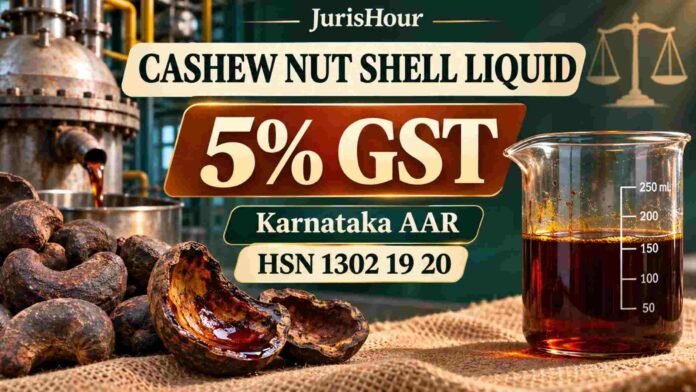
The Karnataka Authority for Advance Ruling (AAR) has held that crude Cashew Nut Shell Liquid (CNSL), obtained through heating and mechanical extraction without chemical modification, is classifiable under HSN 1302 19 20 and attracts 5% GST.
The bench of Kalyanam Rajesh Rama Rao, Member (Central), and Sivakumar S Itagi, Member (State) ruled that the product falls within Serial No. 74 of Schedule I to Notification No. 9/2025–Central Tax (Rate), dated September 17, 2025, effective from September 22, 2025. The applicable tax comprises 2.5% CGST and 2.5% SGST.
Buy Now: 210+ GST Judgments E-Magazine – October 2026
The ruling clarifies that the relevant rate entry covers Heading 1302 as a whole, without restricting its application to particular subheadings or tariff items.
The applicant, based in Udupi district, Karnataka, approached the AAR seeking clarity on the classification and applicable GST rate for CNSL manufactured from cashew nut shells.
The manufacturing process involves heating the shells and mechanically expelling the liquid. The resulting crude CNSL is supplied to domestic and overseas buyers for industrial applications.
The order describes CNSL as a dark reddish-brown viscous liquid contained within the honeycomb structure of the cashew nut shell. It is a naturally occurring phenolic material used in manufacturing resins, surface coatings, paints, varnishes, laminates and friction materials.
The applicant sought confirmation that its product fell under Heading 1302 and qualified for the 5% GST rate prescribed under the September 2025 notification.
The applicant submitted that CNSL was appropriately classifiable under Heading 1302, covering vegetable saps and extracts, and specifically under tariff item 1302 19 20.
It argued that the rate notification referred to the entire four-digit heading without limiting its scope to specified products or individual subheadings. Consequently, the 5% rate should extend to CNSL falling within that heading.
Chartered Accountant M. Ravi Rao appeared as the applicant’s authorised representative during the personal hearing on May 20, 2026, and reiterated these submissions.
The authority admitted the application under Sections 97(2)(b) and 97(2)(e) of the CGST Act, concerning the applicability of a notification and determination of liability to pay tax.
The AAR examined the composition, essential character and degree of processing of the product to determine its classification under the Customs Tariff.
It observed that cashew-related products appear under different tariff chapters depending on their form and processing. These include edible nuts, prepared foods, vegetable extracts and chemically modified products.
For the product before it, the authority emphasised that CNSL was obtained through mechanical and thermal extraction, retained its natural constituents, and underwent no chemical modification or polymerisation.
These characteristics were central to its conclusion that the product remained a vegetable extract.
The authority found that Heading 1302 specifically covers vegetable saps and extracts and contains tariff item 1302 19 20 for crude cashew shell liquid.
It also referred to the explanatory notes, which expressly include cashew nutshell extract while excluding polymers of cashew nutshell liquid, generally falling under Heading 3911.
Since the applicant supplied crude CNSL without converting it into a polymer or synthetic resin, the product retained the character of a vegetable extract under Heading 1302.
The AAR distinguished CNSL from cashew nuts covered under Chapter 08. Those entries concern nuts in their natural or minimally processed form, including shelled nuts and broken or whole kernels. Liquid extracted from the non-edible shell was a distinct product.
The authority also rejected classification under Chapter 20, observing that the relevant entries concern prepared or preserved edible products, such as roasted or salted cashew nuts. CNSL was non-edible and intended for industrial applications.
While examining Chapter 15, the authority relied on the product’s non-edible phenolic composition and industrial use to reject classification there. Its findings concerned the crude CNSL described in the application.
The authority separately examined the exclusion concerning polymers of cashew nutshell liquid.
It observed that the exclusion becomes relevant when CNSL is converted into polymers or resins and acquires a new chemical identity. In the applicant’s case, the product had not undergone polymerisation or chemical transformation and was neither a synthetic resin nor a plastic material.
Accordingly, Heading 3911 did not apply to the crude liquid supplied by the applicant.
The ruling therefore draws a material distinction between extracting CNSL from shells and subsequently transforming that extract into a different chemical product.
After determining classification, the AAR examined Serial No. 74 of Schedule I to Notification No. 9/2025–Central Tax (Rate).
The entry refers to Heading 1302 and covers vegetable saps and extracts, pectic substances, pectinates and pectates, agar-agar and other mucilages and thickeners derived from vegetable products, including tamarind kernel powder.
The authority reasoned that a rate entry referring to a four-digit heading, without restricting it to particular subheadings or tariff items, covers goods falling within that heading unless specifically excluded.
Since crude CNSL under tariff item 1302 19 20 falls within Heading 1302, the AAR held that it qualified for the 5% rate.
The Karnataka AAR ruled that the applicant’s CNSL was appropriately classifiable under HSN 1302 19 20, attracting 5% GST—2.5% CGST and 2.5% SGST—under Serial No. 74 of Schedule I to Notification No. 9/2025–Central Tax (Rate), effective from September 22, 2025.
Membership Required to Access Case Details & Order Copy
To view the complete Case Details and Download Order Copy, you must have an active membership. Please subscribe to continue.
Read More: GST Audit Officer Can’t Adjudicate Same Matter: Karnataka High Court

