
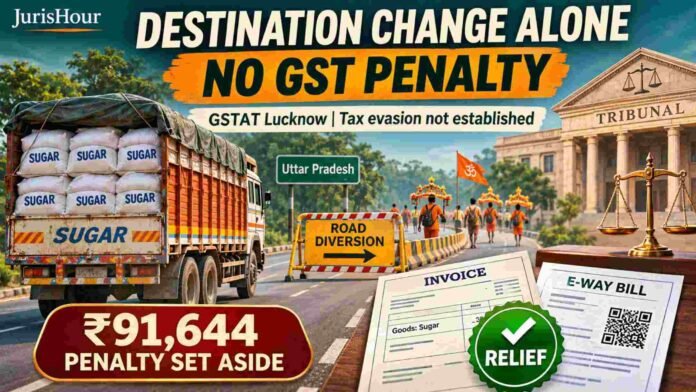
The Goods and Services Tax Appellate Tribunal (GSTAT), Lucknow, has dismissed a departmental appeal seeking restoration of a ₹91,644 penalty on a sugar trader, holding that a change in the declared destination of goods did not justify penalty under Section 129 of the Uttar Pradesh Goods and Services Tax Act, 2017, when the diversion was explained and the transactions were supported by documentary evidence.
The Bench of Santosh Kumar Srivastava (Judicial Member) and Arvind Kumar (Technical Member) found that the Department had failed to establish an unaccounted supply, a fictitious subsequent sale or suppression of taxable turnover.
Buy Now: 210+ GST Judgments E-Magazine – October 2026
The dispute concerned goods originally destined for Bareilly that were subsequently transported towards Etah. The taxpayer explained that traffic restrictions during the Kanwar Yatra prevented the vehicle from entering Bareilly, following which the goods were sold to a registered purchaser at Etah.
The Mobile Squad intercepted the vehicle at Budaun at approximately 7:15 a.m. on July 21, 2023. It was carrying 250 quintals of sugar, comprising consignments of 200 quintals and 50 quintals, with a total declared value of ₹9,16,429.
The driver produced Tax Invoice Nos. 3108 and 3109, both dated July 20, 2023, along with the corresponding e-way bills issued by M/s L.H. Sugar Factory Limited, Pilibhit. These documents disclosed the description, quantity, value and identity of the goods.
However, while the invoices and e-way bills mentioned Bareilly as the destination, the driver stated that the goods were being transported towards Etah. The Department also noted that the original supplier had no declared branch, warehouse or additional place of business at Etah.
Suspecting that the goods were being moved through an undeclared transaction, the proper officer imposed a penalty of ₹91,644 under Section 129. The goods and vehicle were released after the taxpayer deposited the penalty.
Before the first appellate authority, the taxpayer explained that the goods had initially been purchased for delivery at Bareilly. Restrictions on vehicle entry during the month of Saawan, on account of the Kanwar Yatra, prevented the vehicle from entering the city and led to its diversion towards Budaun.
The goods were subsequently sold to M/s Faqir Chand Panna Lal, a registered purchaser at Etah. To substantiate the transaction, the taxpayer produced an e-invoice and e-way bill dated July 21, 2023, together with bank statements evidencing payments through banking channels.
The Additional Commissioner, Grade-2 (Appeals), First, State Tax, Bareilly, accepted the explanation and supporting records. By an Order-in-Appeal dated October 15, 2024, the authority set aside the penalty, finding that a deliberate attempt to evade tax had not been established.
The Department challenged that decision before GSTAT.
The taxpayer raised a preliminary objection that the disputed penalty fell below the ₹20 lakh monetary threshold prescribed for departmental appeals under Circular No. 207/01/2024-GST.
The Department relied on the circular’s exclusions for recurring issues and matters involving interpretation of statutory provisions.
The Tribunal held that the dispute raised a recurring legal question affecting the Mobile Squad’s enforcement jurisdiction during transportation checks. It therefore overruled the taxpayer’s objection and held the appeal maintainable.
The departmental appeal was consequently examined on its merits.
The Department argued that the difference between the destination recorded in the original documents and the destination stated by the driver constituted a material discrepancy.
It maintained that compliance with the statutory requirements governing invoices, e-way bills and transportation was mandatory. According to the Department, documents subsequently produced before the first appellate authority could not automatically regularise transportation already undertaken contrary to the declared particulars.
The Department also characterised the subsequent sale documents as an afterthought. It alleged that, without interception, the subsequent transaction might not have come to the tax authorities’ notice.
It further relied on the absence of the original supplier’s branch or warehouse at Etah to question the movement of goods.
The Tribunal rejected the proposition that production of relevant documents at the appellate stage, by itself, made the transaction non-genuine.
It observed that the first appellate authority could examine material bearing on the controversy, subject to applicable procedural requirements. In this case, the subsequent documents had been considered together with the original purchase invoices, e-way bills and the explanation for the diversion.
The subsequent sale was supported by an identifiable registered purchaser, an e-invoice, an e-way bill and banking transactions.
The Department had not established that the intercepted goods differed from those covered by the original invoices. Nor had it produced material showing that the subsequent sale was fictitious or that the goods were intended for an unaccounted transaction.
The Tribunal also rejected the Department’s reliance on the original supplier having no declared branch or warehouse at Etah.
The taxpayer’s explanation was that the goods had been sold to a separate registered purchaser at Etah. It had not claimed that the original supplier maintained a branch or warehouse there.
Accordingly, the absence of the supplier’s place of business at the changed destination could not, by itself, establish that the subsequent sale was fictitious.
The Bench observed that Section 129 deals with goods transported or stored in transit in contravention of the Act or Rules. However, the nature of the alleged contravention and the surrounding circumstances required examination before determining liability.
A discrepancy concerning the destination could not automatically be treated as conclusive proof of an attempt to evade tax.
The Tribunal considered the Kanwar Yatra traffic restrictions a relevant circumstance. It found that the Department had not effectively rebutted the taxpayer’s explanation and held that the diversion, which was beyond the taxpayer’s control, could not independently establish an intention to evade tax.
The Bench relied on judicial decisions including Assistant Commissioner (ST) & Others v. Satyam Shivam Papers Pvt. Ltd. and M/s Hindustan Herbal Cosmetics v. State of U.P. It referred to those decisions while emphasising the need to examine the taxpayer’s explanation, surrounding circumstances and evidence indicating tax evasion.
The Tribunal found that the Department had not established that the goods were removed from the books of account, that the subsequent sale was unrecorded or that taxable turnover had been suppressed.
It treated the allegation that the goods would have escaped taxation without interception as an assumption unsupported by concrete evidence. The documentary material instead demonstrated a traceable chain of purchase and subsequent sale.
On these facts, the destination discrepancy did not justify sustaining the penalty under Section 129.
The Tribunal dismissed the departmental appeal and affirmed the first appellate authority’s order setting aside the ₹91,644 penalty.
Membership Required to Access Case Details & Order Copy
To view the complete Case Details and Download Order Copy, you must have an active membership. Please subscribe to continue.
Read More: Wrong TRAN-1 Table Can’t Defeat Eligible GST Credit: GSTAT

