
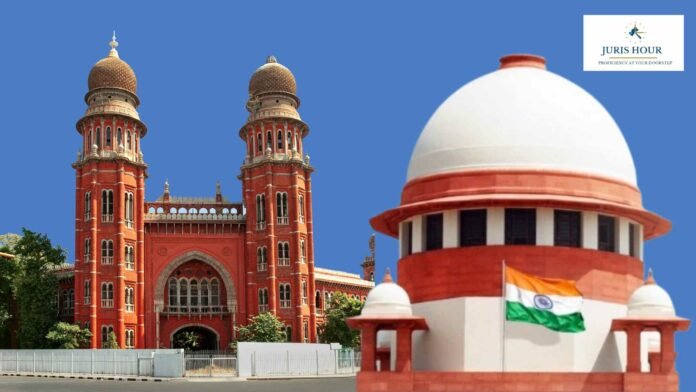
The Supreme Court has issued notice in a challenge against a Madras High Court judgment upholding the cancellation of a taxpayer’s GST registration over an alleged wrongful Input Tax Credit claim of approximately ₹18.62 crore.
A Bench comprising Justice Ujjal Bhuyan and Justice Atul S. Chandurkar issued notice returnable on November 3, 2026 and condoned the delay in refiling or curing defects in the petition. It did not, however, stay the Madras High Court judgment or the GST registration cancellation order at this stage.
The Special Leave Petition challenges the Madras High Court’s April 20, 2026 judgment, which held that cancellation of registration was justified because the taxpayer failed to furnish adequate evidence establishing the physical movement of goods underlying its substantial ITC claim.
Buy Now: 150 + Judgments On GST – E-Compilation For August 2026
The petitioner/assessee is a proprietorship concern that obtained GST registration on April 5, 2022, with its declared business premises situated at Mooker Nallamuthu Street, Chennai.
According to the proceedings, an inspection conducted by the Assistant Commissioner revealed that the declared premises appeared insufficient for conducting business of the scale reflected in the firm’s ITC claims.
The tax authorities consequently issued a show-cause notice on November 14, 2024, calling upon the taxpayer to produce documents showing the actual movement of goods corresponding to the ITC claimed. The taxpayer submitted a detailed response and participated in the personal hearing.
The Assistant Commissioner remained dissatisfied with the explanation and supporting records and cancelled the GST registration on November 29, 2024.
An appeal filed before the Deputy Commissioner was subsequently dismissed. The taxpayer then approached the Madras High Court, but a Single Judge refused to interfere with the cancellation order on January 21, 2026.
In its intra-court appeal, the taxpayer contended that one of the reasons cited by the authorities was that it shared its business premises with another concern, M/s Gaurav Metal, allegedly to camouflage transactions.
It argued that there was no statutory prohibition against two traders carrying on business from the same premises. Mere co-location, without evidence of overlapping business activities, financial nexus, common accounts, intermingling of stock or wrongful transfer of ITC, could not satisfy the requirements for cancellation under Section 29(2) of the GST enactment or Rule 21 of the CGST Rules.
The taxpayer maintained that Gaurav Metal was a partnership firm registered under the pre-GST regime and was legally distinct from Sri Balajee Udyog. It claimed that Gaurav Metal had sold approximately 94% of its stock between April and August 2022 and separately stored the remaining stock before the partnership was dissolved and its GST registration surrendered.
Sri Balajee Udyog, on the other hand, claimed that although it obtained registration in April 2022, it commenced business operations only in September 2022.
The taxpayer also argued that mechanically blocking ITC without adjudication under Section 73 or Section 74 of the GST law was arbitrary and violated its right to carry on business under Article 19(1)(g) of the Constitution.
The State opposed the appeal, pointing out that the taxpayer had claimed and availed ITC of approximately ₹18.62 crore during the relevant period.
Given the magnitude of the transactions, the State submitted that the taxpayer was required to produce credible evidence showing the actual transportation and receipt of goods.
The taxpayer reportedly claimed that the goods were ordinarily transported through tricycles or similar vehicles. The State argued that merely producing printouts of e-way bills could not conclusively establish the actual physical movement of the goods.
According to the department, supporting records such as proof of freight payments, loading and unloading charges, lorry receipts and way bills were necessary to substantiate the transactions. The taxpayer allegedly failed to produce such documents.
The State therefore contended that the taxpayer had failed to establish receipt of goods, a mandatory condition for availing ITC under Section 16(2)(b) of the GST law.
It further informed the High Court that consequential proceedings had been initiated against both the taxpayer and its suppliers in connection with allegedly fabricated sales documents and invoices.
A Division Bench of Justice G. Jayachandran and Justice Shamim Ahmed agreed with the tax department and dismissed the writ appeal.
The High Court observed that the taxpayer attempted to establish the genuineness of the transactions by producing e-way bill printouts but failed to provide sufficient independent evidence of the actual movement of goods.
The Court noted that the alleged irregularities had surfaced during an all-India drive against fake GST registrations. It also took note of the State’s submission that action had been initiated against the suppliers, including blocking of ITC under Rule 86A and contemplated proceedings under Section 74.
Rejecting the contention that the State lacked the power to cancel registration in such circumstances, the High Court held that cancellation was an appropriate preventive measure where material indicated that ITC had been claimed on the strength of fabricated documents and fake invoices.
“The Constitution guarantees only genuine and honest trade and not illegal and fake trade intended to cheat the revenue of the State,” the High Court observed.
The Court further held that the taxpayer had been given an adequate opportunity to produce evidence of the movement of goods but failed to do so. The cancellation under Section 29(2)(a), therefore, could not be characterised as procedurally improper.
Accordingly, the Division Bench affirmed the Single Judge’s decision and dismissed the writ appeal without imposing costs.
Membership Required to Access Case Details & Order Copy
To view the complete Case Details and Download Order Copy, you must have an active membership. Please subscribe to continue.

