
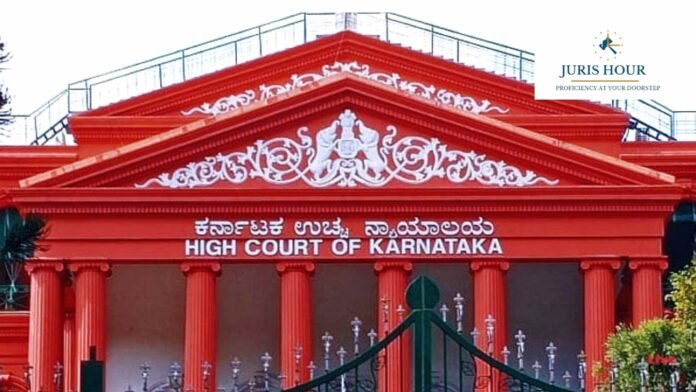
The Karnataka High Court has ruled that a bona fide error in Form GST DRC-03 should not deprive a taxpayer of substantive relief, permitting a registered taxpayer to correct an incorrect tax period mentioned in the form through a physical amendment.
The bench of Justice B M Shyam Prasad quashed two separate adjudication orders passed for the same tax period, observing that the authorities must reconsider the matter after taking into account the corrected DRC-03 declaration.
The petitioner/assessee challenged two adjudication orders dated 3 January 2025 relating to the financial year 2020-21. One order had been passed by the Assistant Commissioner of Commercial Taxes following scrutiny under Section 61 of the CGST/KGST Act, while the other had been issued after an audit conducted under Section 65 of the Act.
Buy Now: Customs Duty Judgements E-Compilation – June 2026
Apart from challenging these parallel adjudication proceedings, the petitioner sought permission to amend Form GST DRC-03 filed on 24 March 2021, contending that it had inadvertently mentioned the tax period as April 2019 to March 2020 instead of the intended April 2020 to March 2021. The petitioner maintained that it had no outstanding tax liability for FY 2019-20 and that the error was purely clerical and bona fide.
Before the High Court, the petitioner argued that two separate adjudication orders covering the same tax period could not legally operate simultaneously. It also relied upon the Bombay High Court’s decision in Rajesh Developer Private Limited v. Union of India, which recognized the need to permit correction of inadvertent mistakes in GST DRC-03 forms.
The petitioner submitted that if the tax authorities believed any liability actually existed for FY 2019-20, they remained free to examine the matter independently after verification, but the clerical mistake itself should not prejudice its rights.
The State defended the adjudication proceedings by explaining that the two orders arose from different statutory provisions—one following scrutiny under Section 61 and the other after audit under Section 65 of the GST law.
Regarding amendment of Form GST DRC-03, the State argued that the GST framework contains no statutory mechanism permitting modification of an already filed DRC-03. It further submitted that practical limitations existed because such forms are digitally filed and maintained on the GST portal administered by the Central Government, making post-filing alterations technically difficult.
Justice B. M. Shyam Prasad rejected the argument that the absence of an express statutory provision should prevent correction of a bona fide mistake.
The Court endorsed the reasoning adopted by the Bombay High Court, observing that taxpayers operate under diverse circumstances with varying levels of expertise and resources. Given the relatively new GST regime, inadvertent human errors are inevitable and taxpayers must be afforded an opportunity to rectify genuine mistakes instead of suffering irreversible consequences.
The Court observed that procedural requirements should not override substantive justice where the mistake is bona fide and capable of verification.
Recognizing that the GST portal may not technically permit online modification of a filed DRC-03, the High Court fashioned a practical remedy.
It permitted the petitioner to submit a physical amended copy of Form GST DRC-03 correctly mentioning the tax period as April 2020 to March 2021. The Court directed the tax authorities to rely upon this corrected form while reconsidering the matter.
At the same time, the Court protected the interests of the revenue by granting liberty to the authorities to verify whether any tax liability actually existed for FY 2019-20 and, if necessary, initiate proceedings in accordance with law.
Allowing the writ petition, the Karnataka High Court set aside both adjudication orders dated 3 January 2025 relating to FY 2020-21.
The Court further clarified that while the authorities must reconsider the matter based on the corrected DRC-03, they remain free to examine all issues raised in the original show cause notices and take appropriate action under law. Importantly, the Court directed that the petitioner should not raise limitation as a defence against such fresh proceedings.
Membership Required to Access Case Details & Order Copy
To view the complete Case Details and Download Order Copy, you must have an active membership. Please subscribe to continue.

