
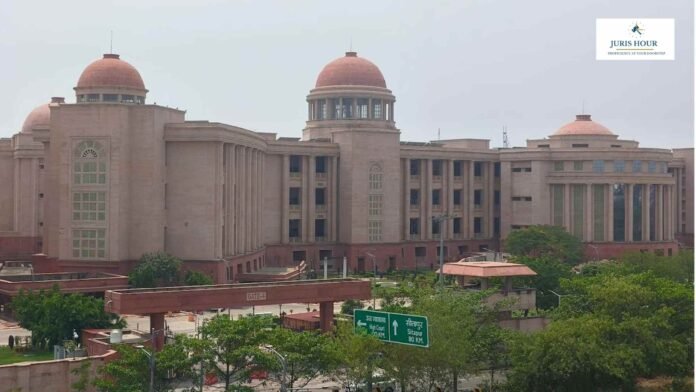
The Allahabad High Court (Lucknow Bench) has dismissed a writ petition challenging a GST assessment order, holding that a taxpayer cannot invoke the extraordinary writ jurisdiction under Article 226 of the Constitution merely to overcome the limitation period prescribed for filing a statutory appeal under the GST law.
The bench of Justice Shekhar B. Saraf and Justice Abdhesh Kumar Chaudhary has observed that the petitioner failed to demonstrate either a jurisdictional defect in the proceedings or any denial of fair hearing that would justify interference under Article 226. The taxpayer had participated in the adjudication process by filing a reply and attending the hearing.
The petitioner contended that the assessment proceedings were without jurisdiction and requested the High Court to set aside the impugned notice and assessment order. The taxpayer also sought protection against any coercive recovery action arising from the assessment order.
However, during the hearing, the Court noted that the petitioner had already filed a reply to the show cause notice and had also been granted an opportunity of personal hearing before the assessment order was passed. As a result, the Court found no apparent violation of the principles of natural justice.
Accordingly, the Court held that the matter did not fall within the exceptional categories where writ jurisdiction may be exercised despite the availability of an alternate statutory remedy.
Delay of Nearly One Year Proves Fatal
One of the key reasons for dismissal was the considerable delay in approaching the High Court.
The Bench observed that the impugned assessment order had been passed on June 4, 2025, whereas the writ petition was filed nearly a year later. The Court further noted that the petitioner had earlier approached the High Court in January 2026 but had withdrawn that petition with liberty to file a fresh petition with better particulars. Even then, the petitioner failed to pursue the available statutory remedy within the prescribed time.
The Court expressed surprise at the attempt to challenge the assessment order at such a belated stage, observing that the taxpayer appeared to be using the writ jurisdiction as a substitute for the appellate mechanism after allowing the limitation period for appeal to expire.
GST Appeal Time Limits Cannot Be Circumvented
The High Court highlighted that Section 107 of the GST Act provides a specific appellate framework. Under the provision, an appeal must be filed within three months from the communication of the order, with a further one-month condonable period available if sufficient cause is shown.
Referring to the Supreme Court’s landmark decisions in Singh Enterprises v. CCE and Commissioner of Customs & Central Excise v. Hongo India Pvt. Ltd., the Bench reiterated that appellate authorities created by statute cannot condone delays beyond the period expressly permitted by law. The Court observed that tax statutes prescribe strict limitation periods and those timelines must be respected.
Writ Jurisdiction Cannot Defeat Statutory Limitation
The Court rejected the petitioner’s argument that deficiencies existed in the show cause notice and assessment order under Section 74 of the GST Act. According to the Bench, these grounds were available to the petitioner immediately after issuance of the notice and could have been raised before the appropriate appellate authority within the prescribed time.
The Bench remarked that the petitioner had effectively attempted to convert the writ petition into an appeal after the statutory appeal period had lapsed. Such an approach, the Court held, would undermine the legislative scheme governing GST disputes.
Reliance on Earlier Allahabad High Court Precedent
The Court also relied upon its earlier decision in Atlantis Intelligence Ltd. v. Union of India, where broad principles governing maintainability of writ petitions after expiry of statutory appeal periods were summarized. The earlier judgment emphasized that courts exercising writ jurisdiction should not render statutory limitation provisions meaningless and should generally refrain from entertaining delayed challenges when a special statute prescribes a complete appellate framework.
Final Verdict
Dismissing the writ petition, the Allahabad High Court held that the case did not involve any gross violation of natural justice or patent illegality warranting exercise of extraordinary jurisdiction. The Court concluded that entertaining the petition would effectively allow the taxpayer to bypass the statutory appellate mechanism and the limitation regime prescribed under the GST law.
While dismissing the petition, the Bench clarified that the taxpayer remains free to pursue any remedy available in law and that the observations made in the judgment should not prejudice any future proceedings before the appellate forum.
Membership Required to Access Case Details & Order Copy
To view the complete Case Details and Download Order Copy, you must have an active membership. Please subscribe to continue.

